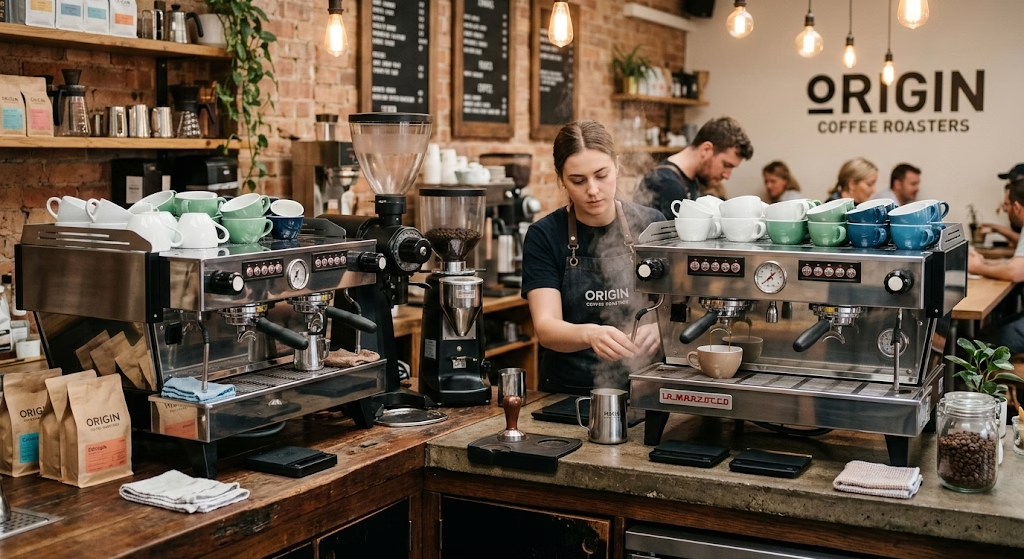
The best commercial espresso machine is not the model with the longest feature list. It is the machine that can clear your busiest hour, fit the counter and utility plan, survive service every day, and be repaired locally before downtime erases the value of a lower purchase price. For most staffed U.S. cafes, that points to a plumbed two-group volumetric machine with a verified sanitation listing, a dedicated 208-240V circuit, and a local service route.
Our best overall pick is the La Marzocco Linea Classic S 2 Group because its current U.S. documentation establishes the dimensions, 30-amp requirement, boiler capacities, and NSF and UL certifications that a real procurement decision needs. The Nuova Simonelli Appia Life 2 Group is the stronger value choice for a medium-volume cafe, while the Synesso S200 and Slayer Steam EP make sense when independent brew tanks, ergonomics, and premium workflow justify the added cost.
This guide ranks seven traditional machines and treats the JURA X10 separately because a self-service super-automatic solves a different staffing problem. It also explains why the Nuova Simonelli Oscar II, Breville, and DeLonghi machines should not be presented as default commercial foodservice choices without model-specific sanitation, electrical, and duty-cycle evidence.
Quick Answer
For a typical specialty cafe serving a concentrated morning rush, the best commercial espresso machine is a two-group volumetric model supported by a local technician. Choose the Linea Classic S when reliability, dual-boiler stability, and a mature service network matter most. Choose the Appia Life when value and straightforward volumetric service matter more than independent brew boilers. Choose the Synesso S200 or Slayer Steam EP only when your menu, staff, and rush can pay back their premium workflow.
| Recommendation | Best fit | Key utility | Planning price | Evidence status |
| La Marzocco Linea Classic S 2 Group | Best overall cafe workhorse | 208-240V 30A; plumb and drain | Request 2-group quote | Strong |
| Nuova Simonelli Appia Life 2 Group | Best value for medium volume | 220V class; verify U.S. circuit | $7,600-$8,990 observed | Strong |
| La Marzocco Linea PB 2 Group | Best controls and upgrade path | 208-240V 30A; plumb and drain | Dealer quote | Strong |
| Synesso S200 2 Group | Best premium ergonomics | 220V 28A; 3/8 in water | $15,268-$17,350 observed | Strong |
| Slayer Steam EP 2 Group | Best programmable pre-wet | 200-260V; NEMA 6-50 | About $20,400 observed | Strong |
| La Spaziale S2 Spazio Tall | Best 110V qualified option | 110V or 220V; plumb and drain | $5,336-$7,150 observed | Strong with qualification |
| Rancilio Classe 5 USB 2 Group | Best budget dealer-supported option | 220-240V; 4,300W | Dealer quote | Qualified |
Prices are planning inputs observed during September 2026 research, not offers. Finish, voltage, freight, water treatment, installation, tax, commissioning, warranty labor, and grinder packages can change the delivered cost. Require a written, itemized U.S. quote before ordering.
Table of Contents
- How the machines were selected
- Seven commercial espresso machine picks
- Self service and office alternative
- Machines excluded from the ranking
- Peak hour sizing and boiler architecture
- Power plumbing drainage and counter readiness
- Water chemistry and warranty protection
- Five year total cost of ownership
- Grinder pairing ergonomics and used equipment
- Procurement checklist and frequently asked questions
How We Selected the Best Commercial Espresso Machine
A machine entered the ranking only when the evidence established a current model, a defined business use case, clear utility requirements, a service and parts route, and documentation strong enough to explain its limits. The best commercial espresso machine must also have model-specific evidence of commercial sanitation and electrical suitability for the market where it will be installed. Confirm the listing in the certification database and with the local authority having jurisdiction because approval rules vary by city and county.
The NSF commercial food equipment program explains why sanitation certification matters to regulators. Current SCA coffee standards provide a quality framework, but they do not replace local health, electrical, plumbing, or building approval.
We did not claim hands-on testing that was not performed. Rankings combine current manufacturer documentation, current certification records, the supplied procurement audits, dealer planning prices, and operating judgment. That distinction matters because several competing pages rank home appliances, rely on Amazon availability, or repeat energy and throughput claims without publishing the assumptions behind them.
| Gate | Pass condition | Why it matters |
| Commercial compliance | Verified sanitation and electrical listings for the exact model | Reduces inspection and insurance risk |
| Peak capacity | Fits the busiest 30-60 minutes with headroom | Daily averages hide queue failure |
| Utilities | Voltage amperage water drain and clearances are documented | Prevents an unusable delivery |
| Service | Qualified local technician and parts path | Controls downtime and warranty friction |
| Workflow | Controls steam and group layout fit staffing and menu | Features must reduce a real bottleneck |
| Ownership cost | Machine install water grinder maintenance and repair are budgeted | Sticker price is incomplete |
The 7 Best Commercial Espresso Machine Picks
1 La Marzocco Linea Classic S Best Overall
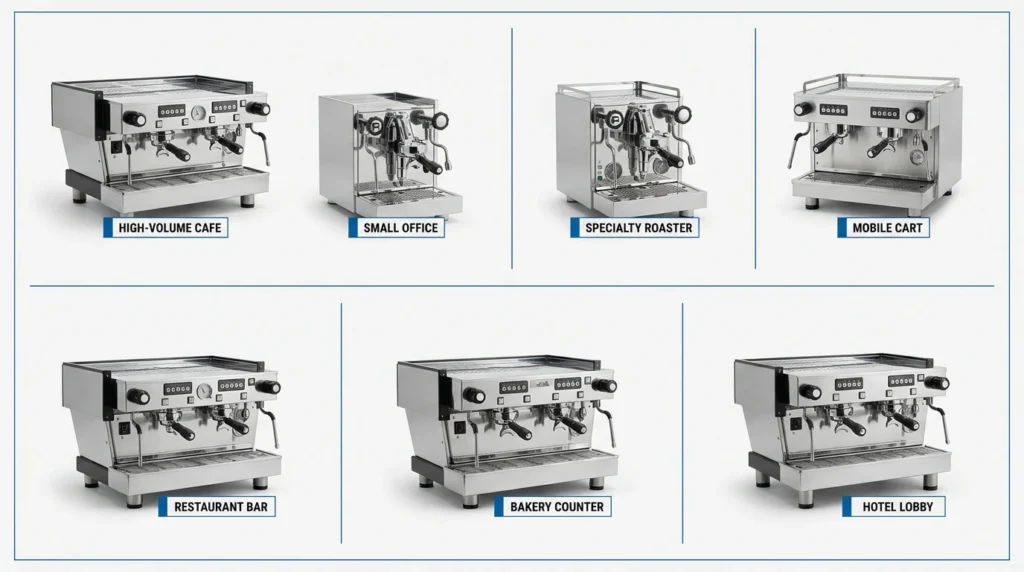
The Linea Classic S 2 Group is the best commercial espresso machine for a staffed cafe that wants proven architecture, volumetric repeatability, and a service ecosystem with fewer surprises. La Marzocco’s 2026 U.S. catalog lists a 27.3 by 23 by 17.5 inch footprint, 130-pound empty weight, 208-240V single-phase supply, 30-amp service, and a 4,600W element. Its 3.4-liter brew boiler and 7-liter steam boiler separate extraction from milk production.
The current Linea Classic S specifications list dual PID control, saturated groups, half-turn steam valves, and AV or EE configurations. The 2026 catalog also identifies UL-197, NSF-4, and CAN/CSA-C22.2 No. 109 certifications. Verify the exact suffix on the quote against the current certification listing before purchase.
- Buy it when the rush requires two baristas, milk drinks are a major share of sales, and local La Marzocco service is available.
- Skip it when the operation cannot support 30-amp 208-240V power, direct plumbing, drainage, filtration, and the installed budget.
- Best commercial espresso machine verdict: the safest all-around recommendation for a quality-focused U.S. cafe with conventional barista workflow.
2 Nuova Simonelli Appia Life Best Value
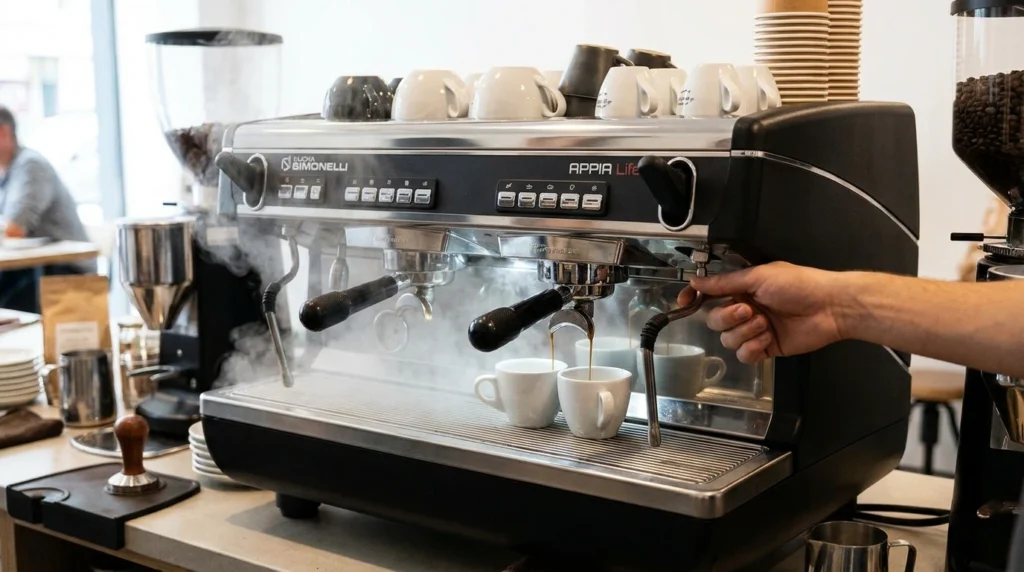
The Appia Life 2 Group is the best commercial espresso machine for a medium-volume cafe or restaurant that needs volumetric consistency without paying for independent brew boilers. The current manufacturer page lists an 11-liter heat-exchanger boiler, 3,350W power for the XT two-group version, and a body roughly 30.9 inches wide, 21.5 inches deep, and 19.6 inches high. Heat-exchanger architecture lowers capital cost, but it offers less independent temperature control than a multi-boiler platform.
Nuova Simonelli publishes the current Appia Life family specifications, including compact, one-group, two-group, and three-group configurations. Request the U.S. installation sheet for the exact variant because global pages combine regional voltage and power information.
For many operators, this is the best commercial espresso machine value because it directs budget toward the grinder, filtration, electrical work, and preventive service rather than controls the team may never use. Size it by peak drinks per hour, not the monthly sales forecast.
Pair it with a grinder selected through the commercial espresso grinder guide so the lower machine price does not create a dosing bottleneck elsewhere on the bar.
3 La Marzocco Linea PB Best Advanced Controls
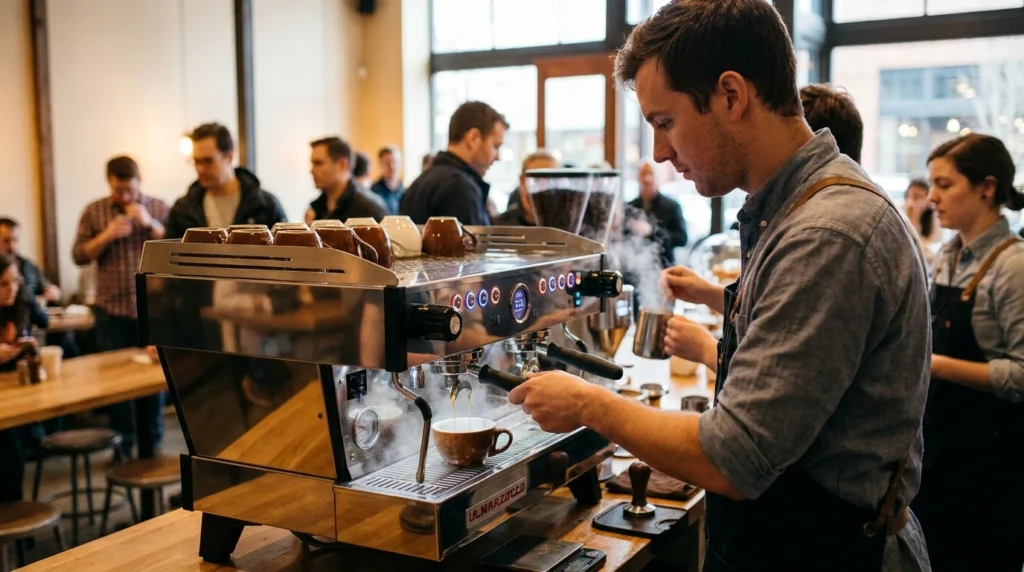
The Linea PB 2 Group is the best commercial espresso machine for operators who want the Linea platform with a digital display, shot timers, auto backflush, optional brew-by-weight scales, and a stronger control interface. The 2026 U.S. catalog lists a 28 by 23.2 by 21 inch body, 134.5-pound empty weight, 208-240V single-phase supply, 30-amp service, 4,600W element, 3.4-liter brew boiler, and 7-liter steam boiler.
Review the official Linea PB technical page and distinguish it from the Linea PB X. The standard PB uses one 3.4-liter brew boiler in the two-group configuration; the PB X uses two 1.3-liter brew boilers. Mixing those specifications is a common procurement error.
Choose this best commercial espresso machine candidate when recipe control, auto-cleaning support, and optional scales reduce measurable labor or quality variance. Otherwise, the Linea Classic S may deliver the same core output with a simpler purchase.
4 Synesso S200 Best Premium Ergonomics
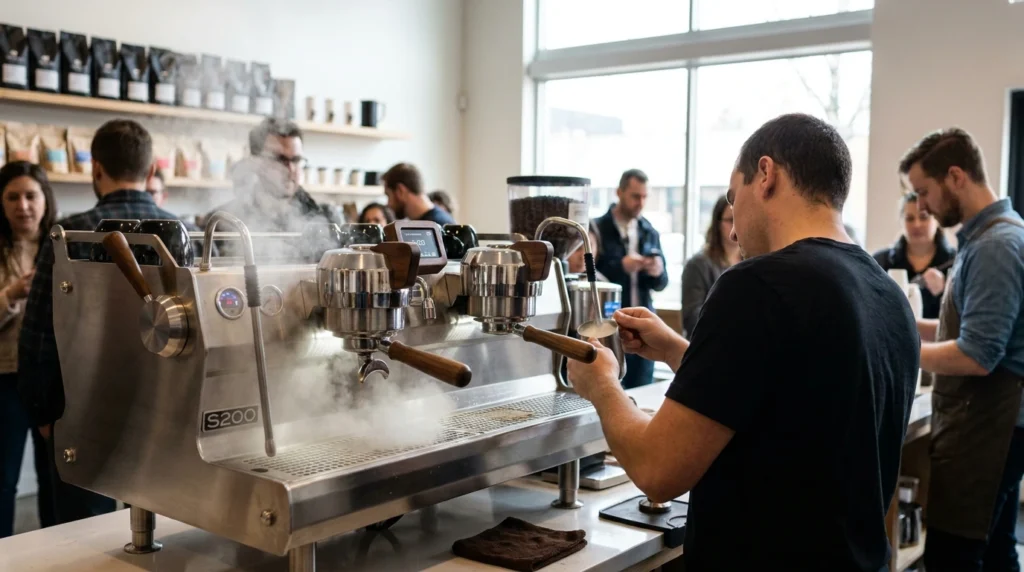
The Synesso S200 is the best commercial espresso machine for a premium bar that values independent brew tanks, a low body, and ambidextrous steam actuation. The current S200 sheet lists 220V single-phase power, 28-amp maximum draw, a 30-amp plug rating, 4,000W steam element total, two 1.9-liter brew tanks, a 7.7-liter steam tank, 3/8-inch water connection, and a 27.6 by 24 by 16.9 inch footprint.
The Synesso S200 specification sheet should travel with the electrical and plumbing drawings sent to the contractor. Confirm the exact current warranty, labor coverage, water limits, and loaner policy in writing with the regional dealer.
This best commercial espresso machine choice makes sense when a trained team can use the independent boilers and when the local technician stocks Synesso parts. Premium hardware without local coverage is an expensive single point of failure.
5 Slayer Steam EP Best Programmable Pre Wet
The Slayer Steam EP 2 Group is the best commercial espresso machine for a specialty bar that wants independent brew tanks, volumetric dosing, and programmable pre-wet without moving to the more complex pressure-profiling end of the market. Slayer’s installation guide lists a 35 by 28 by 17 inch counter envelope, 220-pound filled weight, 200-260V single-phase power, 4.7-5.6kW draw, NEMA 6-50 receptacle, 3-5 bar incoming water pressure, and gravity drainage within four feet.
The Slayer Steam EP product page describes the programmable pre-wet and service access. Do not approve the order from a marketing page alone; provide the installation guide to the electrician, plumber, cabinet maker, and technician before the deposit becomes nonrefundable.
The best commercial espresso machine is never the best choice if the counter cannot carry its filled weight or the panel cannot support the specified circuit. On a mobile trailer, verify generator surge capacity, water pump behavior, drainage, ventilation, and loaded axle limits before considering this class.
6 La Spaziale S2 Spazio Tall Best 110V Qualified Option
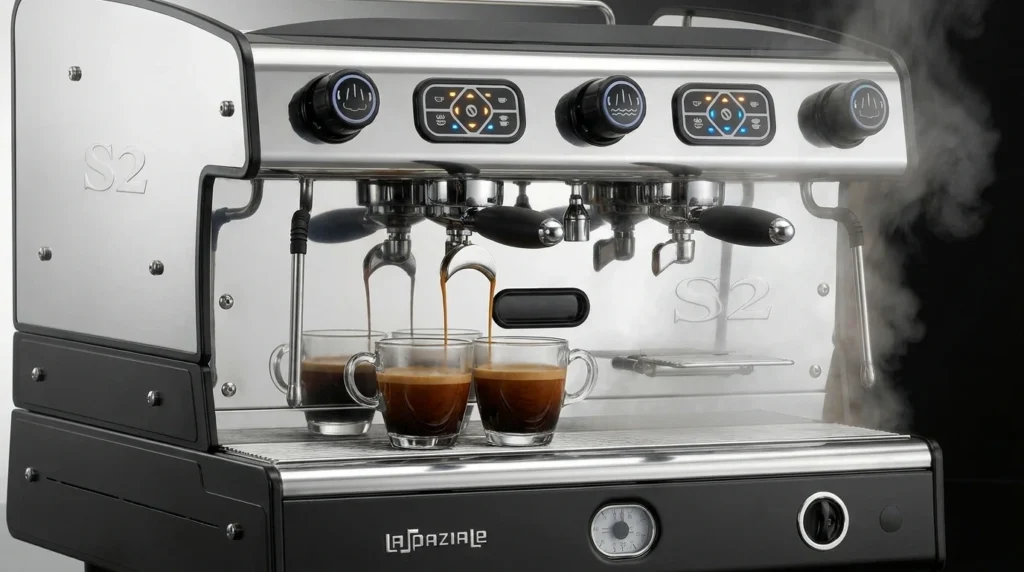
The La Spaziale S2 Spazio Tall earns a qualified place as the best commercial espresso machine for a constrained site that cannot add a standard 208-240V cafe circuit. The U.S. brochure documents 110V and 220V versions, about 2,300W or 3,800W power, a 5-liter boiler, and a two-group body. The 110V configuration is valuable, but lower available power limits heating and steam recovery during a concentrated rush.
Read the La Spaziale S2 U.S. technical brochure before treating the voltage as the only decision. The proprietary 53mm portafilter changes basket geometry and limits accessory interchangeability with common 58mm commercial tools.
This is the best commercial espresso machine only when the documented peak fits its recovery rate and the local service company supports La Spaziale. A 110V label does not automatically make any two-group machine suitable for a trailer or historic building.
7 Rancilio Classe 5 USB Best Budget Dealer Supported Option
The Rancilio Classe 5 USB 2 Group is a qualified best commercial espresso machine option for budget-conscious operators with a strong Rancilio dealer. The manufacturer catalog lists a 30.3 by 21.3 by 20.5 inch footprint, 123.4-pound weight, 11-liter boiler, 4,300W boiler power, and 220-240V operation. It uses volumetric controls and a conventional heat-exchanger layout.
Use the Rancilio Classe 5 manufacturer catalog as a starting point, then require the current U.S. certification record, installation drawing, warranty language, and parts commitment for the exact model code. The supplied evidence was thinner here than for the other ranked machines.
The best commercial espresso machine decision should reward evidence quality. If the dealer cannot provide current documents and a named service route, move the Classe 5 below a better-supported alternative even when the sticker price is attractive.
The Self Service Alternative
A super-automatic should not be scored against a staffed portafilter machine as if both solve the same problem. The JURA X10 is the best commercial espresso machine style for an office, cafeteria, care facility, or self-service area where training and drink variety matter more than manual control. JURA recommends a maximum daily output of 100 preparations and lists 120V power, 1,450W, 10A, and 34 drink specialties for the current U.S. model.
The JURA X10 professional specification page reports per-hour outputs by drink type. Treat those as standardized test figures, not a promise that a milk-heavy self-service station will match a two-group cafe bar. The beverage style, cleaning burden, milk refrigeration, and refill workflow are different.
Do not claim that a super-automatic produces the same beverage quality or bar experience as a trained barista on a semi-automatic machine. It can still be the best commercial espresso machine for a business whose main constraint is labor, consistency, or unattended service.
Machines Not Ranked and Why
The best commercial espresso machine list excludes the Nuova Simonelli Oscar II, Breville Barista models, DeLonghi machines, and similar prosumer appliances as default U.S. foodservice recommendations. A professional-looking group head or a retailer’s commercial label does not establish model-specific NSF sanitation, UL or ETL electrical listing, continuous duty, warranty coverage for business use, or local permit acceptance.
Readers shopping for a kitchen can compare home espresso machines under 700 dollars. That is a different use case from production foodservice. The category separation protects the buyer from using a home warranty and duty cycle in a regulated commercial environment.
The Victoria Arduino Eagle One was not ranked in this edition because the supplied research package did not establish every U.S. installation, certification, and price field to the same standard as the included products. It may be a valid machine; it needs a current OEM submittal, exact model certification record, and itemized U.S. dealer quote before comparison.
Size the Machine by Peak Hour
The best commercial espresso machine is sized from the busiest 15, 30, and 60 minutes, not the daily drink total. A bakery selling 160 drinks evenly across ten hours has a different thermal and staffing problem from a commuter cafe selling 120 drinks between 7:30 and 9:00. Count espresso shots, milk drinks, hot-water drinks, decaf changes, and re-makes during the peak, then add operating headroom.
| Peak demand | Likely starting class | Main risk to test | Typical fit |
| Under 50 drinks per hour | One group or compact two group | Single-group queue and steam recovery | Small cafe bakery restaurant |
| 50-150 drinks per hour | Standard two group | Grinder and milk workflow | Most staffed cafes |
| Over 150 drinks per hour | Three group or multi-station plan | Power counter labor and backup | Drive through or flagship bar |
| Up to 100 preparations per day | Professional super automatic | Cleaning refills and milk system | Office or self service |
These ranges are planning bands, not guarantees. Menu mix, barista skill, steam demand, grinder output, drink size, cup staging, and payment flow determine real capacity. The best commercial espresso machine can still underperform when the grinder or bar layout forces the team to wait.
Heat Exchanger Dual Boiler and Multi Boiler
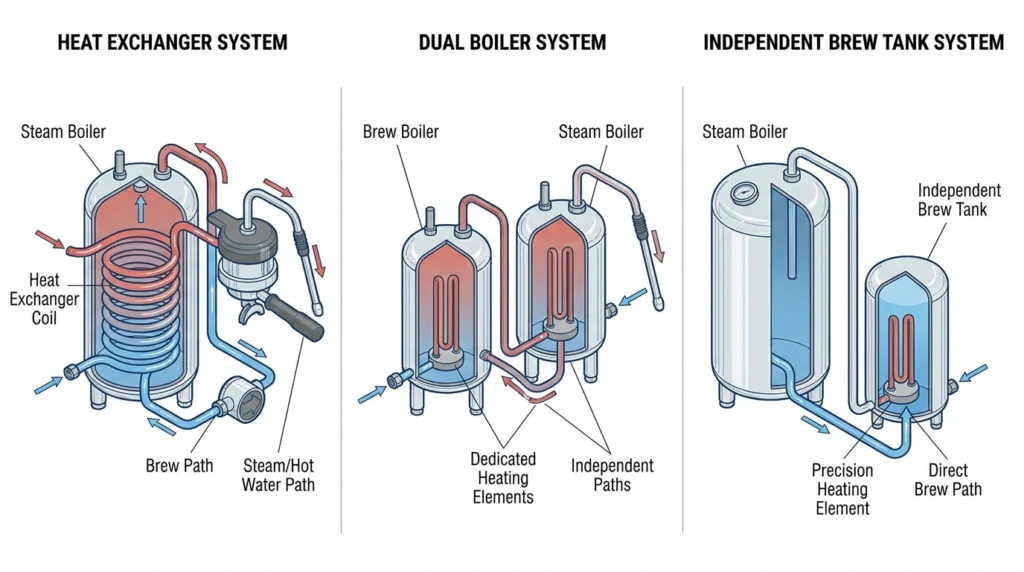
A heat-exchanger machine uses one main boiler to support brewing and steam through separate water paths. It is cost-effective and capable, but temperature management is more coupled to boiler pressure, flush routine, and workload. A dual-boiler machine separates brew and steam water. A multi-boiler machine can add independent brew tanks for each group, enabling recipe-specific temperatures and stronger recovery control.
Choose the architecture by menu and operating discipline. The Appia Life is the best commercial espresso machine value for a traditional medium-volume menu because its heat exchanger controls cost. The Linea Classic S and Linea PB are better when stable brew temperature and steam production need separate control. The S200 and Steam EP earn their premium when independent groups and ergonomic controls reduce a demonstrated bottleneck.
Machine temperature cannot compensate for inconsistent particle size. Read why grind quality controls extraction before shifting the entire capital budget from the grinder to the espresso machine.
Power Plumbing Drainage and Counter Readiness
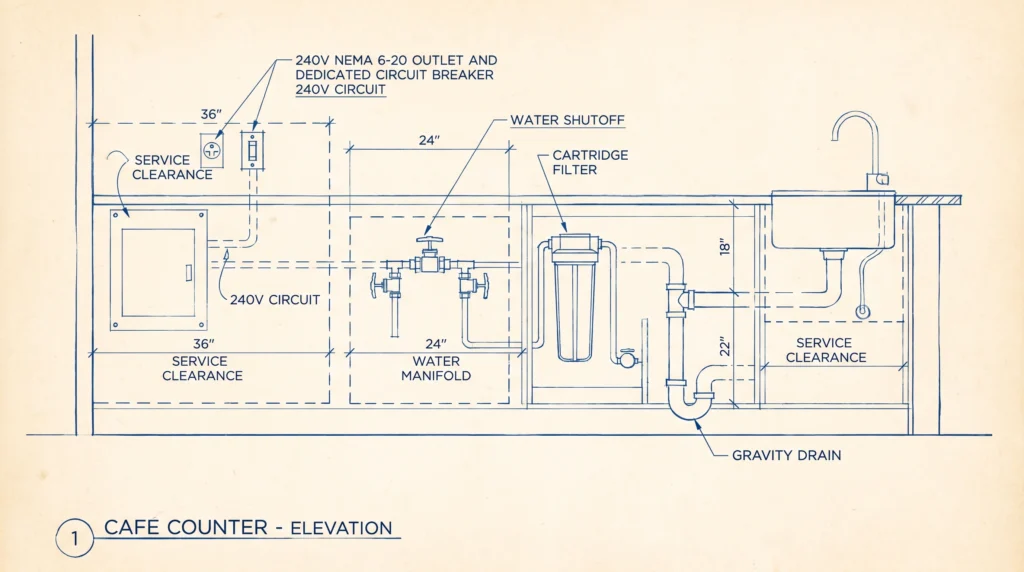
The best commercial espresso machine can arrive as an unusable crate when the utility plan is treated as an afterthought. Standard two-group cafe machines commonly require a dedicated 208-240V circuit, direct cold-water connection, approved backflow protection where required, a gravity drain with continuous fall, water treatment space, and a counter that supports the filled operating weight.
| Readiness item | Verify before deposit | Evidence to retain |
| Electrical | Voltage phase frequency amperage receptacle hardwire method and panel capacity | OEM sheet plus electrician signoff |
| Water | Static and dynamic pressure flow line size shutoff and treatment bypass | Water test and plumbing plan |
| Drain | Diameter slope air gap local code and trap location | Approved drain drawing |
| Counter | Width depth service clearance cutouts filled weight and anchoring | Dimensioned cabinet drawing |
| Commissioning | Delivery access install labor startup training and acceptance test | Itemized dealer scope |
| Service | Response time travel charge stocked parts loaner policy and warranty labor | Signed service terms |
Never copy amperage from a foreign listing. Regional versions can use different voltage, phase, frequency, elements, plugs, and certification marks. Give the exact U.S. submittal to a licensed commercial electrician and let the electrician calculate panel capacity, conductor size, overcurrent protection, and code compliance.
Water Chemistry Protects the Machine and Warranty
Water must support flavor, level sensing, and corrosion control at the same time. Hardness can form scale that insulates heating surfaces and restricts flow. Chloride can drive pitting corrosion in stainless components. Carbon filtration improves taste and removes disinfectant residuals, but it does not solve every hardness or chloride problem. Reverse osmosis can remove dissolved ions, yet the output may require controlled remineralization for taste and reliable conductivity sensing.
The best commercial espresso machine water plan starts with a laboratory or professional field test at the site. Compare the result with the exact manufacturer limits in the current installation manual. La Marzocco guidance commonly targets 90-150 ppm TDS, 70-100 ppm total hardness, 40-80 ppm alkalinity, pH 6.5-8, and no more than 30 ppm chloride for specified U.S. installations. Other manufacturers publish different bands.
| Test result | Likely treatment direction | Do not assume |
| Hardness above OEM range with low chloride | Softening scale control or blended treatment sized by volume | A carbon cartridge prevents scale |
| Chloride above OEM limit | Engineer RO or another membrane process with controlled blend or remineralization | A softener removes chloride |
| Very low mineral water | Remineralize or blend to the machine and coffee target | Pure RO is automatically safe |
| Seasonal municipal variation | Set retest and cartridge replacement intervals | One test lasts for the lease |
Do not publish one universal hardness number as if it applies to every brand. The best commercial espresso machine article should direct the buyer to the model manual, the local water report, a test at the point of use, and written treatment approval when warranty language depends on water chemistry.
Five Year Total Cost of Ownership
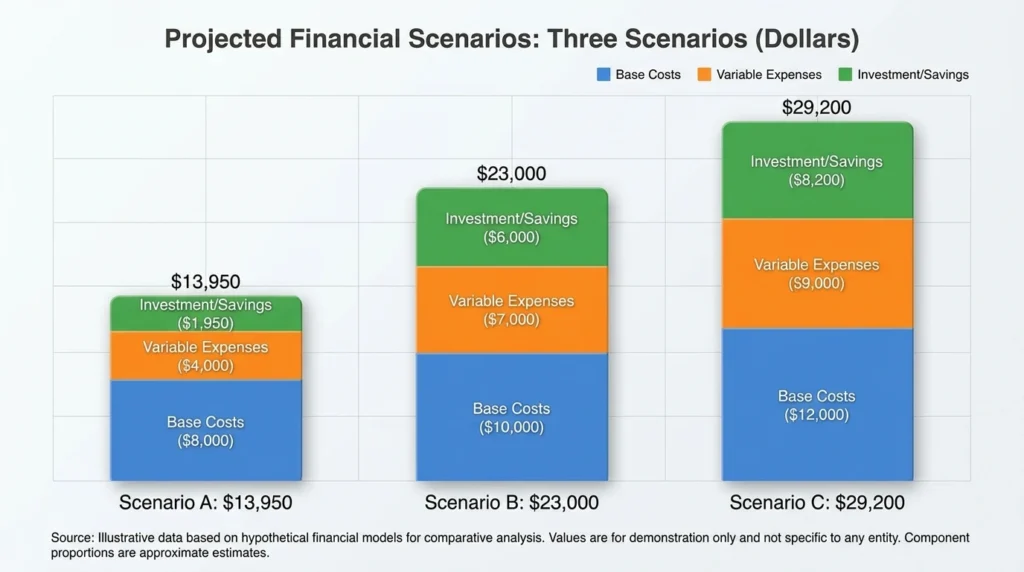
Sticker price is only the first line. The best commercial espresso machine budget includes electrical work, plumbing, drainage, filtration, commissioning, grinder capacity, preventive maintenance, wear parts, technician travel, downtime, energy, training, and a backup plan. The supplied evidence model produced the following illustrative five-year scenarios.
| Scenario | Machine | Install | Water | Maintenance | Repair | Five year total |
| Entry heat exchanger | $8,000 | $1,000 | $1,650 | $2,500 | $800 | $13,950 |
| Typical dual boiler | $14,000 | $2,300 | $2,500 | $3,000 | $1,200 | $23,000 |
| Premium multi boiler | $18,000 | $3,200 | $2,500 | $3,500 | $2,000 | $29,200 |
These are editorial scenarios, not audited forecasts. They assume two preventive visits per year, one major out-of-warranty repair over five years, and periodic filter replacement. They exclude tax, financing, energy, grinder purchase, coffee waste, employee time, and lost gross margin during downtime. Replace every input with written local quotes before choosing the best commercial espresso machine for the business.
Build daily and monthly care from the commercial espresso machine maintenance checklist and use the broader maintenance library for supporting cleaning procedures. Do not descale a commercial boiler casually; follow the manufacturer and technician because aggressive chemistry can damage components or move scale into valves.
The Grinder Is Part of the Purchase
A premium machine paired with a slow or inconsistent grinder creates an immediate queue. The best commercial espresso machine system sizes grinder output from peak-hour doses, roast style, decaf demand, recipe changes, and redundancy. A cafe serving two coffees usually needs a primary grinder and a decaf or backup path, not one overworked hopper.
| Bar profile | Grinder starting point | Workflow priority |
| Low to medium volume | Serviceable 64-65mm commercial flat burr | Repeatable timed or weight dosing and easy cleaning |
| Concentrated high volume | 80-85mm platform with thermal management | Fast output and backup capacity |
| Multi site consistency | Grind by weight with documented calibration | Dose control training and parts support |
| Traditional body focused menu | Commercial conical option where locally supported | Heat control and retention routine |
Use the site’s coffee grinder reviews and 2026 espresso grinder index to understand burr geometry and dosing terms, then return to the commercial guide for production-scale choices. The hand versus electric grinder comparison reinforces why manual grinding is not a production cafe workflow.
Ergonomics Training and Menu Load
The best commercial espresso machine reduces unnecessary reach, wrist rotation, valve force, and repeated manual steps. Evaluate steam control location, portafilter angle, cup clearance, display visibility, purge access, work height, and whether an automatic tamper can remove a repetitive task. Do not repeat an ergonomic force number unless the original study and units have been independently checked.
Run a timed bar simulation before choosing the best commercial espresso machine. Milk-heavy drinks load the steam system differently from straight espresso and Americanos. Use the site’s explanation of latte and cappuccino milk ratios and the Americano build guide to model steam and hot-water demand by menu rather than by beverage count alone.
Volumetric dosing can reduce variation and free attention for milk and customer service, but it does not remove the need to dial in the grinder. The best commercial espresso machine for a high-turnover team may favor repeatable buttons and guided cleaning over advanced manual profiling.
New staff can review basic espresso machine training before hands-on instruction. That article covers home-oriented basics, so the cafe must add its own food safety, opening, closing, calibration, and escalation procedures.
Buying Used Without Buying a Hidden Repair
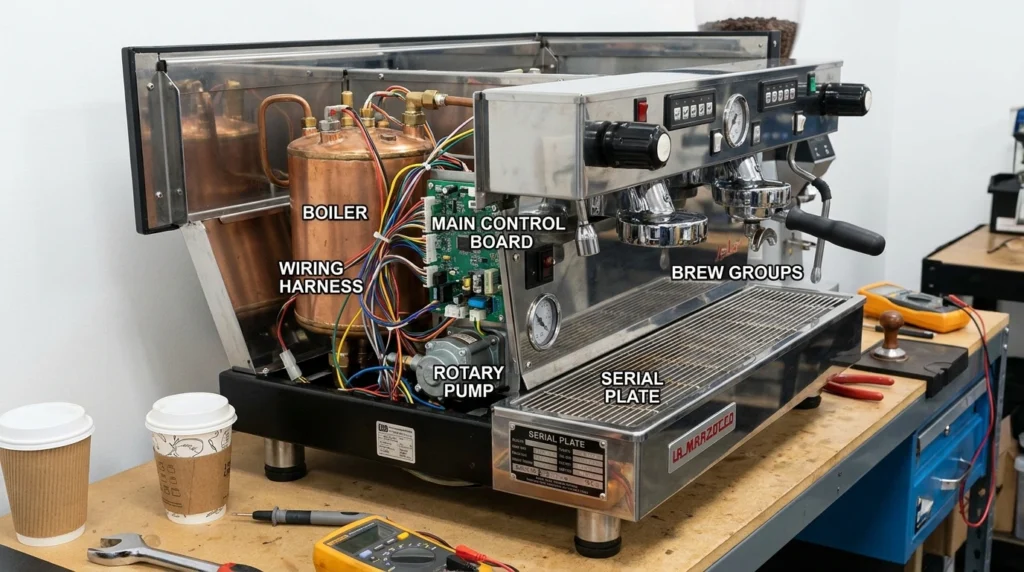
A used unit can be the best commercial espresso machine value only after a qualified technician inspects it. External stainless steel says little about boiler scale, pitting, heating-element leakage, wiring changes, control-board availability, pump wear, group seals, or the quality of prior water. Require serial numbers, service history, installation history, and a live load test.
- Match the serial number and model suffix to the correct manual certification and regional voltage.
- Inspect boiler and hydraulic components for scale corrosion leaks and non-OEM modifications.
- Test every group flowmeter steam wand hot-water valve pump autofill sensor and display under load.
- Confirm boards elements valves gaskets and pumps are still available in the United States.
- Price freight rigging installation filtration commissioning and immediate preventive service.
- Obtain a written rebuilt warranty when buying refurbished equipment and define labor coverage.
Do not publish a blanket instruction to buy used to save money. The best commercial espresso machine purchase is the lowest risk-adjusted installed system, which may be a new value model with warranty and local service rather than a cheaper premium machine with unknown internals.
Best Commercial Espresso Machine Procurement Checklist
Complete this sequence before naming the best commercial espresso machine for the site.
- Record drinks and espresso doses in the busiest 15 30 and 60 minutes and add planned growth headroom.
- Map the menu milk share cup sizes decaf demand hot-water demand and simultaneous barista count.
- Measure counter width depth height service clearance delivery path and filled load capacity.
- Have a licensed electrician verify voltage phase frequency panel capacity circuit and connection method.
- Have a plumber verify water pressure flow backflow protection treatment location shutoff drain and air gap.
- Test water for hardness alkalinity TDS pH chloride iron and disinfectant residual at the point of use.
- Confirm the exact model certification entries with the local health and building authorities.
- Get an itemized machine freight rigging installation commissioning training grinder and filtration quote.
- Get written warranty terms including parts labor travel response time exclusions and water requirements.
- Call the local technician about parts stock loaners common failures and preventive maintenance intervals.
- Run a workflow trial using the real cups menu and staffing pattern before final approval.
- Keep a backup plan for grinder failure machine downtime and peak service.
Once these records are complete, the best commercial espresso machine becomes a defensible procurement decision instead of an affiliate recommendation.
Best Commercial Espresso Machine FAQ
The La Marzocco Linea Classic S 2 Group is the best overall fit for many staffed U.S. cafes because current documentation establishes its dual-boiler architecture, 30-amp electrical requirement, dimensions, certifications, and service ecosystem. The Appia Life is the value alternative when a heat exchanger fits the menu and budget.
Entry traditional machines often start around the mid four figures, while premium two-group platforms can exceed 20000 dollars before installation. A five-year budget should also include electrical and plumbing work, water treatment, grinders, preventive maintenance, repairs, training, and downtime.
Most two-group machines use a dedicated 208-240V circuit, but exceptions exist. The La Spaziale S2 Spazio has documented 110V and 220V versions, while the JURA X10 uses 120V. Verify the exact U.S. model sheet and let a licensed electrician design the circuit.
Most traditional two-group machines require a direct cold-water line and gravity drain. Some one-group and professional automatic machines can use a reservoir or optional fresh-water kit. Confirm line size pressure flow drain and backflow requirements for the exact model.
A low-volume shop may fit one group or a compact two-group machine, but size from the peak hour. Once queues depend on one group or milk production exceeds recovery, a standard two-group platform is safer. Staff count and grinder speed matter as much as daily cups.
It can be for offices, self-service areas, and hospitality sites where training is the main constraint. It is not automatically equivalent to a staffed specialty cafe bar in beverage style, steam workflow, capacity, or maintenance.
Do not assume so. Verify the exact model’s sanitation and electrical listings, business-use warranty, duty cycle, plumbing, and local permit acceptance. Prosumer performance at home does not establish commercial foodservice compliance.
Buy used only after a qualified technician inspects the boiler, hydraulics, electrical system, control boards, pump, groups, and service history. Add transport, installation, water treatment, commissioning, and immediate maintenance before comparing it with a new machine.
Use water inside the exact manufacturer’s range for hardness, alkalinity, TDS, pH, chloride, iron, and disinfectant residual. Test at the site, choose treatment from the results, and document filter replacement. A softener does not remove chloride, and pure RO may require remineralization.
A serviceable commercial platform can operate for many years, but lifespan depends on water, duty cycle, cleaning, preventive maintenance, parts availability, and repair economics. A brand name alone cannot predict life without those operating conditions.
For most staffed specialty cafes, the best commercial espresso machine is the La Marzocco Linea Classic S 2 Group when the site supports its 208-240V 30-amp circuit, direct plumbing, drainage, filtration, and installed cost. The Nuova Simonelli Appia Life is the best value path for medium volume. The Linea PB, Synesso S200, and Slayer Steam EP should win only when their controls, independent boilers, or ergonomics solve a measurable operational problem.
Before ordering, compare the grinder through the commercial grinder shortlist, choose beans that fit the menu using the espresso bean guide, and browse the site’s espresso machine reviews for adjacent comparisons. Then obtain an itemized quote and make the electrician, plumber, water specialist, and service technician sign off on the exact model.
The best commercial espresso machine is the one your busiest hour, building, water, staff, and service network can support together.
Share your coffee experience
Have you tried this product? Add a thoughtful review or ask a question.