How to Make Cowboy Coffee: The Authentic Campfire Brewing Guide
Cowboy coffee is more than just a source of caffeine; it is a ritual of the American West. Whether you are waking up on a crisp mountain morning or just want to master a new skill in your kitchen, brewing coffee without a machine is a timeless art.
Contrary to the myth that it has to be “sludge” or strong enough to float a horseshoe, properly made cowboy coffee can be surprisingly smooth, rich, and full-bodied.
How to Make Cowboy Coffee (Quick Steps)
If you are at the campsite and need coffee fast, here is the master method for the best flavor:
1. Boil: Bring your pot of water to a rolling boil, then remove it from the heat source.
2. Cool: Let the water sit for 30–60 seconds to lower the temperature (aiming for ~200°F).
3. Add: Stir in coarse coffee grounds (approx. 1/2 cup grounds per quart of water).
4. Steep: Cover the pot and let it sit undisturbed for 4 minutes.
5. Settle: Pour a splash of cold water down the spout or around the edges to sink the grounds.
6. Pour: Serve slowly and steadily, keeping the last ounce of liquid in the pot to trap the sediment.
What Is Cowboy Coffee?
At its core, cowboy coffee is the simplest method of brewing coffee: coarse grounds, hot water, and time. It requires no filters, no electricity, and no fancy machinery.
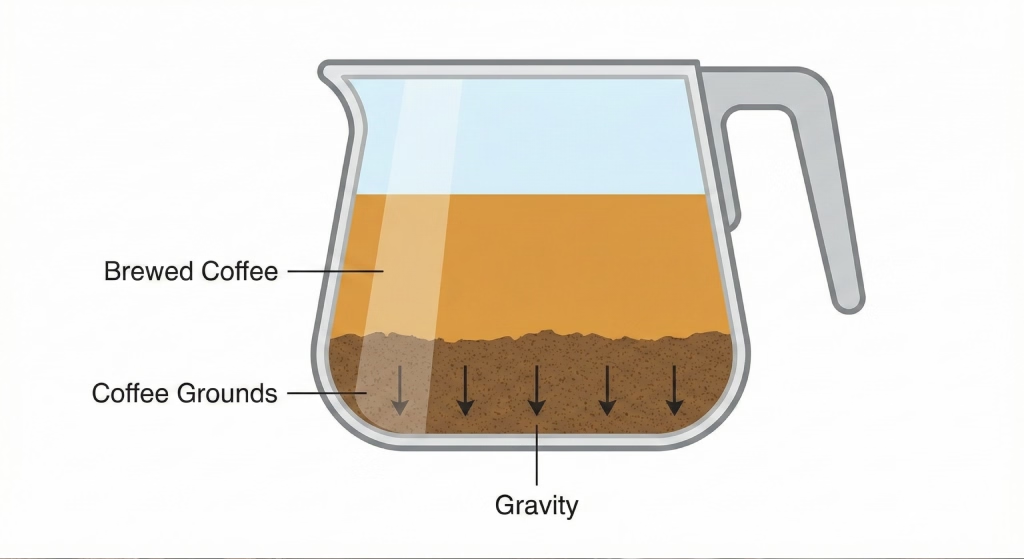
Technically, it is an immersion brew, very similar to a French Press but without the mesh plunger. The “filter” in cowboy coffee is gravity. By allowing the grounds to saturate and sink to the bottom of the pot, you achieve a separation of solid and liquid that results in a robust, flavorful cup.
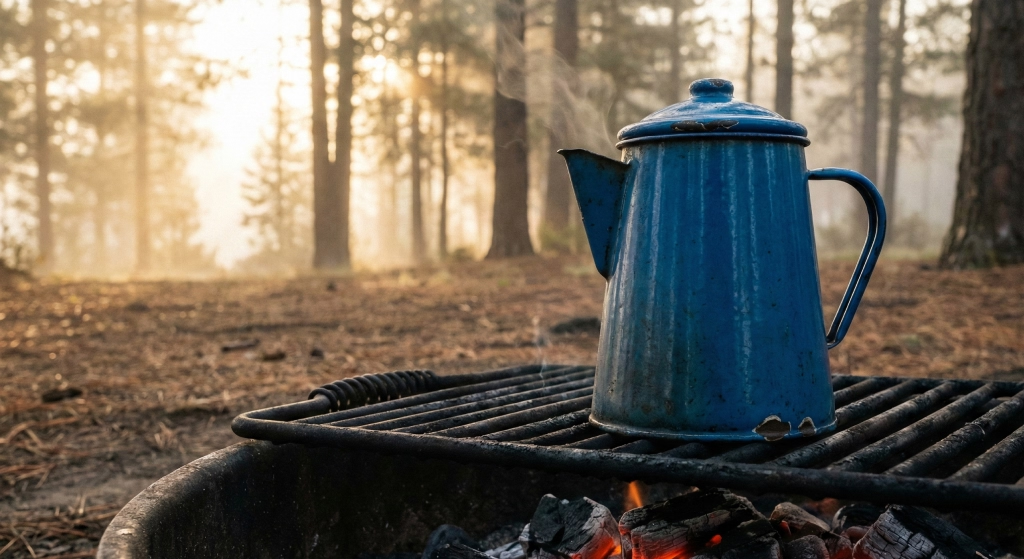
Historically, this method was born of necessity. On the frontier, cowboys and chuck wagon cooks used whatever was available usually a battered tin or enamel pot and a fire.
The Recipe: How to Brew the Perfect Cup
There are two schools of thought on how to make cowboy coffee: the **Modern Steep** (best for flavor) and the **Traditional Boil** (best for high altitude or historical accuracy).
Ingredients & Gear
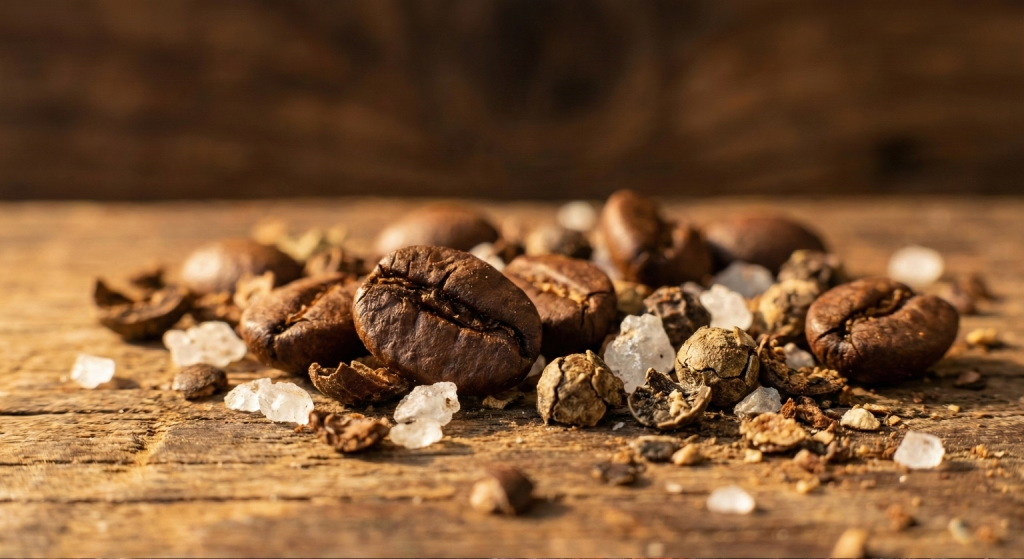
Coffee: Fresh beans, ground Extra Coarse (think sea salt or breadcrumbs).
Water: Fresh water (river or spring water adds character, but clean filtered water is best for flavor).
Pot: An enamelware kettle (graniteware), stainless steel pot, or even a simple saucepan.
Heat: Campfire coals, a propane camp stove, or your kitchen range.
Method 1: The “Modern Steep” (Recommended)
Best for: Flavor clarity, avoiding bitterness, and sea-level camping.
This method avoids “scorching” the coffee, which happens when grounds are boiled vigorously.
1. Heat the Water: Bring your water to a boil.
2. Stop the Heat: Remove the pot from the fire or turn off the stove. Wait 30 seconds to let the violent bubbling stop.
3. Add Grounds: Toss in your coffee. The ratio is roughly 2 tablespoons per 8oz cup, or 1/2 cup of grounds per quart of water.
4. Stir & Cover: Give it a gentle stir to wet all the grounds. Cover and wait 4 minutes.
5. Break the Crust: After 4 minutes, you will see a “crust” of floating grounds. Stir the surface gently; most grounds will sink immediately.
6. The Cold Water Trick: Sprinkle a little cold water (about 1/4 cup) onto the surface. The change in temperature disrupts convection currents and helps the remaining fines settle to the bottom.
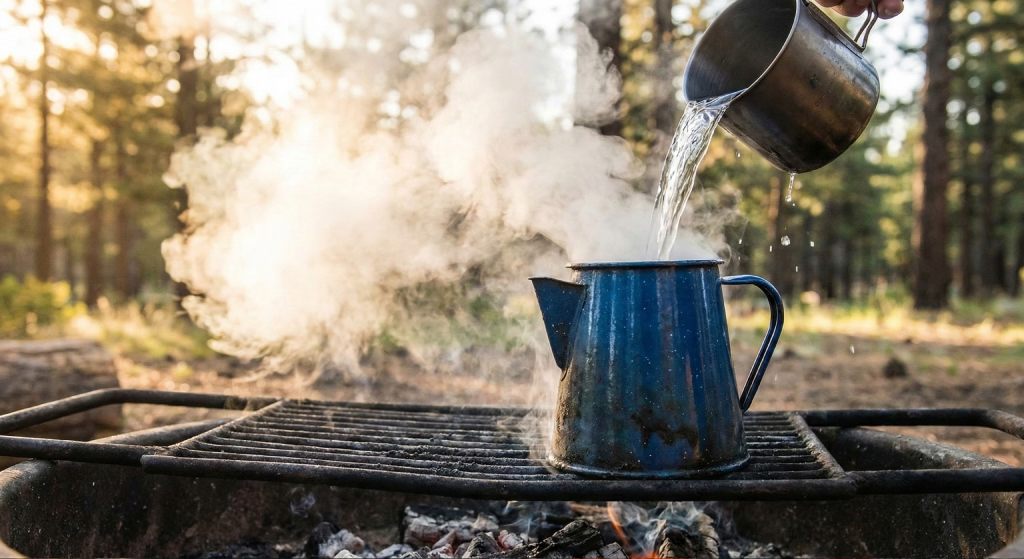
7. Serve: Pour gently. Do not tilt the pot back and forth; commit to the pour angle to keep the mud cake at the bottom undisturbed.
Method 2: The “Traditional Rolling Boil”
*Best for: High altitude, cast iron pots, and historical reenactment.*
Traditionalists, like famous chuck wagon cooks, often swear by boiling.
1. Warm the Water: Place the pot over the fire until warm (not boiling).
2. Add Grounds: Dump the grounds into the warming water.
3. Rolling Boil: Bring the mixture to a full boil. Let it boil for **2 to 4 minutes**.
4. Shock: Remove from heat and immediately add cold water to stop the brewing process and sink the grounds.
5. Rest: Let it sit for 5 minutes before serving.
Pro Tip for High Altitude: Water boils at lower temperatures at high elevations (approx. 202°F in Denver, 193°F in Leadville). If you are camping at 5,000+ feet, you *must* use the boiling method to get the water hot enough to extract the flavor.
3 Secrets to “Grit-Free” Coffee
The biggest fear beginners have is a mouthful of grounds. Here is the science behind a clean cup:
1. The Grind is King
You must use a Coarse Grind. If you use fine espresso powder or standard drip grind, the particles are too light to sink quickly according to *Stokes’ Law* of sedimentation. Fine grounds create a suspended “mud” that never clears.
2. The Cold Water Shock
Pouring cold water on top isn’t just superstition; it’s physics. Boiling water creates upward currents that keep things floating. Cold water is denser; it sinks, dragging floating particles down with it and stopping the turbulence.
3. Patience
Time is an ingredient. Waiting 5 to 10 minutes after brewing allows the grounds to form a compact cake at the bottom. The thermal mass of a large camp pot keeps the coffee hot enough to drink even after this rest period.
Cowboy Coffee vs. The Rest
How does this method stack up against other camping favorites?
| Feature | Cowboy Coffee | French Press | Percolator |
|---|---|---|---|
| Principle | Immersion (Gravity Settle) | Immersion (Mesh Filter) | Recirculating Boil |
| Flavor Profile | Rich, heavy body, low acid | Heavy, oily, some silt | Often hot, flat, or bitter |
| Bitterness Risk | Medium (if over-boiled) | Low | High (re-boils coffee) |
| Cleanup | Easy (dump grounds) | Hard (cleaning mesh) | Medium (basket) |
| Best For | Large groups, simplicity | Gourmet flavor | Nostalgia, very hot coffee |
Troubleshooting Your Brew
Problem: The coffee is bitter.
Cause: It was boiled too long (over-extraction) or the water was too hot.
Fix: Use Method 1 (Steep) instead of boiling.
Frontier Hack: Add a pinch of salt. Sodium ions block the bitter receptors on your tongue, making the coffee taste smoother.
Problem: The coffee tastes sour or weak.
Cause: The water cooled down too fast or you didn’t steep long enough.
Fix: Steep for 6–8 minutes. If using a thin titanium pot in winter, keep it near the fire (not in the flames) to maintain heat.
Problem: There are grounds in my teeth.
Cause: The grind was too fine or you poured too fast.
Fix: Use a coarser grind. When pouring, don’t return the pot to an upright position between cups—keep the angle consistent to prevent the “mud wave” from sloshing back toward the spout.
A Taste of History: Eggshells and Arbuckles
Why do some old recipes call for eggshells?
Historically, crushed eggshells were added to the pot for two reasons:
1. Chemistry: Coffee is acidic. Eggshells are calcium carbonate (alkaline). They neutralize the acid, mellowing the flavor.
2. Clarification: The protein in the egg helps bind the grounds together into a “raft,” making it easier to separate the liquid from the solid.
The Brand That Won the West
In the post-Civil War era, Arbuckles’ Ariosa Coffee was the king of the trail. Before Arbuckles, cowboys had to roast green beans in a skillet (often burning them). Arbuckles sold roasted beans coated in an egg-and-sugar glaze to seal in freshness. Each bag came with a peppermint stick, which became a currency on the trail—cooks would offer the candy to any cowboy willing to grind the coffee for the crew!
Myth Buster: You may hear the “Horseshoe Test” (coffee so strong a horseshoe floats). Physically, this is impossible. Iron is denser than water. It was just a tall tale to describe the “stout” nature of the brew.
Essential Gear for Campfire Coffee
Enamelware (Graniteware): The classic blue speckled pot. It’s lightweight and nostalgic but loses heat fast.
Cast Iron: Heavy and holds heat forever. Great for keeping coffee warm on the coals, but acidic coffee can strip the seasoning if left too long.
Stainless Steel: The modern standard. Durable and easy to clean.
The Cup: A tin or enamel cup is traditional, but be warned—they get hot!
Frequently Asked Questions
No. Cowboy coffee relies on gravity to settle the grounds to the bottom of the pot. If ground coarsely and allowed to rest, the coffee pours clear without a paper or mesh filter.
It often has a “kick,” yes. Because the water stays in contact with the grounds for 4–10 minutes (compared to 3 minutes for drip), caffeine extraction is very high.
Eggshells are alkaline and help neutralize the acidity of the coffee. They also help the grounds clump together, making the coffee clearer.
A good starting point is 1/2 cup of grounds for every 1 quart of water. For a single cup, use about 2 heaping tablespoons per 8oz of water.
You likely boiled the grounds for too long. Try the “steep” method: bring the water to a boil, remove from heat, and *then* add the coffee.
Absolutely. The process is identical whether you use a campfire, a propane camping stove, or your kitchen range. The stove actually offers better temperature control.
Pouring a small amount of cold water onto the hot coffee stops the brewing process and disrupts the convection currents, causing the floating grounds to sink to the bottom immediately.
Extra Coarse. It should look like crushed peppercorns or sea salt. Fine grounds will not settle properly and will leave you with a gritty cup.
Conclusion
Cowboy coffee is a lesson in simplicity. It strips the brewing process down to the elements: heat, water, and bean. While modern machines offer convenience, there is a deep satisfaction in watching the steam rise from a battered pot over an open fire.
Next time you head into the wild, leave the gadgets at home. Grab a bag of coarse grounds, fire up the stove, and brew a cup the way the West was won.
Have you tried the cold water trick? Share your campfire coffee stories in the comments below