
Table of contents
- Quick Answer: French Press in 60 Seconds
- What Is a French Press and How Does It Work?
- What You Need Before You Start
- The Right Grind Size: Why Coarse Ground Coffee for French Press Matters
- French Press Coffee Ratio: How Much Coffee to Use
- How to Make French Press Coffee: Step-by-Step Instructions
- The James Hoffmann French Press Method (Advanced Technique)
- Best Coffee for French Press Brewing
- French Press Troubleshooting: Fix Common Problems
- Beyond Coffee: Other Uses for Your French Press
- How to Clean Your French Press
- Frequently Asked Questions
Learning how to use a French press is one of the simplest ways to brew rich, full-bodied coffee at home. Unlike drip machines that filter out the natural oils, a French press uses a metal mesh plunger that lets those flavorful oils pass right into your cup — producing a heavier, more aromatic brew with almost zero learning curve.
Whether you just pulled a French press out of the back of your cupboard or you received one as a gift, this guide walks you through everything: the right grind size, the ideal coffee-to-water ratio, step-by-step brewing instructions, an advanced technique from coffee expert James Hoffmann, and troubleshooting tips when your cup does not taste quite right.
By the end, you will know exactly how to make French press coffee that rivals what you would get at a specialty café — and it takes just four minutes of your morning. For background on immersion brewing methods, this approach is as forgiving as it is rewarding.
Quick Answer: French Press in 60 Seconds
Here is the short version: Grind your beans coarse (like breadcrumbs), use a 1:15 coffee-to-water ratio, pour water heated to 200°F (93°C) over the grounds, steep for exactly 4 minutes, then press the plunger down slowly and pour immediately. That is it — a full-bodied, delicious cup of coffee with minimal effort and no paper filters.
What Is a French Press and How Does It Work?
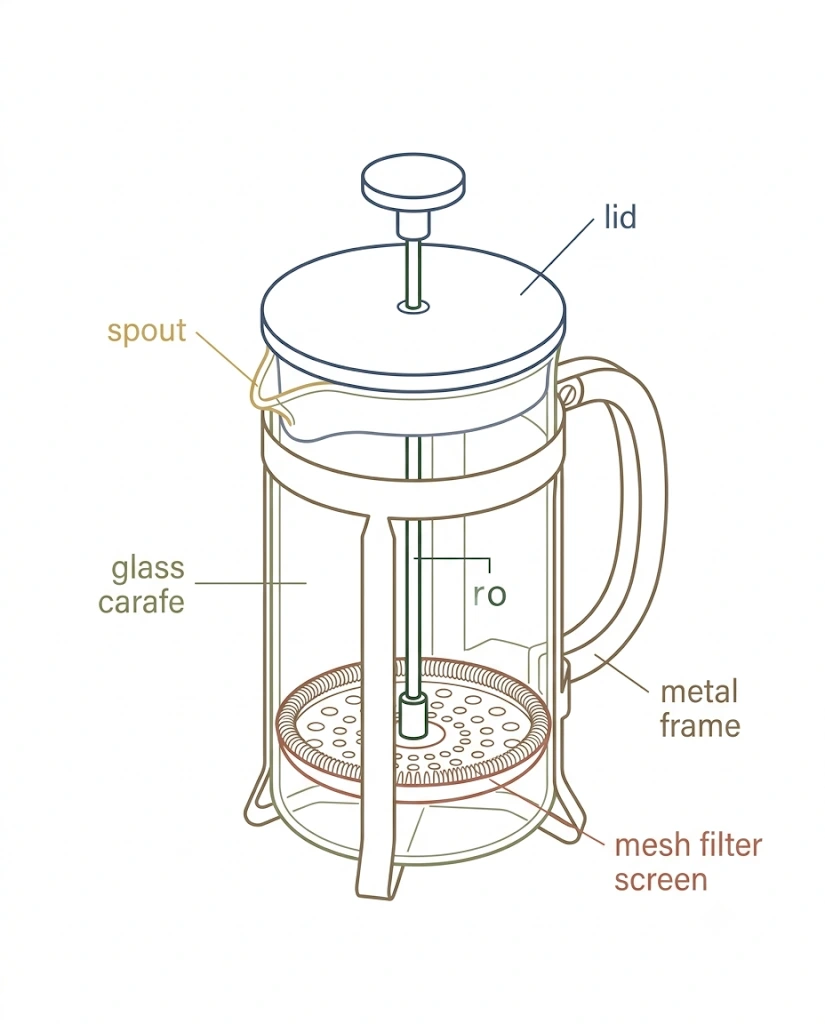
A French press (also called a coffee press, press pot, or cafetière) is a manual coffee brewer made up of a cylindrical glass or stainless-steel carafe, a plunger with an attached metal mesh filter, and a lid. Unlike pour-over or drip coffee makers that use paper filters, the French press uses full-immersion brewing the coffee grounds sit fully submerged in hot water for the entire brew time.
Because the metal mesh lets the coffee’s natural oils and fine particles pass through, French press coffee has a distinctly heavier body and deeper flavor profile compared to paper-filtered methods. It is coffee with texture and richness, which is exactly why millions of people around the world prefer it.
What You Need Before You Start
Gathering your equipment and ingredients before you begin makes the process seamless. Here is your complete checklist:
| Item | Details |
| French Press | Any size works. Common sizes: 3-cup (12 oz), 4-cup (17 oz), 8-cup (34 oz). The Bodum Chambord and Espro P7 are popular, well-reviewed options. |
| Whole Coffee Beans | Medium to medium-dark roast recommended. Freshly roasted within 2–4 weeks for best flavor. |
| Burr Grinder | A burr grinder like the Baratza Encore produces the consistent coarse grind a French press demands. Blade grinders create uneven particles. |
| Kettle | A gooseneck kettle with temperature control is ideal but any kettle works. Target 195–205°F (90–96°C). |
| Scale (Optional) | A kitchen gram scale takes the guesswork out of ratios. Weighing beans is more accurate than tablespoon scoops. |
| Timer | Your phone timer works perfectly. You need exactly 4 minutes. |
| Filtered Water | Fresh, cold, filtered water. Coffee is 98% water — quality matters. |
The Right Grind Size: Why Coarse Ground Coffee for French Press Matters
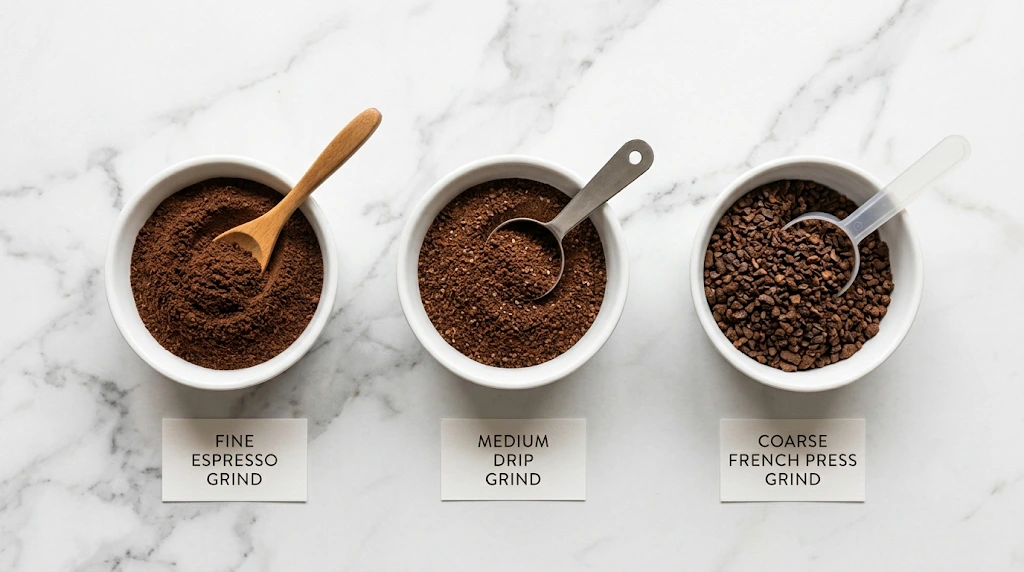
Getting the grind right is the single most important variable in French press brewing. You need a coarse grind — the grounds should resemble breadcrumbs, coarse sea salt, or raw sugar. This is noticeably chunkier than what you would use for drip coffee.
Why does grind size matter so much? Because the French press is an immersion brewer, the grounds sit in water for 4 full minutes. Grounds that are too fine extract too quickly, producing bitter, over-extracted coffee. They also slip through the metal mesh filter, creating a muddy, silty cup. Coarser particles extract more slowly and evenly, and they stay above the filter when you press.
A burr grinder produces consistent particle sizes. If you only have a blade grinder, pulse in short bursts and shake the grinder between pulses to get a more even result. If you buy pre-ground coffee, ask the store to grind it on the coarsest setting available.
French Press Coffee Ratio: How Much Coffee to Use
The standard French press coffee-to-water ratio is 1:15 by weight — meaning 1 gram of coffee for every 15 grams of water. This ratio produces a balanced, full-bodied cup that most people enjoy. If you prefer a stronger brew, try 1:13. For a lighter cup, go up to 1:17.
Here is a ready-to-use ratio table for every common French press size:
| French Press Size | Water | Coffee (grams) | Coffee (tbsp) |
| 3-cup (12 oz / 350 ml) | 350 g | 23 g | ~4.5 tbsp |
| 4-cup (17 oz / 500 ml) | 500 g | 33 g | ~6.5 tbsp |
| 8-cup (34 oz / 1 L) | 850 g | 56 g | ~11 tbsp |
| 12-cup (51 oz / 1.5 L) | 1,275 g | 85 g | ~17 tbsp |
Pro tip: “Cups” on a French press are small (about 4 oz each), not standard 8 oz mugs. A “4-cup” French press actually makes about two normal mugs of coffee. Always measure by weight (grams) when possible for consistency. The Specialty Coffee Association’s brewing guidelines recommend a ratio between 1:15 and 1:18 for optimal extraction.
How to Make French Press Coffee: Step-by-Step Instructions
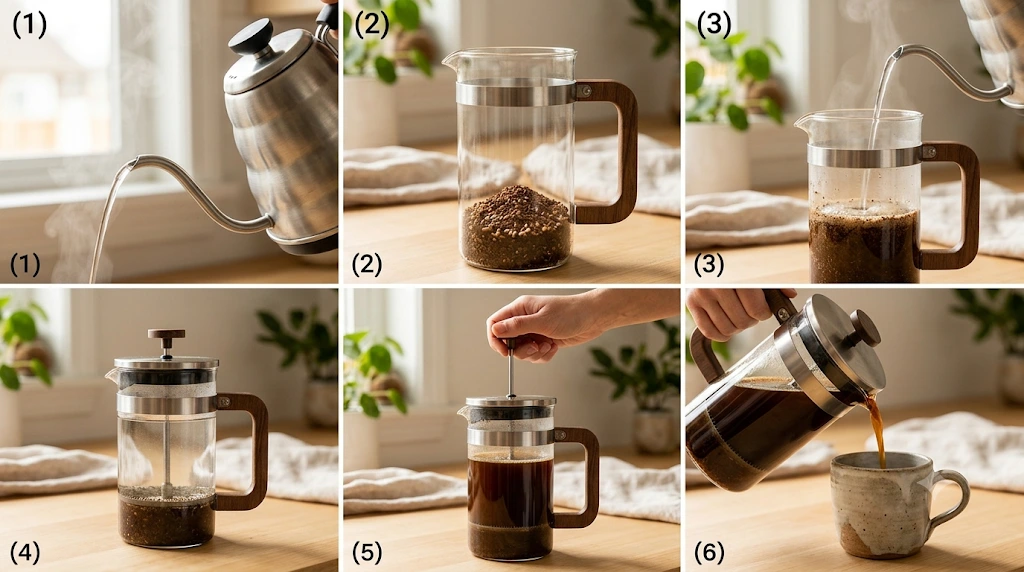
Step 1: Heat Your Water
Bring fresh, filtered water to a boil, then let it cool for about 30–60 seconds until it reaches 195–205°F (90–96°C). If you have a variable-temperature kettle, set it to 200°F. Water that is too hot will scorch the grounds and create bitterness; water that is too cool will under-extract, leaving you with a flat, sour-tasting cup.
Step 2: Preheat the French Press
Pour a small amount of hot water into the empty French press to warm the glass carafe. Swirl it around for 10–15 seconds, then discard the water. This step prevents the cold glass from dropping the brewing temperature when you add your coffee and hot water.
Step 3: Grind and Add Coffee
Grind your beans to a coarse consistency (like breadcrumbs) and add them to the preheated French press. If you are using the 1:15 ratio for an 8-cup press, weigh out 56 grams of coffee. Gently shake the press to level the bed of grounds.
Step 4: Bloom the Grounds (Optional but Recommended)
Start your timer and pour just enough water to wet all the grounds — roughly twice the weight of the coffee (about 100–120 g for 56 g of coffee). Wait 30 seconds. This “bloom” phase lets carbon dioxide escape from freshly roasted beans, allowing the water to extract flavor more evenly during the main brew.
Step 5: Pour the Remaining Water and Steep
Pour the rest of your hot water in a slow, steady stream until you reach your target weight (850 g for an 8-cup press). Give the slurry one gentle stir to make sure all the grounds are submerged. Place the lid on top with the plunger pulled all the way up — this traps heat without pressing the grounds.
Let the coffee steep for exactly 4 minutes. This is the standard French press brew time recommended by roasters like Stumptown and Blue Bottle. Do not press early — the coffee needs the full 4 minutes to reach proper extraction. If you prefer a stronger cup, you can steep up to 5 minutes, but going beyond that risks bitterness.
Step 6: Press the Plunger
When the timer hits 4 minutes, press the plunger down slowly and steadily. The press should take about 15–20 seconds. If you feel heavy resistance, your grind is probably too fine. If the plunger drops with almost no resistance, your grind may be too coarse. The plunger feedback is a real-time diagnostic tool for your grind setting.
Step 7: Pour and Serve Immediately
Pour the coffee into your mug or a separate carafe right away. Do not leave brewed coffee sitting in the French press — the grounds are still in contact with the liquid, and the coffee will continue to extract and turn bitter. If you have made more coffee than you can drink immediately, transfer the rest to an insulated carafe.
The James Hoffmann French Press Method (Advanced Technique)
Coffee expert and World Barista Champion James Hoffmann popularized an alternative technique that produces a noticeably cleaner cup with less sediment — while keeping the rich body that makes French press coffee special. Here is how it works:
1. Add 30 g of medium-coarse ground coffee to your French press and pour 500 g of boiling water (not cooled Hoffmann uses water straight off the boil).
2. Wait 4 minutes without touching anything. A crust of grounds will form on the surface.
3. At the 4-minute mark, use a spoon to break the crust by stirring gently. Most of the grounds will sink to the bottom.
4. Scoop off the foam and any floating bits from the surface with two spoons.
5. Wait another 5–6 minutes. Yes, you read that correctly — a total of 9–10 minutes. The extended wait lets the fine particles settle completely.
6. Press the plunger down gently — only to the surface of the liquid, not all the way to the bottom. You are not using the plunger to filter; you are using it as a strainer to keep the settled grounds in place while you pour.
7. Pour slowly and enjoy a remarkably clean, sweet French press coffee.
This method takes longer but dramatically reduces the gritty sediment that many people dislike about French press coffee. It is the best of both worlds: full-bodied immersion flavor with pour-over-level clarity.
Best Coffee for French Press Brewing
The French press’s metal filter lets oils and body through, so it flatters coffees with weight and richness. Here is what to look for:
Roast level: Medium and medium-dark roasts shine in the French press. They bring out chocolatey, nutty, and caramel notes that pair beautifully with the full-bodied texture. Light roasts can work but their bright, delicate characteristics are generally better suited to pour-over methods.
Origin: Brazilian naturals, Sumatran Mandheling, Colombian, and Ethiopian Sidamo all make excellent French press coffee. Single-origin beans let you taste the terroir; blends offer balanced complexity.
Freshness: Buy whole beans roasted within the last 2–4 weeks. Coffee stales quickly after grinding, so grind just before brewing for the best flavor.
If you’re looking to elevate your brew even further, check our article about the best coffee beans for French press to find the perfect match for your setup.
French Press Troubleshooting: Fix Common Problems
If your French press coffee does not taste right, use this troubleshooting table to diagnose the issue:
| Problem | Likely Cause | Fix |
| Bitter coffee | Grind too fine, steeped too long, or water too hot | Grind coarser, steep exactly 4 min, let water cool to 200°F |
| Sour coffee | Under-extracted — grind too coarse, water too cool, or steep too short | Grind slightly finer, use hotter water (200–205°F), or steep 30 sec longer |
| Weak / watery | Not enough coffee or water too cool | Increase coffee amount (try 1:13 ratio), ensure water is 200°F+ |
| Muddy / gritty | Grind too fine — particles pass through mesh filter | Grind coarser. Try the Hoffmann method. Replace worn mesh filter. |
| Hard to press | Grind too fine — packed grounds resist the plunger | Grind coarser. Do not force it — you may crack the glass carafe. |
| Coffee cools fast | Glass carafe loses heat quickly, or press was not preheated | Preheat the press. Consider a double-walled stainless-steel model. |
Beyond Coffee: Other Uses for Your French Press
French Press Cold Brew
Your French press doubles as a cold brew maker. Add coarse grounds and cold water at a 1:7 ratio (for example, 100 g coffee to 700 g water). Stir gently, place the lid on without pressing, and refrigerate for 12–16 hours. Press, pour over ice, and enjoy a smooth, low-acidity cold brew concentrate you can dilute to taste.
Loose-Leaf Tea
The French press is perfect for brewing loose-leaf tea. Add 1 teaspoon of tea leaves per 8 ounces of water. Pour water at the temperature appropriate for your tea type (175°F for green, 200°F for black, 212°F for herbal). Steep for the recommended time, press, and pour.
Frothed Milk
Heat milk gently without boiling (about 150°F / 65°C), pour it into the French press until it is about one-third full, then rapidly pump the plunger up and down for 15–20 seconds. The mesh filter aerates the milk, creating a surprisingly good froth for lattes and cappuccinos — no dedicated milk frother required.
Related: : How to make cold brew coffee at home
How to Clean Your French Press
Proper cleaning after every use prevents stale oil buildup that taints future brews. Remove the plunger assembly, knock the spent grounds into a compost bin or trash (never down the drain — coffee grounds can clog pipes), and rinse all parts with warm water. Once a week, disassemble the plunger screen and give it a deeper clean with a mild dish soap and a soft brush. Rinse thoroughly so no soap residue remains.
Most Bodum and Espro French presses are dishwasher safe check your model’s instructions. Air-dry all parts completely before reassembling to prevent mold.
Frequently Asked Questions
French press coffee is made by steeping coarsely ground coffee in hot water for about 4 minutes, then pressing a metal mesh filter down to separate the grounds from the brewed coffee. It produces a rich, full-bodied cup because the metal filter allows the coffee’s natural oils to pass through — unlike paper filters that absorb them.
A 1:15 ratio (1 gram of coffee to 15 grams of water) is the standard starting point. For a standard 8-cup French press, that means 56 grams of coffee to 850 grams of water. Adjust to 1:13 for stronger or 1:17 for lighter coffee based on your preference.
The standard steep time is 4 minutes. This gives the water enough time to extract the desirable flavors from the coarse grounds without pulling out bitter compounds. If you use the James Hoffmann method, the total time extends to about 9–10 minutes (4-minute steep plus a 5–6-minute settling period).
You can, but most pre-ground coffee is sized for drip machines (medium grind), which is too fine for a French press. It will result in over-extraction and a gritty cup. If buying pre-ground, look for packages specifically labeled “coarse” or “French press grind.” For best results, grind whole beans at home just before brewing.
Bitter French press coffee is almost always caused by one of three things: the grind is too fine (causing over-extraction), the steep time went beyond 4 minutes, or the water was too hot (above 205°F). Try grinding coarser, timing your steep precisely, and letting boiled water cool for 30–60 seconds before pouring.
For a standard 8-cup (34 oz) French press, use about 56 grams (roughly 8 level tablespoons) of coarsely ground coffee. For a smaller 3-cup press, use about 23 grams (4–5 tablespoons). Always adjust up or down to match your personal taste preference.
French press coffee tastes bolder and more robust than drip because the metal mesh filter allows coffee oils and micro-grounds into the cup. However, the actual caffeine content per cup is similar between the two methods — what differs is body, texture, and perceived intensity of flavor.
How do I prevent sediment in my French press coffee?
Use a consistent coarse grind from a burr grinder, not a blade grinder. Try the James Hoffmann method (described above), which involves breaking the crust, skimming, and waiting for grounds to settle before gently pressing. You can also pour through a fine-mesh sieve for an extra-clean cup.
Start Brewing Better French Press Coffee Today
Now that you know how to use a French press from start to finish, the only thing left is to brew your first (or next) cup. Remember the three fundamentals: grind coarse, use a 1:15 ratio, and steep for 4 minutes. Nail those three variables and you will produce a consistently delicious cup every single morning. If you want to level up, try the James Hoffmann method for a cleaner cup, experiment with different single-origin beans, or use your French press for cold brew and loose-leaf tea. The French press is the most versatile manual brewer you can own — and one of the most forgiving.
Related Articles
Share your coffee experience
Have you tried this product? Add a thoughtful review or ask a question.
2 Responses