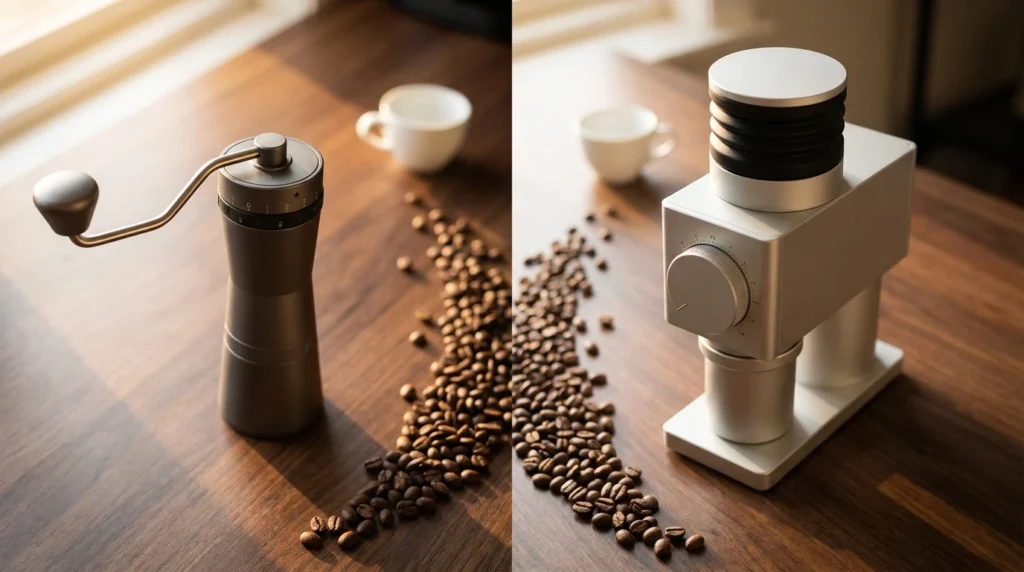
The short answer to hand grinder vs electric grinder: under $200, a hand grinder will almost always out-grind an electric grinder at the same price. Above $300 especially for espresso a good electric grinder pulls ahead on convenience, speed, and capacity. Everything between those two numbers comes down to how you brew and how much effort you want to put in.
This isn’t a hedged “it depends” answer. There are clear thresholds where one type wins decisively, and clear use cases where the other is the obvious choice. This article walks through exactly how the two compare — on grind quality, speed, price, retention, noise, and long-term cost and gives you a direct recommendation based on your specific situation.
Quick Verdict: When Each Type Wins
Buy a hand grinder if:
- Your budget is under $200
- You brew 1–2 cups a day, mostly pour over or French press
- You travel, camp, or want a backup for power outages
- You care about freshness and prefer single-dosing
- You want zero-maintenance gear that will last 10+ years
Buy an electric grinder if:
- Your budget is $300+, especially for espresso
- You brew for 3 or more people every morning
- You pull multiple espresso shots back-to-back
- You value speed over tactile experience
- You frequently switch between brew methods and want fast adjustment
Hand Grinder vs Electric Grinder: Side-by-Side Comparison
Here’s how the two types stack up on the factors that actually affect your daily cup. Numbers are for mid-to-premium grinders in each category; budget and prosumer models sit at the extremes.
| Factor | Hand Grinder | Electric Grinder |
| Grind time (20g) | ~45–90 seconds | ~10–30 seconds |
| Noise | Near-silent | Loud (70–90 dB) |
| Retention | ~0.1–0.3g (near zero) | ~0.5–3g (varies widely) |
| Entry price (usable) | ~$70–$100 | ~$150–$200 |
| Sweet spot (value) | ~$100–$200 | ~$250–$400 |
| Espresso-capable | Yes, with right model | Yes, above $250 |
| Capacity | ~18–40g per batch | Single-dose or 200g+ hopper |
| Portable | Yes | No |
| Lifespan | 10+ years, no motor to fail | 5–10 years, motor lifespan varies |
| Maintenance | Simple — unscrew, brush, reassemble | More complex — can require service |
Grind Quality: The Price-Per-Performance Reality
Grind quality is the single most important factor in how coffee tastes, and it’s where the hand grinder vs electric grinder comparison gets interesting. Below roughly $200, hand grinders consistently produce more uniform grounds than electric grinders at the same price. The reason is structural: a hand grinder at $150 doesn’t need to budget for a motor, fan, power supply, or timer circuit — all of that money goes into burrs, burr alignment, and bearings, which is where grind quality actually comes from.
A $100 manual grinder like the KINGrinder K6 or Timemore C3 ESP Pro typically outperforms a $150 electric grinder like the Baratza Encore for pour over and French press. The manual’s burrs are larger, sharper, and better-aligned at that price point. The electric wins on speed and convenience, not grind quality.
Around $300 and above, the situation flips for espresso. Flat-burr electric grinders produce more uniform particles at espresso-fine settings than almost any manual grinder, because the motor maintains consistent rotation speed under load in a way human cranking can’t match. Premium manual grinders like the Kinu M47 or 1Zpresso J Ultra come remarkably close, but they don’t quite match a dedicated $500+ electric espresso grinder.
For filter brewing specifically, a good manual grinder holds its own against electrics up to $500+. For our current top picks, see our best manual coffee grinders for 2026 guide.
Speed: The Biggest Practical Difference
This is the one category where electric grinders win outright. Grinding 20 grams of coffee for a pour over takes 10–15 seconds on a decent electric grinder. The same dose on a hand grinder takes 45–90 seconds depending on grind size and how aggressively you crank. Finer grinds — espresso in particular — take longer on a manual grinder and require more force.
For a single daily cup, the time difference doesn’t matter. You’re boiling water, rinsing a filter, or warming a cup anyway; the grind happens in parallel. If you’re making four pour overs for houseguests, though, three extra minutes per cup adds up to something. Households that brew for multiple people every morning feel the manual grind time much more than solo brewers do.
One caveat: premium hand grinders with 48mm burrs (the 1Zpresso K-Ultra, J Ultra, and KINGrinder K6) are noticeably faster than the old-school Hario Skerton or Porlex Mini everyone used to cite when comparing speed. If your reference point for “manual grinding is slow” is a 2015-era ceramic-burr grinder, the modern alternatives will surprise you.
Retention: Where Manual Grinders Quietly Win
Retention the coffee that stays inside the grinder instead of coming out the chute matters more than most buyers realize. Hand grinders retain essentially nothing. The grinds fall straight from the burrs into the catch cup, and what you put in is what you get out.
Electric grinders are a different story. Traditional hopper-fed electric grinders can retain anywhere from half a gram to several grams, and that retained coffee goes stale between sessions. Single-dose electric grinders with bellows and cleaning brushes reduce this, but rarely to zero. If you care about freshness or single-dosing for specialty coffee, hand grinders have a real advantage here.
Retention also matters for dose accuracy in espresso. If your electric grinder retains 0.8g and releases it unpredictably on the next pull, your shot weights will drift. A near-zero-retention hand grinder gives you exactly the dose you weighed into the hopper.
Noise: The 6 A.M. Consideration
Electric grinders are loud. Entry-level models in particular can hit 80–90 decibels at the burrs comparable to a garbage disposal or a blender. In an apartment, with a partner or baby sleeping, that’s genuinely disruptive. Premium prosumer electric grinders are quieter, but none are silent.
Hand grinders produce the soft mechanical sound of bean-cracking and burr rotation noticeable but conversational. You can grind coffee at 5:30 AM without waking anyone. This is a meaningful quality-of-life difference that rarely shows up in spec sheets.
Price and Long-Term Value
Here’s the honest pricing landscape as of 2026:
Under $100
Hand grinders win decisively. The Timemore C2, C3 ESP Pro, and KINGrinder K6 (often under $100) deliver grind quality that electric grinders at this price simply cannot match. Most electric grinders below $100 are blade grinders, which produce wildly inconsistent particles and should be avoided regardless of coffee preferences.
$100–$250
Hand grinders still win for grind quality. A $150 hand grinder outperforms a $150 electric grinder at pour over, French press, and AeroPress. Electric grinders at this price (Baratza Encore, Breville Smart Grinder Pro, Fellow Opus) are faster and more convenient but not better-tasting. Buy electric here for convenience, manual for taste.
$250–$500
The two types become competitive. Premium hand grinders (1Zpresso K-Ultra, Comandante C40, Kinu M47) are genuinely world-class at this price. Electric grinders (DF54, Baratza Vario+) start to match manual quality and add real convenience. Pick based on your brewing volume and noise tolerance.
$500+
Electric wins for espresso. Flat-burr espresso grinders at this price tier produce more uniform espresso-fine particles than any manual grinder. For filter brewing, premium manuals still hold their own, but above $500 you’re paying for speed and consistency at scale, which is what motors do best.
By Brew Method: Which Grinder Fits Your Setup
Pour over, V60, Kalita Wave, Chemex
Hand grinder up to $300. Filter brewing is where premium manual grinders genuinely rival electrics costing 2–3x as much. If you’re a pour-over person, don’t waste money on an expensive electric grinder.
French press, AeroPress, cold brew
Hand grinder at any price tier. Coarse grinds are the easiest job for any burr grinder, and the time-per-brew is low enough that manual cranking isn’t a burden.
Espresso
Depends on budget. Under $300, a premium hand grinder (1Zpresso J Ultra, Kinu M47) will pull better shots than most electric grinders at the same price. Above $400–$500, dedicated flat-burr electric espresso grinders are worth the step up for daily espresso drinkers.
Multiple methods daily
Electric grinder with external adjustment, or a hand grinder with a numbered external dial. Switching between espresso and pour over on a grinder without external adjustment is tedious. If you brew three different methods on any given day, prioritize workflow over raw grind quality.
For finding the right ratios once you’ve got your grinder sorted, our French press ratio guide covers grams-and-tablespoons for every press size.
Quick Decision Framework: Which One Should You Buy?
If you want a one-line answer based on your specific situation, use this table:
| Your Situation | Recommended Choice |
| Budget under $150, one or two cups a day | Hand grinder |
| Budget $150–$300, one or two cups a day | Hand grinder (better grind quality) |
| Budget $300+, espresso-focused | Electric grinder (flat burrs) |
| Brew for 3+ people every morning | Electric grinder |
| Pour over, French press, or AeroPress only | Hand grinder |
| Frequent traveler or camper | Hand grinder |
| Sensitive to noise / early riser | Hand grinder |
| Multiple brew methods daily, need fast switching | Electric grinder |
| Care about freshness and single-dosing | Hand grinder |
| Want to set it and forget it | Electric grinder |
Common Myths About Hand Grinders vs Electric Grinders
Myth 1: “Hand grinders are too slow for daily use”
True for old-school ceramic-burr grinders, false for modern 48mm steel-burr hand grinders. A 1Zpresso J Ultra or KINGrinder K6 grinds 20g in under a minute — faster than many mid-tier electric grinders, which often run at slow RPM to reduce heat.
Myth 2: “Hand grinders can’t do espresso”
False. Premium hand grinders with small step sizes (8–16 microns per click) pull excellent espresso shots. The 1Zpresso J Ultra and Kinu M47 are routinely used by home baristas with lever and manual espresso machines. The only barrier is effort — espresso-fine grinding requires more force than coarse.
Myth 3: “Electric grinders overheat the beans”
Overstated. Modern electric grinders running at low RPM (like the Fellow Ode or Baratza Vario) generate only marginal heat, and even that heat is below the threshold that degrades coffee flavor in a single grind cycle. This was a real concern with high-RPM blade grinders and early espresso grinders, not modern burr grinders.
Myth 4: “You need an electric grinder for consistency”
False under $300. At this price, premium hand grinders are routinely more consistent than electric grinders of the same cost because the burr budget is higher. Above $500, electric grinders catch up and surpass — but that’s a very different price point.
Frequently Asked Questions
Under $200, a hand grinder produces better grind quality at the same price. Above $300, a good electric grinder is worth it for speed, convenience, and (for espresso) flat-burr uniformity. The right choice depends on your budget, brew method, and how many cups you make per day.
At the same price point up to about $300, yes — and often better. Premium manual grinders like the 1Zpresso K-Ultra, Comandante C40, and Kinu M47 produce grind quality that rivals electric grinders costing twice as much.
Yes, with the right model. You need a manual grinder with fine step sizes (roughly 8–16 microns per click) and sharp steel burrs. The 1Zpresso J Ultra, Kinu M47, KINGrinder K6, and Timemore C3 ESP Pro can all pull quality espresso shots.
About 45–90 seconds for 20 grams of pour-over-ground coffee with a quality manual grinder. Espresso-fine grinding takes longer — 60–90 seconds for 18g — and requires more effort. Cheap ceramic-burr manuals can take 2–3 minutes for the same dose.
Significantly. Entry-level electric grinders can hit 80–90 decibels, similar to a blender. Hand grinders produce a soft mechanical sound around conversational volume. If you brew early in a shared household, this matters.
Usually yes. Hand grinders have no motor to fail — the only wear components are the burrs and bearings, both of which last 10+ years with daily use. Electric grinders have motors, timers, and switches that can fail independently of the burrs.
As a backup or travel grinder, absolutely. For daily use, only if your current electric grinder is below $150 or you’re looking to upgrade grind quality without spending $400+ on a prosumer electric. A $150 hand grinder will often outperform a $150 electric.
The Bottom Line: Hand Grinder vs Electric Grinder
Pick based on your actual life, not a hypothetical one. If you brew one or two cups a day for yourself, a hand grinder under $200 will give you better coffee than an electric at the same price and last longer. If you brew for a family, pull daily espresso on a real machine, or simply value getting from bean to cup in 30 seconds, an electric grinder earns its cost.
There’s no single “better” type of grinder — there’s only the better fit for your setup. The decision framework earlier in this article is the fastest way to land on the right one. Whatever you choose, make sure it has burrs (not blades), match it to your brew method, and grind fresh every time. That alone will beat 90% of home coffee setups.
Ready to pick a specific model? See our current picks in the best manual coffee grinders for 2026 guide.
Related Articles
Share your coffee experience
Have you tried this product? Add a thoughtful review or ask a question.
One Response