
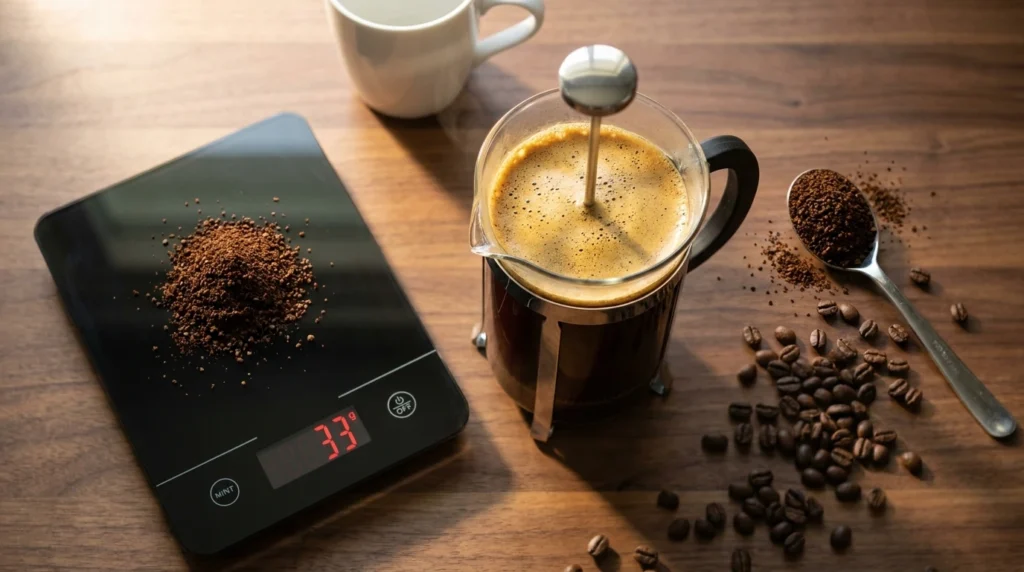
The short answer: for most French presses, use a 1:15 coffee-to-water ratio by weight. That’s about 1 gram of coffee for every 15 grams of water, or roughly 1 rounded tablespoon of coarse-ground coffee per 4 ounces (120 ml) of water. A standard 4-cup (17 oz) French press needs 33 grams of coffee; an 8-cup (34 oz) press needs 67 grams. But the right amount depends on your press size, your roast, and how strong you like your cup. This guide walks through exact measurements for every common French press size — in grams, tablespoons, and ounces — plus how to adjust the ratio for stronger or milder coffee, and how to fix the most common brewing problems.
Quick Answer: French Press Coffee Ratios at a Glance
The golden ratio for French press is 1:15 coffee to water by weight. Here’s what that looks like for common press sizes:
- 1-cup (3 oz / 90 ml): 6 g coffee (1 tbsp + 1 tsp)
- 3-cup (12 oz / 350 ml): 23 g coffee (~4½ tbsp)
- 4-cup (17 oz / 500 ml): 33 g coffee (6–7 tbsp)
- 8-cup (34 oz / 1000 ml): 67 g coffee (13 tbsp, or about ⅔ cup)
- 12-cup (51 oz / 1500 ml): 100 g coffee (20 tbsp, or about 1 cup)
For stronger coffee, move to a 1:12 ratio (more coffee). For milder coffee, go to 1:17 or 1:18 (less coffee). Always use a coarse grind and 195–205°F water, and steep for 4 minutes.
Why “Cup” Measurements Are Confusing
Before you measure anything, know this: French press manufacturers don’t use standard US measuring cups when they label a press as “4-cup” or “8-cup.” They use a 4-ounce (118 ml) “cup” — which is closer to a demitasse than a mug. A typical American coffee mug holds 10–12 ounces.
So a “4-cup” French press actually makes about 17 ounces of coffee total — enough for one large mug or two small ones. An “8-cup” press makes about 34 ounces, or 2–3 standard mugs. This is why the table below lists press sizes in both cups and ounces, and why using a kitchen scale is more reliable than counting mugs.
How Much Coffee by French Press Size
Here’s the complete reference table. All amounts use the standard 1:15 ratio, which produces a balanced, full-bodied cup.
| Press Size | Water | Coffee (grams) | Coffee (tablespoons) | Serves |
| 1-cup (3 oz) | 90 ml / 90 g | 6 g | 1 tbsp + 1 tsp | Single small cup |
| 3-cup (12 oz) | 350 ml / 350 g | 23 g | ~4½ tbsp | 1 mug |
| 4-cup (17 oz) | 500 ml / 500 g | 33 g | 6–7 tbsp | 1 large / 2 small |
| 8-cup (34 oz) | 1000 ml / 1000 g | 67 g | 13 tbsp (~⅔ cup) | 2–3 mugs |
| 12-cup (51 oz) | 1500 ml / 1500 g | 100 g | 20 tbsp (~1 cup) | 4–5 mugs |
Measurements assume coarse-ground coffee. One tablespoon of coarse-ground coffee averages about 5 grams, but dark roasts are less dense than light roasts, so a tablespoon of dark roast weighs slightly less. A kitchen scale is always more accurate than tablespoons.
If you don’t own a scale yet, a basic digital kitchen scale costs about $15 and will improve every brew you make. See our coffee brewing gear starter kit guide.
Adjusting the Ratio for Stronger or Milder Coffee
The 1:15 ratio is the starting point. Once you’ve brewed a few cups that way, you can tweak it up or down to match your taste. Here’s how the three common strength settings compare:
| Strength | Ratio | 4-cup (500 ml) | 8-cup (1000 ml) | Flavor Profile |
| Strong / bold | 1:12 | 42 g coffee | 83 g coffee | Heavy body, thick mouthfeel, bold |
| Standard | 1:15 | 33 g coffee | 67 g coffee | Balanced, full-bodied, sweet |
| Mild / light | 1:17 | 29 g coffee | 59 g coffee | Tea-like, delicate, bright |
Two practical notes on strength adjustments:
- Don’t adjust strength by extending the steep time. Four minutes is the sweet spot; past that, coffee over-extracts and turns bitter regardless of ratio. Change the amount of coffee, not the clock.
- Dark roasts generally taste better at slightly lower ratios (1:16 or 1:17) because they already pack more body. Light roasts often shine at 1:14 or 1:15, where you can pull out their brighter notes.
Grind Size Matters Almost As Much As Ratio
You can hit the perfect ratio and still end up with muddy, bitter coffee if your grind is wrong. French press needs a coarse grind — particles roughly the size of kosher salt or sea salt. Coarser than drip, much coarser than espresso. If you can see distinct particles (not a fine powder), you’re in the right territory.
Too-fine grinds cause two problems: the fines slip through the metal mesh filter and make the cup gritty, and finer particles over-extract quickly, producing bitter coffee. Too-coarse grinds under-extract, making the cup thin and sour.
If you’re using pre-ground coffee from the grocery store, it’s almost always ground for drip machines — too fine for a French press. Buy whole beans and grind fresh if at all possible, and specifically request a coarse grind if you have the store grind for you.
For step-by-step grind settings on popular manual grinders, see our manual coffee grinder buying guide
Step-by-Step: How to Use the Right Ratio
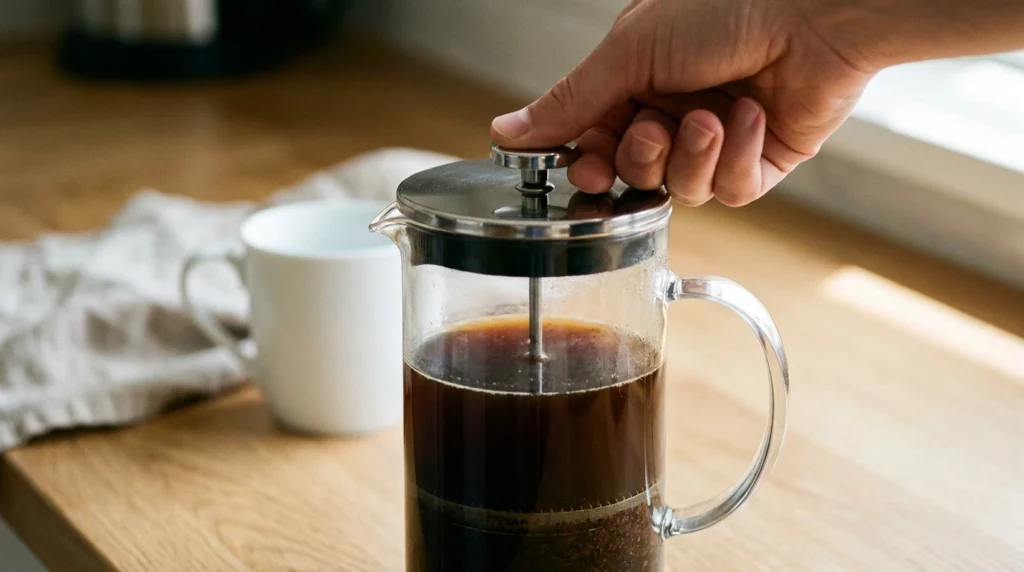
Using the ratios above is straightforward once you have the numbers. Here’s the complete process for a standard 4-cup (17 oz) press with 33g of coffee and 500g of water:
- Boil filtered water, then let it sit for about 30 seconds so it drops to 200°F (93°C). Boiling water will scorch the coffee and make it bitter.
- Preheat the press by rinsing it with some of the hot water, then discard that water. This keeps brewing temperature stable.
- Weigh 33 g of coffee beans (or 6–7 rounded tablespoons) and grind coarse — like kosher salt.
- Add the ground coffee to the press. Tare your scale if using one.
- Start a timer. Pour the 500 g of water slowly in a circular motion, saturating all the grounds. At 30 seconds, give the grounds a gentle stir to break the crust that forms on top.
- Put the lid on with the plunger pulled all the way up. This keeps heat in.
- At 4 minutes, press the plunger down slowly and evenly — about 20 seconds of downward pressure. A gentle press keeps fines at the bottom where they belong.
Pour immediately into mugs or decant into a carafe. Coffee left sitting on the grounds will keep extracting and turn bitter
How Many Tablespoons of Coffee per Cup?
If you don’t have a scale, tablespoons will get you close — but with a caveat. One tablespoon of coarse-ground coffee weighs approximately 5 grams, but that varies by roast: dark roasts are less dense, so a tablespoon of French roast weighs less than a tablespoon of light roast. You may end up using a little extra dark roast to hit the same strength.
Quick tablespoon-based math for the 1:15 ratio:
- Per 4 oz (120 ml) of water: 1 rounded tablespoon of coarse coffee
- Per 8 oz (240 ml) of water: 2 rounded tablespoons
- Per 12 oz (355 ml) of water: 3 rounded tablespoons
- Per 16 oz (475 ml) of water: 4 rounded tablespoons
For reliable results, invest in a scale. For quick reference when you’re camping or traveling, the tablespoon method is perfectly fine — just expect minor variation from cup to cup.
Troubleshooting: Fixing Common French Press Problems
If your French press coffee isn’t tasting right, the ratio is usually the first place to look — but not the only place. Here are the most common issues and how to fix them:
| Problem | Likely Cause | Fix |
| Bitter / harsh | Too much coffee, over-extraction, or grind too fine | Drop to 1:16 or 1:17, grind coarser, decant immediately after pressing |
| Weak / watery | Not enough coffee or grind too coarse | Increase to 1:14, or grind slightly finer, or extend steep to 5 min |
| Muddy / gritty | Grind too fine, fines slipping past filter | Use a burr grinder on coarse setting (like kosher salt) |
| Sour / thin | Under-extracted — water too cool or steep too short | Use water at 200°F, steep full 4 minutes |
| Over-extracted after sitting | Coffee kept steeping in the press after plunging | Decant into a carafe or thermos immediately after pressing |
Water Temperature and Why It Matters
Water temperature has a bigger effect on French press coffee than most people realize. The sweet spot is 195–205°F (90–96°C). Below 195°F the coffee under-extracts and tastes sour and thin; above 205°F it scorches and tastes bitter regardless of how careful you were with the ratio.
The easiest way to hit this range without a thermometer: bring water to a full boil, then let it sit for 30–45 seconds before pouring. That’s usually enough to drop it from 212°F (boiling at sea level) into the target range. If you live at altitude, water boils at a lower temperature, so you can pour straight off the boil.
A 4-cup French press holds about 17 ounces (500 ml) of water. At the standard 1:15 ratio, use 33 grams of coffee, or roughly 6–7 rounded tablespoons of coarse-ground coffee.
An 8-cup French press holds about 34 ounces (1000 ml) of water. Use 67 grams of coffee at a 1:15 ratio — about 13 tablespoons, or two-thirds of a US measuring cup.
For French press, use 1 rounded tablespoon of coarse-ground coffee per 4 ounces (120 ml) of water at the standard 1:15 ratio. That’s 2 tablespoons per 8 oz, 3 per 12 oz, and 4 per 16 oz.
The golden ratio is 1:15 (one part coffee to 15 parts water by weight). For stronger coffee, try 1:12; for milder, 1:17 or 1:18. Start with 1:15 and adjust by 1 gram of coffee at a time until you find your preference.
Weight is more accurate because coffee density varies by roast. A kitchen scale eliminates the guesswork. If you don’t have one, tablespoons get you close — just know that a tablespoon of dark roast weighs slightly less than a tablespoon of light roast.
Most often it’s either grind size (too fine causes over-extraction) or leaving the coffee sitting on the grounds after plunging. Use a coarse grind and decant into a carafe or mug immediately after pressing.
You can, but look specifically for “coarse grind” labelled for French press or percolator. Standard pre-ground coffee is ground for drip machines — too fine for a French press, which will produce muddy, bitter coffee.
Four minutes is the standard and works for most coffees. Don’t extend steep time to make coffee stronger — change the ratio instead. Over-steeping leads to bitter, over-extracted flavors that no ratio adjustment can fix.
The Bottom Line
The right amount of coffee for a French press comes down to three numbers: press size, ratio, and grind. Start with 1:15 by weight, scale it to your press, and use a coarse grind. That alone will put you ahead of 90% of French press brews.
From there, fine-tune in small steps. If a cup is too strong, drop the coffee by a gram or two next time. If it’s weak, add a gram. Keep the steep time at 4 minutes and the water at 200°F. The French press is one of the most forgiving brew methods in coffee, but it still rewards precision — and a single kitchen scale makes the difference between guessing and knowing.
Once you’ve nailed the ratio, level up with our guide to the best French press coffee beans or browse our full coffee brewing guides for other methods.
Related Articles


Share your coffee experience
Have you tried this product? Add a thoughtful review or ask a question.
One Response