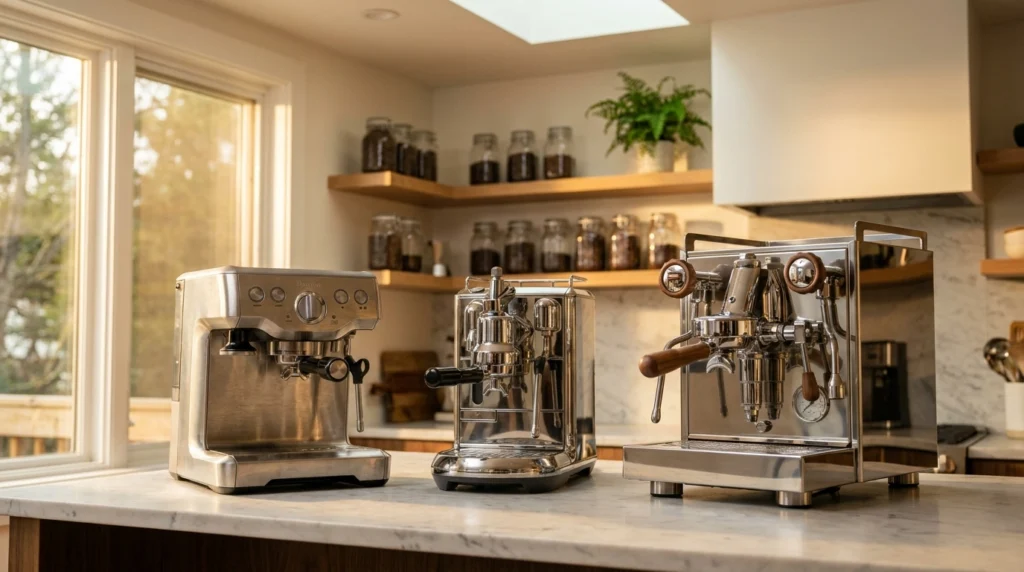
Choosing the best home espresso machine in 2026 isn’t really about the machine — it’s about matching one to how you actually make coffee. A beginner pulling two shots a day doesn’t need the same setup as someone steaming milk for a family of four. A $299 machine can make great espresso in the right hands; a $2,000 machine can make bad espresso in the wrong ones.
This guide is built to help you skip the confusion. We spent weeks comparing specs, expert reviews, real-world owner feedback, and current pricing across seven of the most-recommended espresso machines for home use in 2026 — from genuine budget picks to serious prosumer gear. No fluff, no pretending we ran a laboratory, no recommending whatever pays the highest commission.
| How we picked — honest methodology ✔ We are not a laboratory. We are a coffee publication that researches deeply and uses what we review where possible. ✔ Our picks are based on: manufacturer specs, specialist reviewers we trust (Home-Barista, CoffeeGeek, James Hoffmann), and hundreds of real owner reviews. ✔ We filter aggressively: machines with chronic reliability issues, misleading marketing claims, or bad post-purchase support don’t make the list regardless of brand pressure. ✔ We update this page every 3 months — prices and availability verified before the most recent publish date. |
Quick answer: the 7 best home espresso machines of 2026
If you only want the short version — here are our seven picks, ranked by the buyer they’re best for.
| Best For | Model | Price (approx.) | Why it wins |
| Best overall | Breville Barista Express Impress | $800 | Built-in grinder + assisted tamping = consistent shots for beginners |
| Best budget pick | Breville Bambino Plus | $500 | Automatic microfoam + fast heat-up in a tiny footprint |
| Best under $500 | Gaggia Classic Evo Pro | $499 | Commercial-grade parts, upgrade path, 10+ year lifespan |
| Best for beginners | De’Longhi Dedica Arte | $290 | Ultra-compact and the easiest learning curve on this list |
| Best all-rounder | Breville Barista Express (original) | $700 | Analog pressure gauge teaches you the craft |
| Best prosumer upgrade | Rocket Appartamento TCA | $1,600 | E61 group head, commercial feel, built to be repaired |
| Best dual boiler | Breville Dual Boiler (BES920XL) | $1,600 | Brew and steam simultaneously; serious milk-drink volume |
Need more detail? Keep reading — the full breakdown on each machine, including who it’s NOT for, is below.
What’s in this guide
- The 7 best home espresso machines for 2026 — detailed reviews
- How to choose an espresso machine (the 4 specs that actually matter)
- Common mistakes first-time buyers make
- Frequently asked questions
- Our final verdict for different budgets
1. Best Overall: Breville Barista Express Impress
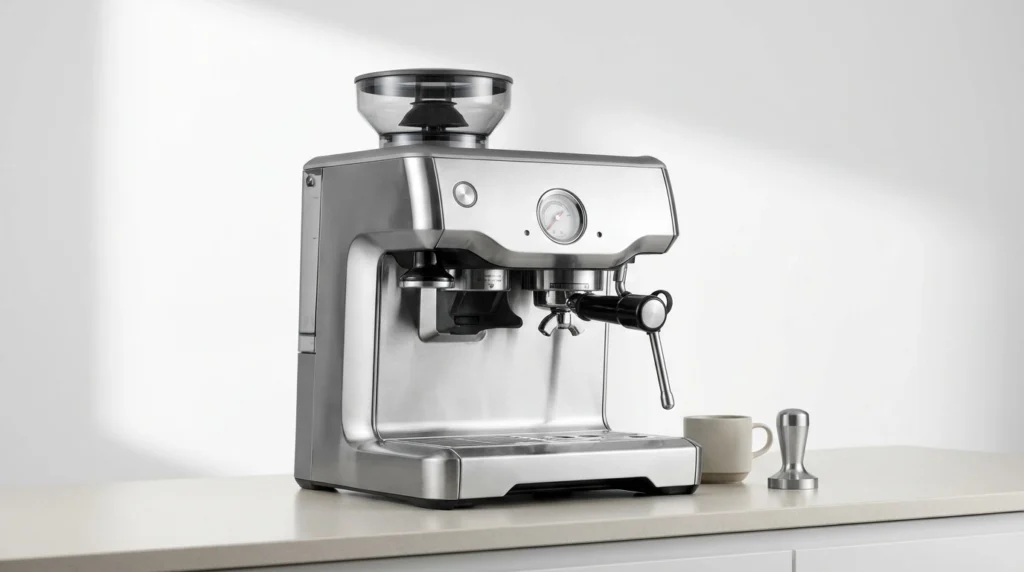
Price: Approximately $799–$849 | Boiler: Thermocoil | Grinder: Built-in 54 mm conical burr | Dimensions: 15″ W × 16″ H × 13″ D
The Barista Express Impress is the updated version of Breville’s most popular home espresso machine. It keeps the built-in grinder and the integrated workflow that made the original so successful, but adds an assisted tamping system that genuinely helps beginners who haven’t yet developed consistent hand pressure.
What sets the Impress apart is its smart dosing: the machine calculates how much coffee went into your basket after tamping, and automatically adjusts the next dose up or down to compensate. That sounds gimmicky until you realize the two things that wreck most beginner shots are (1) inconsistent dose weight and (2) uneven tamping. The Impress eliminates both.
The win
- All-in-one: grinder and machine in roughly 15 inches of counter space
- Assisted tamping produces consistent puck pressure — a skill that normally takes months
- PID temperature control on the 2024+ models gives you stable brew temps shot after shot
- 58 mm commercial-standard portafilter (same as pro cafes use)
The catch
- Still uses a thermocoil (instant heat-up) rather than a thermoblock or boiler — temperature is stable, but thermal mass is limited
- Built-in grinder has higher bean retention than a standalone grinder; if you switch beans often, stale coffee gets stuck
- If the grinder motor fails after warranty, repair cost approaches half the machine’s price
Who should buy it
Beginners to intermediate home baristas who want to make legitimate espresso without learning to grind, dose, and tamp manually from day one. If you pull 1–4 shots per day and value counter space, this is the best all-in-one on the market in 2026.
2. Best Budget Pick: Breville Bambino Plus
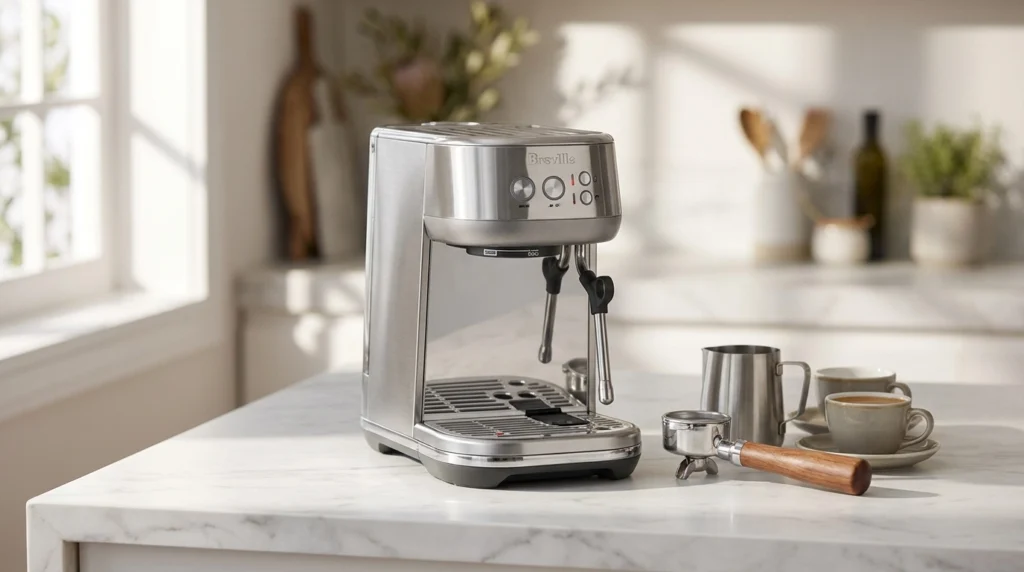
Price: Approximately $499 | Boiler: ThermoJet (3-second heat-up) | Grinder: Not included | Dimensions: 7.7″ W × 12.6″ H × 12.2″ D
For the best home espresso machine under $500, the market is flooded with cheap plastic appliances that fail within two years. The Bambino Plus is the rare exception — a compact, seriously capable machine that costs less than half of what its bigger sibling does.
The reality of the “3-second heat-up”
Breville markets the Bambino Plus as having a 3-second heat-up via the ThermoJet heating system. The water heats instantly, but the group head stays cold. If you pull a shot immediately, the cold metal saps heat from the water and you’ll get underextracted, sour espresso. The fix is simple: run a blank shot (water only) through the portafilter for 10 seconds before brewing. Once you make that a habit, the fast heat-up genuinely delivers on its promise.
The win
- Automated microfoam: select temperature and texture, the machine handles the rest
- Fits in small kitchens where the Barista Express won’t — 7.7 inches wide
- Same 54 mm portafilter as Breville’s bigger machines (upgrade path)
- Electronic PID keeps the water temperature consistent shot to shot
The catch
- You’ll need a grinder — budget another $150–$300 for a decent one (Baratza Encore ESP is a common pairing)
- Drip tray is tiny; the solenoid valve discharges water after every shot, so you’ll empty it often
- No pressure gauge — less learning feedback than the Barista Express
Who should buy it
Milk-drink drinkers on a tight budget who either already own a grinder or plan to buy one separately. Ideal for small kitchens, office setups, or anyone who wants legitimate espresso in the smallest possible footprint.
3. Best Espresso Machine Under $500: Gaggia Classic Evo Pro
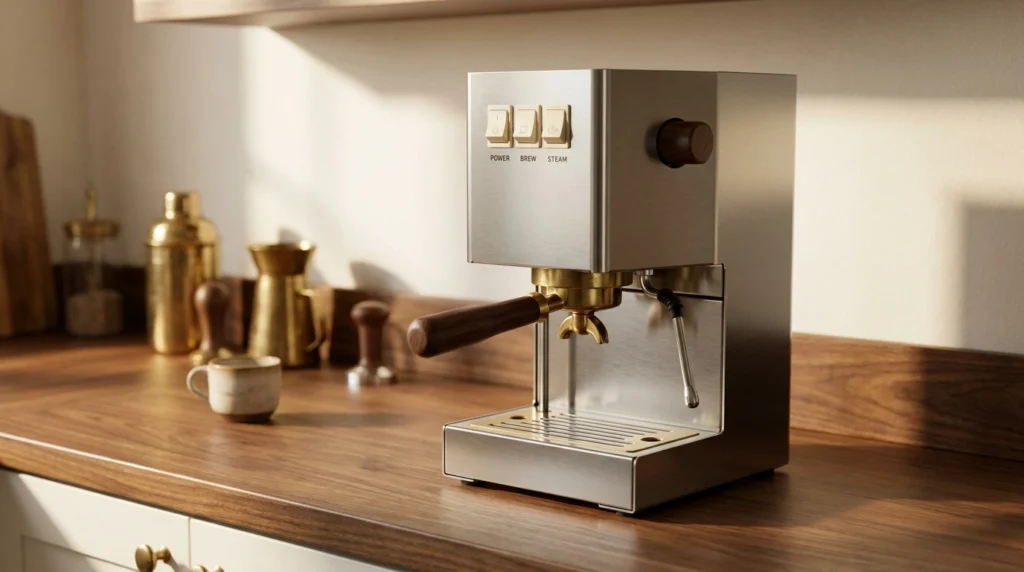
Price: Approximately $499 | Boiler: Brass single boiler | Grinder: Not included | Dimensions: 9.5″ W × 14.2″ H × 8″ D
The Gaggia Classic has anchored the entry-level prosumer category for more than a decade, and the 2024+ Evo Pro revision fixed the two complaints serious home baristas had with earlier versions. The factory OPV (over-pressure valve) is now set to 9 bar instead of the old 12 bar — that single change makes the shots dramatically more balanced out of the box, without any modification.
The rest of the machine is the same proven design: commercial-grade brass boiler, actual solenoid valve, genuine 58 mm commercial portafilter, and an Italian-built chassis with documented 10–15 year daily-use lifespan. There is no other machine under $500 with this parts list.
The win
- Built to last: 10–15 years of daily use is routinely documented in the owner community
- 58 mm commercial portafilter — the widest accessory and aftermarket ecosystem of any home machine
- Massive upgrade path: you can add a PID, pressure gauge, silvia wand, and flow control over time
- Repairable — parts are cheap and available; most repairs are DIY-able with a screwdriver
The catch
- Manual everything: no PID out of the box (can be added later), no pressure gauge, no auto-steam
- Single boiler — you brew, then switch to steam mode and wait. Not ideal for making multiple milk drinks fast
- Learning curve is real: this machine will teach you espresso, but it will also humble you for the first month
Who should buy it
People who want to learn espresso properly, want a machine that will outlast three Barista Expresses, and don’t mind a slower workflow. If you see yourself still making espresso in 10 years, this is the most defensible purchase under $500.
4. Best for Beginners on a Budget: De’Longhi Dedica Arte
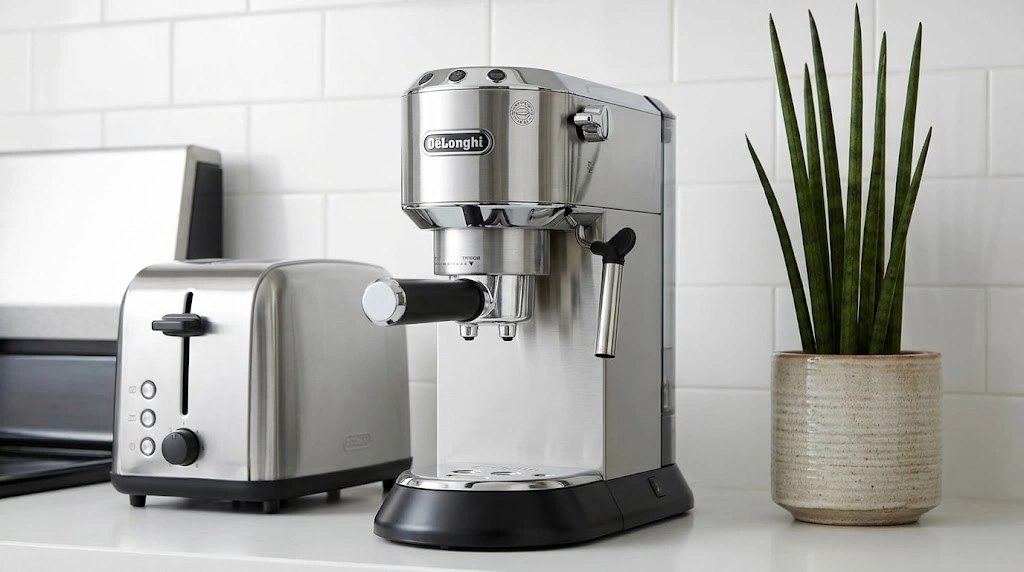
Price: Approximately $290 | Boiler: Thermoblock | Grinder: Not included | Dimensions: 6″ W × 13″ H × 12.4″ D
If you’re not sure whether you’ll stick with espresso long-term, the Dedica Arte is the lowest-risk entry point on this list. At roughly six inches wide, it fits in kitchens where every other machine here would be oversized, and at around $290 you’re not gambling a paycheck to find out if home espresso is for you.
Let’s be honest about what you’re getting at this price: it’s a pressurized-basket machine, which means it creates artificial pressure to produce “espresso-like” extraction from almost any grind size. A purist will tell you this isn’t real espresso. They’re partially right — but for someone just starting out, pressurized baskets make the learning curve genuinely manageable, and the drinks are still genuinely good.
The win
- Tiny footprint — 6 inches wide fits anywhere
- Forgiving with pre-ground coffee thanks to pressurized baskets
- Three temperature settings let you tune to bean type
- Under $300 — the lowest-risk way to find out if home espresso is for you
The catch
- Pressurized baskets mask grind and dose errors — you learn less
- Single boiler, slow steam recovery — making a latte takes a minute or two longer than larger machines
- You’ll likely outgrow it in 6–18 months if you get serious about espresso
Who should buy it
Total beginners testing the waters, people in tiny apartments, or secondary machines for an office or guest kitchen. Not the right pick if you already know you’re committed to learning real espresso.
5. Best All-Rounder: Breville Barista Express
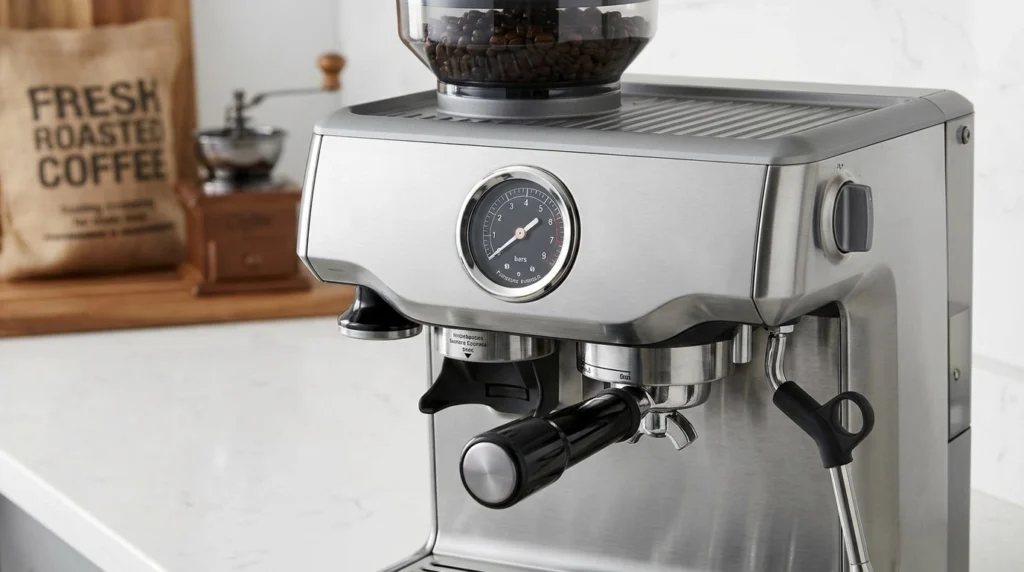
Price: Approximately $699 | Boiler: Thermocoil | Grinder: Built-in conical burr | Dimensions: 13.2″ W × 13.1″ H × 15.5″ D
The original Barista Express predates the Impress and remains Breville’s best value in 2026. It has the same built-in grinder and thermocoil heating, but with one feature the Impress doesn’t have: an analog pressure gauge on the front of the machine.
That gauge is why some home baristas actually prefer the original over the Impress. It shows you, in real time, whether your grind and tamp are producing the right extraction pressure. If you’re someone who learns by watching and adjusting, the gauge is worth more than the Impress’s assisted tamping — because it teaches you the craft rather than compensating for weak technique.
The updated 2024+ models now ship with the OPV factory-set to 9 bar (matching industry standard), so the old complaint about over-extraction from 15-bar pumps is resolved.
The win
- Analog pressure gauge is the single best learning tool on any machine under $1,000
- Same grinder and footprint as the Impress for $100–$150 less
- Updated 9-bar OPV makes shots more balanced out of the box
- Massive community and aftermarket support (bottomless portafilters, better baskets, etc.)
The catch
- Manual tamping — you’re expected to learn it (the Impress doesn’t make this expectation)
- Same high-retention grinder issue as the Impress
- Cleaning cycle indicator is real — ignore it and the solenoid valve will clog
Who should buy it
People who want to learn real espresso technique while still having the grinder integrated. If you value feedback over hand-holding, the original Barista Express is the better choice over the Impress.
6. Best Prosumer Upgrade: Rocket Appartamento TCA
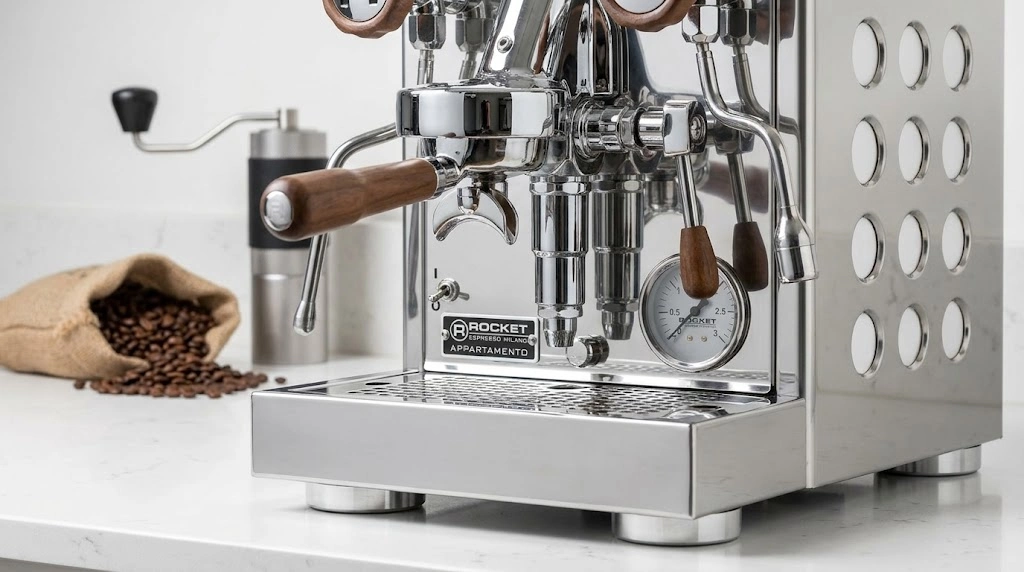
Price: Approximately $1,600 | Boiler: Heat exchanger (HX) with Hybrid PID | Grinder: Not included | Dimensions: 10.2″ W × 15″ H × 16.1″ D
If you want the best home espresso machine that mimics a commercial environment, the Rocket Appartamento has evolved. The new TCA (Temperature Control Adjustment) model moves away from the old pressurestat architecture and now uses a Hybrid PID to manage boiler pressure electronically.
While it’s still a heat exchanger machine, that electronic management results in much tighter temperature stability than previous generations. More importantly, the Appartamento gives you something no machine under $1,000 can: the true commercial workflow. E61 group head with massive brass thermal mass. Steam boiler hot enough to texture milk for a flat white in under 12 seconds. Construction built to be repaired rather than replaced.
The win
- E61 group head offers commercial-level thermal stability once warmed up
- Steam power is in a different league than any thermocoil machine — latte art becomes actually achievable
- Built to be serviced: expected lifespan with care is 15+ years
- The Hybrid PID is a meaningful upgrade over the older pressurestat Appartamento
The catch
- Thermodynamics don’t negotiate — the machine needs 30+ minutes to warm up fully
- Your grinder budget needs to match (minimum $400–$600 grinder to not bottleneck the machine)
- This is not a beginner machine — if you haven’t learned manual espresso yet, learn on something cheaper first
Who should buy it
Experienced home baristas ready to commit to the craft long-term, people who already own a serious grinder, and anyone who values tactile, mechanical feel over convenience features.
7. Best Dual Boiler: Breville Dual Boiler (BES920XL)
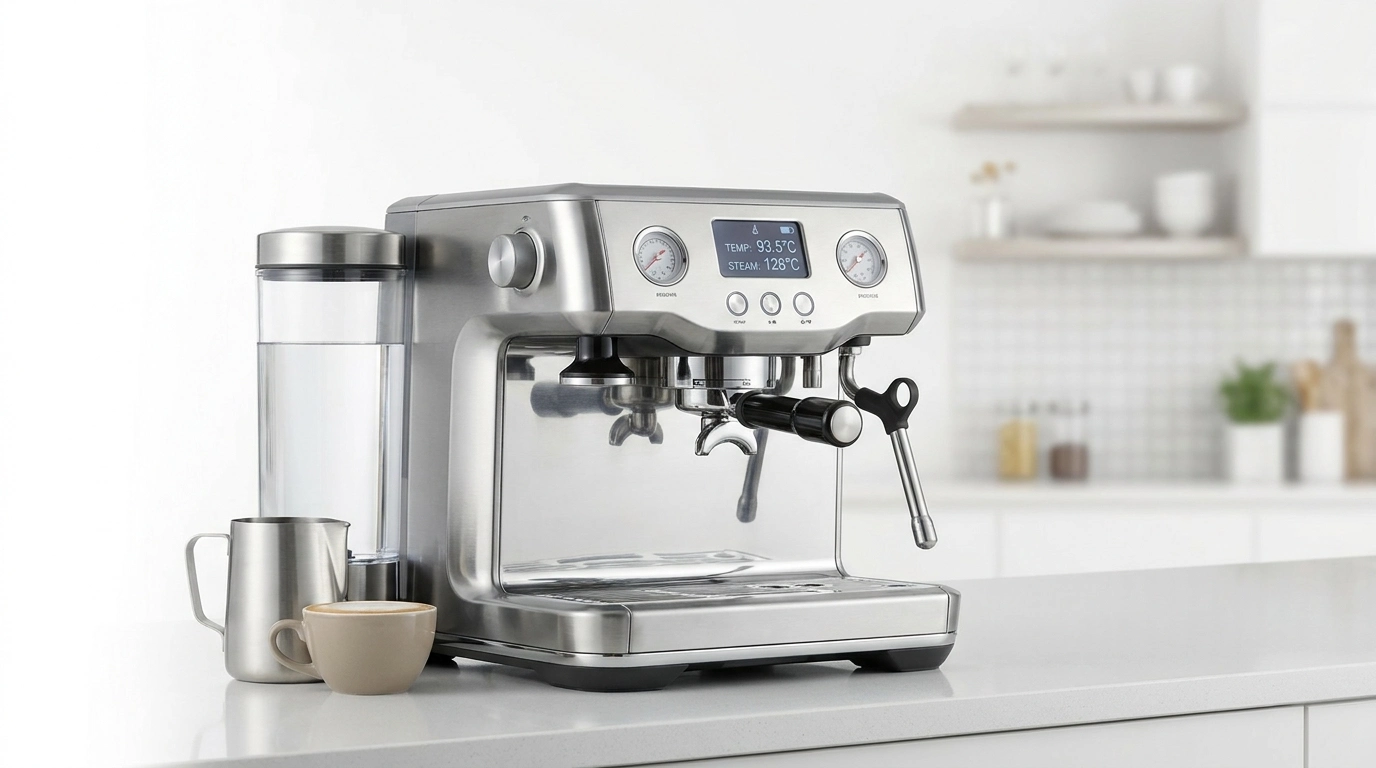
Price: Approximately $1,599 | Boiler: Dual boiler (brew + steam independent) | Grinder: Not included | Dimensions: 14.9″ W × 14.5″ H × 15″ D
If you make a lot of milk drinks — multiple lattes a morning for a household — the Breville Dual Boiler does something no single-boiler machine can: it brews and steams at the same time. Two separate PID-controlled boilers mean zero waiting between pulling the shot and texturing the milk.
At around $1,600, it competes directly with the Rocket Appartamento, but takes a different approach. The Rocket gives you mechanical feel and long-term repairability. The Breville gives you digital convenience, dual boilers, and auto-fill functions. Neither is “better” — they serve different buyers.
The win
- Brew + steam simultaneously — critical for multi-drink mornings
- Independent PID on each boiler — the most consistent shot temperatures at any price
- Pre-infusion time and brew temperature are both user-programmable
- 58 mm commercial portafilter
The catch
- Not serviceable the way a Rocket is — when electronic boards fail, it’s typically replaced rather than repaired
- Takes a real beating if you skip descaling — water quality matters more on this machine than most
- Breville’s aesthetic isn’t for everyone — this is a kitchen appliance, not a piece of furniture
Who should buy it
Families making 3+ milk drinks every morning, or anyone who prioritizes workflow speed and digital precision over mechanical tactility
How to choose a home espresso machine: the 4 specs that actually matter
Forget the marketing. When you shop for an espresso machine, ignore “20 bar pressure” claims on cheap machines — more bars is not better. Real espresso extracts at 9 bars. Here are the four specs that genuinely affect your cup:
1. Temperature stability (PID vs. no PID)
A PID (proportional-integral-derivative) controller monitors and adjusts the boiler element to keep water at your exact set point, usually 93°C / 200°F. Without a PID, boilers swing wildly in temperature, leading to inconsistent shots. Every machine on this list has PID temperature control (built-in or hybrid).
2. Portafilter size (54 mm vs. 58 mm)
58 mm is the commercial standard used by every cafe you’ve ever bought coffee from. The 54 mm size is Breville-specific. Neither is “better” for flavor, but 58 mm has a much larger accessory and upgrade ecosystem — more basket options, more tamper choices, more bottomless portafilter options. If you see yourself upgrading over time, 58 mm gives you more paths forward.
3. Boiler type (thermocoil vs. single boiler vs. dual boiler)
Thermocoil (Breville): fast heat-up, limited thermal mass, fine for 1–3 shots per session. Single boiler (Gaggia Classic): more thermal mass, but you wait between brewing and steaming. Dual boiler (Rocket HX, Breville Dual): brew and steam simultaneously, best for milk-drink volume.
4. Build quality (plastic vs. metal, repairable vs. not)
A $300 machine with a metal boiler and service parts will outlast a $500 machine with plastic internal guts. Check owner reviews for the 3–5 year mark, not the first month. Machines that are documented to be repairable (Gaggia Classic, Rocket) hold long-term value in a way that sealed electronic units don’t.
Common mistakes first-time espresso machine buyers make
- Spending the full budget on the machine. A $600 machine with a $50 blade grinder makes worse espresso than a $300 machine with a $200 burr grinder. Split your budget — ideally 60% machine, 40% grinder.
- Buying a super-automatic expecting cafe quality. Bean-to-cup machines are convenient but rarely produce real espresso. They’re coffee-making robots, not espresso machines.
- Ignoring water quality. Hard water will scale and destroy any espresso machine in 12–18 months. Use filtered water or a remineralization system from day one.
- Believing the “20 bar” marketing. High bar numbers mean the pump is rated high — not that your shot actually extracts at that pressure. 9 bar is the target. Anything else is marketing.
Skipping maintenance. Not backflushing. Not descaling. Not cleaning the steam wand. These habits kill more machines than component failures do.
Frequently Asked Questions
For total beginners on a budget, the De’Longhi Dedica Arte (around $290) is the lowest-risk entry point. For beginners willing to invest in the long-term, the Breville Barista Express Impress (around $800) has built-in grinding, assisted tamping, and PID temperature control — eliminating the three most common beginner mistakes at once.
If you currently buy 2+ espresso drinks a week from cafes, the math works fast. A $500 machine pays for itself in roughly 12–18 months of skipped cafe visits. Beyond the cost, home espresso gives you control over bean freshness, ratio, and technique — things cafes rarely match outside of the top tier.
Semi-automatic machines (every one in this guide) require you to grind, dose, tamp, and start the shot manually — but give you real control over extraction. Fully automatic (bean-to-cup) machines handle everything with a button press, but the internal workflow is optimized for convenience, not flavor. Enthusiasts almost universally choose semi-automatic.
If you’re just testing the waters, $290–$500 is reasonable. If you know you want real espresso and plan to stick with it for years, $500–$1,000 hits the sweet spot (Gaggia Classic, Barista Express, Bambino Plus). Above $1,500 you’re in prosumer territory — only worth it if you’re committed to the craft long-term and have a matching grinder budget.
Yes, unless you buy a machine with an integrated grinder (Barista Express, Barista Express Impress). Pre-ground coffee goes stale within days, and fresh whole-bean coffee is the single biggest factor in espresso quality. Plan for a $150–$400 grinder if your machine doesn’t include one. The Baratza Encore ESP, Baratza Sette 30, and 1Zpresso J-Max are common pairings.
It depends enormously on the machine and your maintenance. A Breville thermocoil machine that’s descaled regularly typically lasts 5–8 years. A Gaggia Classic with routine maintenance has documented 10–15 year lifespans. Prosumer machines like Rocket can last 15–20+ years with proper service. Machines die from water hardness and skipped cleaning far more often than from mechanical failure.
The Breville Barista Express Impress (around $800) is the strongest pick in this range because it includes a built-in grinder and assisted tamping. If you already own a grinder, the Breville Bambino Plus (~$500) leaves you room in the budget for an excellent separate grinder, which often produces better overall results.
You can use any whole beans, but espresso roasts are optimized for the short contact time and high pressure of espresso extraction. Light-roasted beans require more precise dialing in; medium and medium-dark roasts are more forgiving for beginners. Start with a medium or medium-dark espresso blend, then experiment as your skills develop.
Final verdict: which home espresso machine should you actually buy?
If you have under $500 and want to learn properly: Gaggia Classic Evo Pro. It will teach you espresso, last 10+ years, and give you an upgrade path that no plastic Breville can match.
If you have $500–$800 and want the easiest possible learning curve: Breville Bambino Plus if you already have a grinder, or Barista Express Impress if you don’t.
If you’re a learner who wants to see what’s happening: Breville Barista Express (original) — the pressure gauge is worth the minor inconvenience of manual tamping.
If you’re an experienced home barista upgrading: Rocket Appartamento TCA for mechanical feel, or Breville Dual Boiler for digital workflow and milk-drink volume.
If you’re testing whether home espresso is even for you: De’Longhi Dedica Arte at under $300. Lowest possible risk to find out.Whichever direction you go, remember the two rules that matter more than the machine: budget for a proper grinder, and protect your machine with good water from day one. Do those two things, and any of these seven picks will serve you for years
Related Articles
Share your coffee experience
Have you tried this product? Add a thoughtful review or ask a question.
5 Responses