
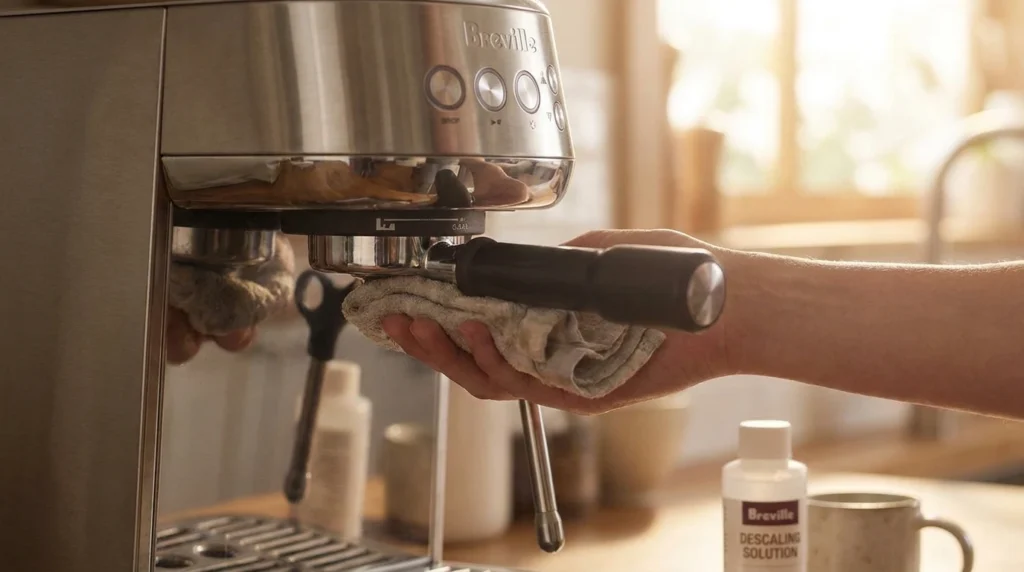
Cleaning vs. Descaling: What’s the Difference?
Cleaning and descaling fix two completely different problems, and doing one doesn’t cover the other.
- Cleaning (backflushing): removes built-up coffee oils and fine grounds from the group head and portafilter. Rancid oils are what make an otherwise fresh shot taste stale and bitter.
- Descaling: dissolves mineral scale (limescale) from the boiler, thermocoil, and internal water lines. Scale ruins temperature stability, slows flow, and eventually strains the pump.
Think of cleaning as flavor maintenance and descaling as hardware protection. You need both, on different schedules.
How Often Should You Descale a Breville Espresso Machine?
This is the question the manuals dance around, so here’s a direct answer. Breville’s official guidance is to descale roughly every three months — some models count it as every 300 shots, whichever comes first. That’s a solid baseline, but the real interval depends almost entirely on your water.
The harder your water, the faster scale forms. Here’s a realistic schedule:
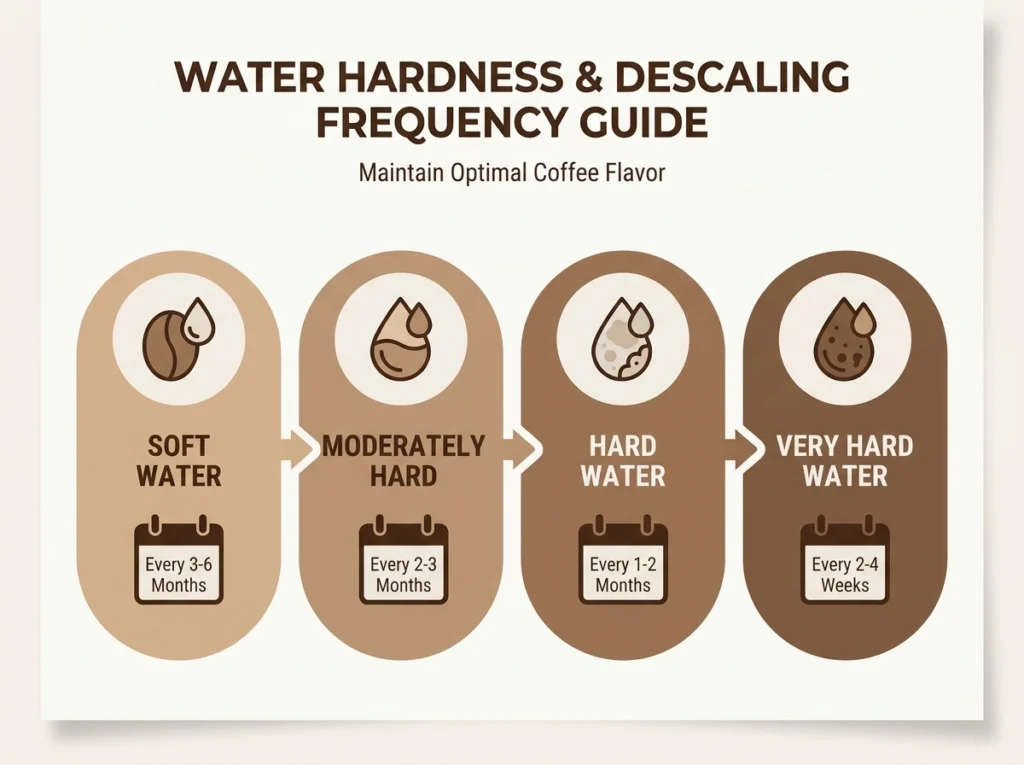
| Water hardness | Typical sources | Descale every |
| Soft / filtered (0–60 ppm) | Brita-filtered or softened water; much of the Pacific Northwest and New England | 3–6 months |
| Moderate (61–120 ppm) | Most US municipal tap water | 2–3 months |
| Hard (121–180 ppm) | Much of the Southwest, Midwest, and parts of the Northeast | 4–6 weeks |
| Very hard (180+ ppm) | Well water; cities like San Antonio, Las Vegas, and central Florida | Monthly |
Not sure where you fall? Check the USGS water-hardness map or test your tap with an inexpensive hardness strip. Most Breville machines also let you set your water hardness in the settings menu, which calibrates when the descale alert fires — worth doing once if you’ve never changed it from the factory default.
Don’t Wait for the Descale Light
Here’s the detail most guides skip: the descale light is a lag indicator, not a real-time reminder. Breville triggers it from a shot counter or your water-hardness setting — not from a sensor measuring actual scale. By the time it lights up, limescale has usually been accumulating in the boiler for weeks. Treat the light as a backstop, not a schedule. Descale on the calendar above and you’ll rarely see it.
If you own the newest model, our step-by-step guide to cleaning and descaling the Barista Express Impress walks through its exact button sequence and maintenance-light behavior.
How to Clean Your Breville Espresso Machine (The Oils)
If you want to know how to clean a Breville espresso machine day to day, the routine is short — it’s mostly about consistency.
The Daily Wipe-Down
After every session, flush the group head (run a shot of water with no portafilter locked in) to rinse away loose grounds. Wipe and purge the steam wand the moment you finish texturing milk; if milk dries inside the tip it hardens into a blockage and harbors bacteria. Knock out the puck, then rinse the portafilter and basket.
The Weekly Backflush
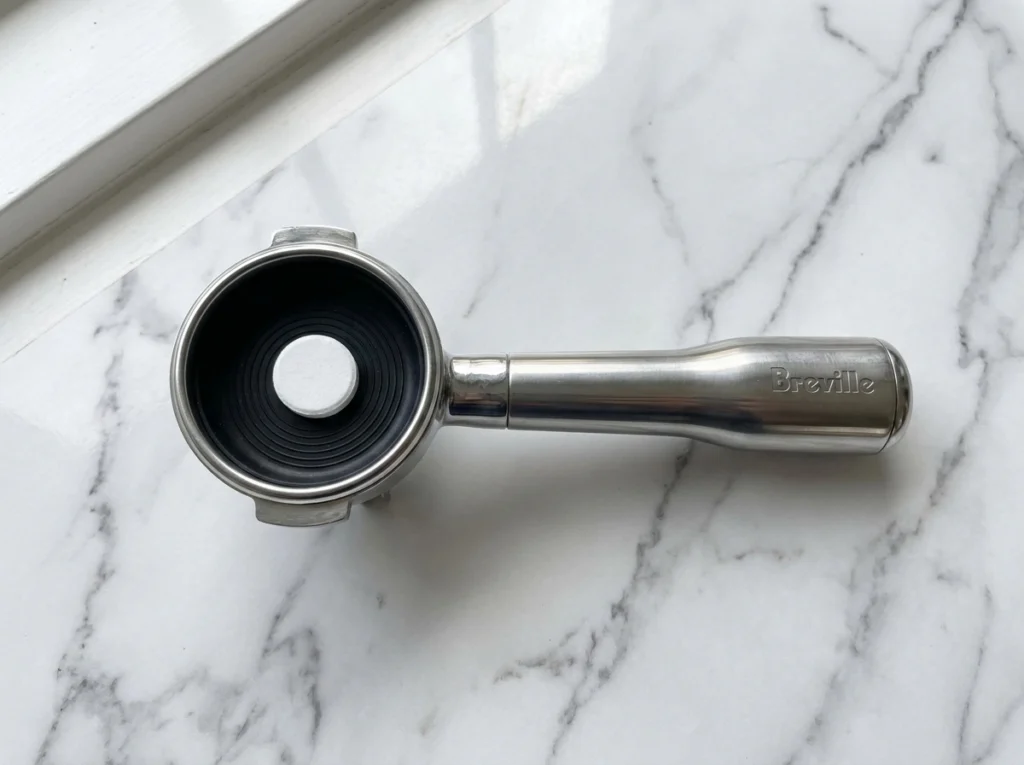
Most Breville machines, including the Barista Express and Duo Temp Pro, use a “Clean Me” light to prompt a cleaning cycle. We backflush weekly regardless of the light.
- Insert the blind (blank) filter — the rubber disc — into your portafilter.
- Add a Breville cleaning tablet to the center of the disc.
- Lock the portafilter in and run the cleaning cycle. If your model has no automatic cycle, run the shot button for about 10 seconds, stop for 10, and repeat five times.
- Remove the portafilter and run a few flushes of clean water to clear all detergent residue.
Pro tip: wash the removable parts — the milk jug, drip tray, and baskets — in warm, soapy water so they don’t pick up stale odors. If your machine has a built-in grinder, it needs its own routine; here’s how to clean the Barista Express Impress grinder.
How to Descale Your Breville Espresso Machine (The Minerals)
Learning how to descale a Breville espresso machine is the single most valuable maintenance skill you can pick up. Scale is the number-one killer of home espresso machines: it coats the heating element, insulating it so the machine can’t hold temperature, and forces the pump to push against restricted flow until it gives out. A proper descale reverses all of that in about 30 minutes.
Step 1 — Choose the Right Descaler
Use a descaler made for espresso machines — Breville’s own descaling solution, or a citric-acid powder like Urnex Dezcal. Citric acid is the active ingredient in almost every commercial descaler, so a food-grade citric-acid solution (about two tablespoons per liter of warm water) does the same job for a fraction of the price.
Don’t use vinegar. It’s the internet’s favorite shortcut and it’s a mistake on a Breville for three concrete reasons: Breville explicitly warns against it, and vinegar damage can void your warranty; acetic acid takes roughly 3.5 times longer to dissolve the same scale as citric acid, so it’s less effective anyway; and it leaves a smell that can take five or more rinse cycles to clear, while slowly degrading the rubber gaskets and O-rings inside. We break down the chemistry in our guide to the vinegar myth vs. citric acid safety.
Step 2 — Prepare the Machine
- Empty the drip tray — you’ll flush a lot of water, so start it empty.
- Remove the water tank and take out the charcoal water filter. Descaling acid will ruin it.
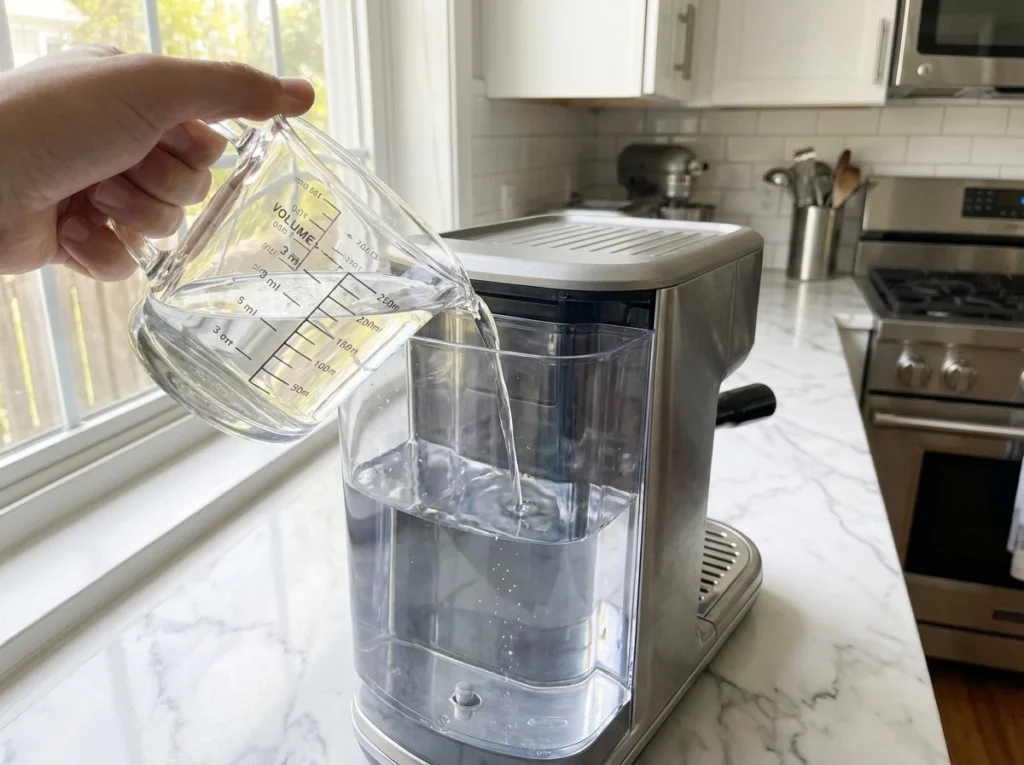
- Dissolve your descaler in a full tank of warm water and stir until it’s fully dissolved (no granules left to clog a valve).
Step 3 — Enter Descale Mode
Entry differs by model:
- Touchscreen models (Barista Touch, Oracle, Barista Pro): open the settings or maintenance menu and select Descale.
- Button models (Barista Express, Duo Temp Pro): typically hold the 1-Cup, 2-Cup, and Power buttons together until the descale indicator is solid.
Sequences vary, so if you’re unsure, check your manual or follow Breville’s official descaling walkthrough for the Barista Express (there’s a matching one for the Barista Express Impress) to confirm the exact steps for your machine.
Step 4 — Run the Cycle
- Run roughly half the tank through the group head.
- Direct the rest through the steam wand and hot-water outlet, so the solution reaches every water path.
- If you’re descaling manually, let the solution sit inside for 5–10 minutes to break down stubborn scale, then finish pumping it through.
Step 5 — Rinse Thoroughly
This step is non-negotiable. Empty the tank, rinse it, refill with fresh cold water, and run a full tank through the group head and wand. Reinstall a fresh water filter and you’re done. Any chemical aftertaste means you owe it one more rinse tank.
Troubleshooting Common Descaling Problems
A few things reliably go wrong mid-descale. Here’s how to handle each.
| Problem | Likely cause & fix |
| Machine won’t enter descale mode | Wrong button combo, or the machine isn’t at standby. Power fully off, then hold the exact sequence for your model; confirm it against the manual. |
| Descale light won’t reset after the cycle | The cycle didn’t fully complete. Run it again start to finish — on button models the light clears only after the final fresh-water rinse phase. |
| No water or weak flow after descaling | Loosened scale can clog a valve, or the pump lost its prime. Run water through with no portafilter to re-prime; if flow is still a trickle, repeat the descale or clean the solenoid valve. |
| Descale light returns quickly | Your water is harder than the setting assumes. Lower the water-hardness setting and switch to filtered water. |
| Loud rattling or grinding during the cycle | The pump is straining against heavy scale. Stop, let it soak longer, and retry; persistent grinding means the pump needs a closer look. |
For issues specific to the newest model, our Barista Express Impress troubleshooting guide goes deeper on error lights, no-water faults, and grinder jams.
Prevention: How to Descale Less Often
Since your cup is roughly 98% water, water quality drives both scale buildup and flavor. The single best way to descale less is to control what goes into the tank:
- Keep the tank’s charcoal-resin filter fresh — replace it every 2–3 months, sooner in hard water.
- Use filtered or bottled water instead of hard tap. A Brita pitcher is enough for most homes; very hard-water areas may want a dedicated espresso-machine filter.
- Never let the tank run dry or sit empty for long stretches.
Good water can stretch your interval from monthly to quarterly and add years to the machine.
When to Replace the Water Pump (and Other Parts)
Breville machines use an Ulka vibratory pump, rated for roughly 1,000 hours of clean-water operation — about five to seven years of typical home use. Scale-restricted flow makes the pump work harder and can cut that lifespan in half, which is one more reason descaling matters.
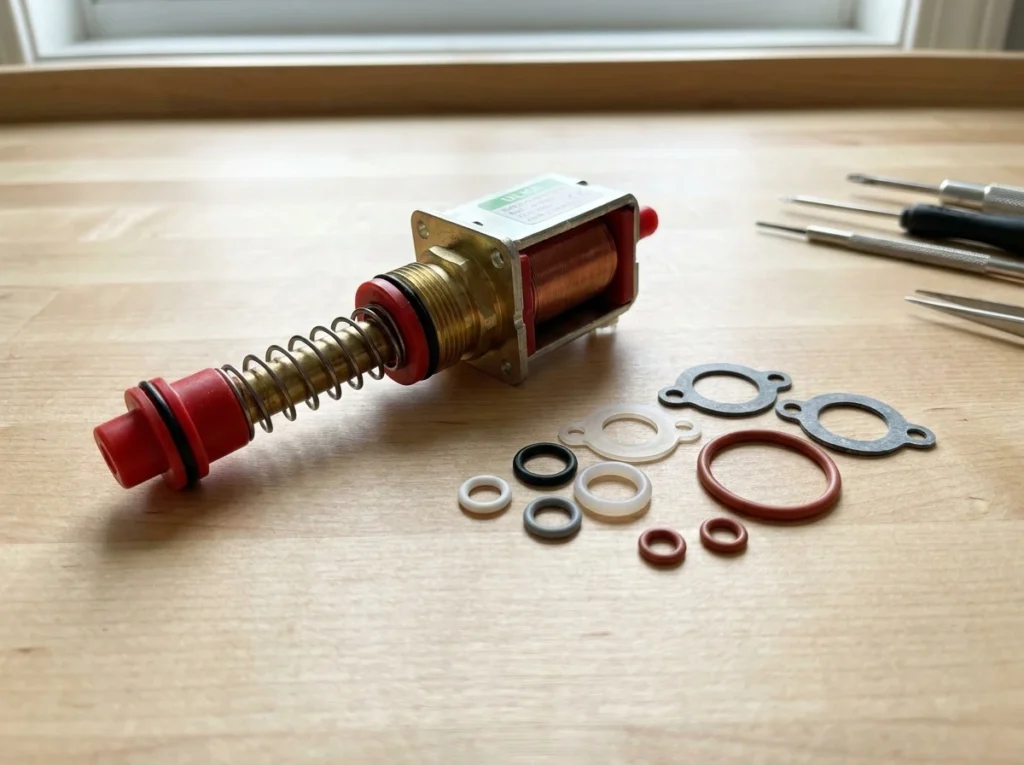
Contrary to a common myth, a failing pump doesn’t go quiet — it usually gets louder and rougher. Watch for:
- A new rattling, screeching, or clicking sound, or loud buzzing with little to no water coming through (a classic loss of prime).
- The pressure gauge failing to climb toward the espresso range.
- Water reduced to a trickle even after a fresh descale.
(Occasionally a pump that has completely failed will drop to a faint hum with no water at all — but a sudden increase in noise is the far more common warning sign.)
Silicone gaskets, seals, and water tanks are straightforward DIY replacements you can source online. But solenoid-valve and electrical faults are best left to professional repair to avoid voiding your warranty. And if the machine is near the end of its life anyway, it’s worth weighing a repair against our roundup of the best espresso machines of 2026 before spending the money. If you’re specifically eyeing the Impress, our full Breville Barista Express Impress review covers its long-term maintenance quirks.
Frequently Asked Questions
Every one to three months for most people: about every 3 months (or 300 shots) on soft or filtered water, every 4–6 weeks on hard water, and monthly on very hard water. Descale sooner if flow slows or steam weakens.
No. Breville warns against it and vinegar damage can void your warranty. It’s also less effective than citric acid and leaves a smell that’s hard to rinse out. Use a dedicated descaler or citric acid instead.
Breville’s own descaling solution, or any citric-acid-based descaler such as Urnex Dezcal. Food-grade citric acid (two tablespoons per liter of warm water) is the same active ingredient at a lower cost.
Complete a full descale cycle, including the final fresh-water rinse. On button models the light clears only after the whole cycle finishes; on touchscreen models the menu confirms when it’s done. If it stays on, run the cycle again from the start.
Loosened scale may have clogged a valve, or the pump lost its prime. Run water with no portafilter to re-prime, and repeat the descale if flow is still restricted. A persistent trickle can mean the solenoid needs cleaning.
You can, but filtered water is far better. It slows scale, means fewer descales, and improves flavor. If your tap water is hard, filtering is the highest-value change you can make.
About 30 minutes of active time, plus a 5–10 minute soak on manual models and a full rinse tank. Budget roughly 45 minutes start to finish.
The Bottom Line
Knowing how to descale a Breville espresso machine — and doing it on schedule — is the whole game in espresso-machine longevity. Backflush weekly, descale on a schedule built around your water, skip the vinegar, and keep a fresh filter in the tank. Do that and your Breville will keep pulling rich, balanced shots for years — no repair bill required.

Share your coffee experience
Have you tried this product? Add a thoughtful review or ask a question.