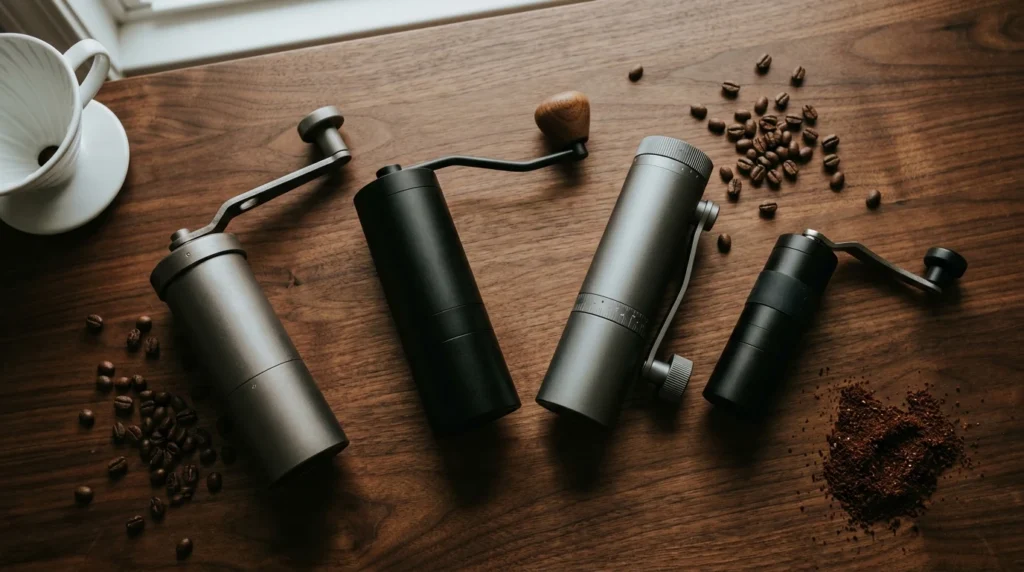
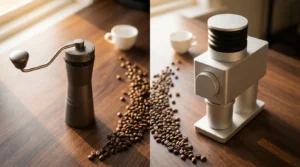
The gap between a cheap hand grinder and a great one used to mean spending $300 or more. That is no longer true. The best manual coffee grinders for 2026 now deliver grind consistency that rivals electric grinders costing two or three times as much, and the competition between brands like 1Zpresso, Comandante, KINGrinder, and Timemore keeps pushing quality up and prices down.
This guide ranks the top eight hand grinders on the market right now, tested and cross-referenced against specialty coffee review sources. Each pick has a clear job: espresso, pour over, travel, or budget. No filler, no sponsored nonsense, no repeating last year’s list. If you brew pour over, French press, AeroPress, or pull espresso shots at home, the right manual grinder will upgrade every cup — and unlike an electric grinder, it will last ten years without needing a motor replacement
Quick Answer: Best Manual Coffee Grinders for 2026
The 1Zpresso J Ultra is the best manual coffee grinder for 2026 overall, with 48mm titanium-coated stainless-steel burrs, roughly 8 microns per click, and a grind range that covers espresso through cold brew for under $200. The Comandante C40 MK4 remains the benchmark premium pick. For value, the KINGrinder K6 delivers nearly identical performance at half the price. For espresso on a tight budget, the Timemore C3 ESP Pro is the answer.
TL;DR picks by use case:
- Best overall → 1Zpresso J Ultra
- Best premium → Comandante C40 MK4 Nitro Blade
- Best value → KINGrinder K6
- Best budget espresso → Timemore C3 ESP Pro
- Best for travel → 1Zpresso Q Air
- Best for beginners → Timemore Chestnut C2
Manual Coffee Grinder Comparison Table
| Grinder | Best For | Burrs | Adjustment | Cap. | Price* | Rank |
| 1Zpresso J Ultra | Espresso / all-round | 48mm stainless steel conical | External, ~8µm per click | 35g | ~$199 | #1 |
| Comandante C40 MK4 | Premium pour over | 39mm Nitro Blade steel | Stepped, 35 clicks | ~30g | ~$299 | #2 |
| 1Zpresso K-Ultra | Versatile daily driver | 48mm stainless steel | External, numbered dial | ~35g | ~$169 | #3 |
| KINGrinder K6 | Best value | 48mm heptagonal stainless | External, 16µm per click | 35g | ~$100 | #4 |
| Timemore C3 ESP Pro | Budget espresso | 40mm S2C stainless | Stepped internal micro-adjust | 25g | ~$85 | #5 |
| Kinu M47 Classic | Premium espresso | 47mm Black Fusion steel | Stepless, 10µm marks | ~50g | ~$340 | #6 |
| Timemore Chestnut C2 | Beginner / pour over | 38mm stainless steel | Internal stepped | 25g | ~$70 | #7 |
| 1Zpresso Q Air | Travel | 38mm heptagonal conical | Numerical internal | 18g | ~$69 | #8 |
Still deciding between a manual and electric grinder? Read our hand grinder vs electric grinder comparison first.
1. 1Zpresso J Ultra — Best Manual Coffee Grinder Overall
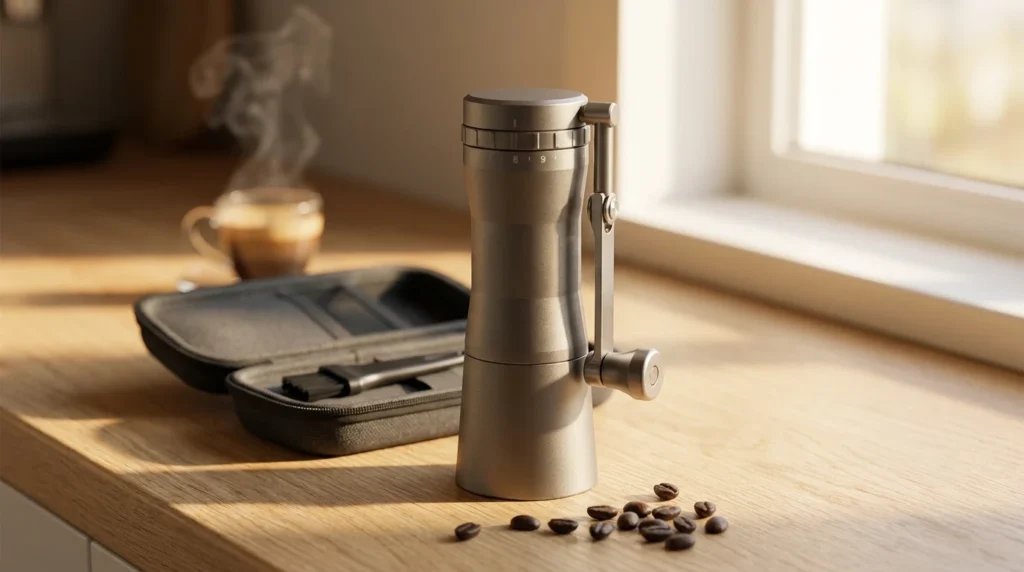
Best for: Home brewers who want one grinder for espresso, pour over, and everything in between.
The J Ultra is the grinder most coffee reviewers landed on as the top 2026 pick, and for good reason. It has 48mm titanium-coated stainless-steel burrs, a functional grind range covering Turkish through cold brew, and an external numbered click system that makes dialling in espresso actually straightforward. Each click moves the burrs about 8 microns — one of the finest resolutions at this price tier.
The two real upgrades over its predecessors are the slimmer body (2.2 inches at its widest, easier to grip with smaller hands) and the magnetic catch cup that pops on and off without threading. A travel case is included.
Pros
- 8µm-per-click precision — competitive with electric grinders several times the price
- External adjustment makes switching between brew methods fast
- Titanium-coated burrs should last a decade of daily use
- Slimmer body than the J Max it replaces
Cons
- The huge click range means many rotations between espresso and French press settings
- Still not cheap at the ~$199 price point
2. Comandante C40 MK4 Nitro Blade — Best Premium Manual Grinder
Best for: Pour over obsessives who want the gold-standard hand grinder and don’t mind paying for it.
The Comandante C40 MK4 has been the reference premium manual grinder for the better part of a decade, and the MK4 Nitro Blade iteration earns its spot on this list through build quality and grind consistency, not nostalgia. The 39mm high-nitrogen stainless steel burrs produce one of the most uniform pour-over grinds you can get from any grinder at any price — electric included.
Where the Comandante trails the J Ultra is espresso. The 35-click stepped adjustment is fine for filter methods but doesn’t give you the micron-level granularity espresso really needs. If your priority is poured over, V60, Kalita Wave, or French press, the Comandante is the move. If espresso is your thing, save money and get the J Ultra instead.
Pros
- Best-in-class grind consistency for filter methods
- Exceptional build — this grinder is designed to outlive you
- Available in a wide range of colors and wood trim options
- Made in Germany (low-volume specialty manufacturing)
Cons
- Stepped 35-click adjustment is not ideal for espresso dial-in
- Expensive — roughly 50% more than the J Ultra for a more specialized tool
- No cleaning accessories included at that price
3. 1Zpresso K-Ultra — Best Multipurpose Daily Driver
Best for: Someone who brews three different ways during the week and wants fast switching between them.
The K-Ultra is the grinder 1Zpresso loyalists keep on the counter. It uses the same 48mm burr size as the J Ultra but trades a tiny bit of espresso precision for a friendlier external adjustment dial that makes it easier to jump between grind sizes. A foldable handle and a magnetic catch cup round out the daily workflow.
If you occasionally pull espresso but mostly drink pour over, drip, and French press, the K-Ultra is a more comfortable daily choice than the J Ultra. If you’re an espresso-first user, stick with the J Ultra.
Pros
- Intuitive external numbered dial — change settings in seconds
- Magnetic catch cup and foldable handle
- Comes with a travel case
Cons
- Less precise espresso dial-in than the J Ultra
Still $200+ — not a budget option
4. KINGrinder K6 — Best Value Manual Coffee Grinder
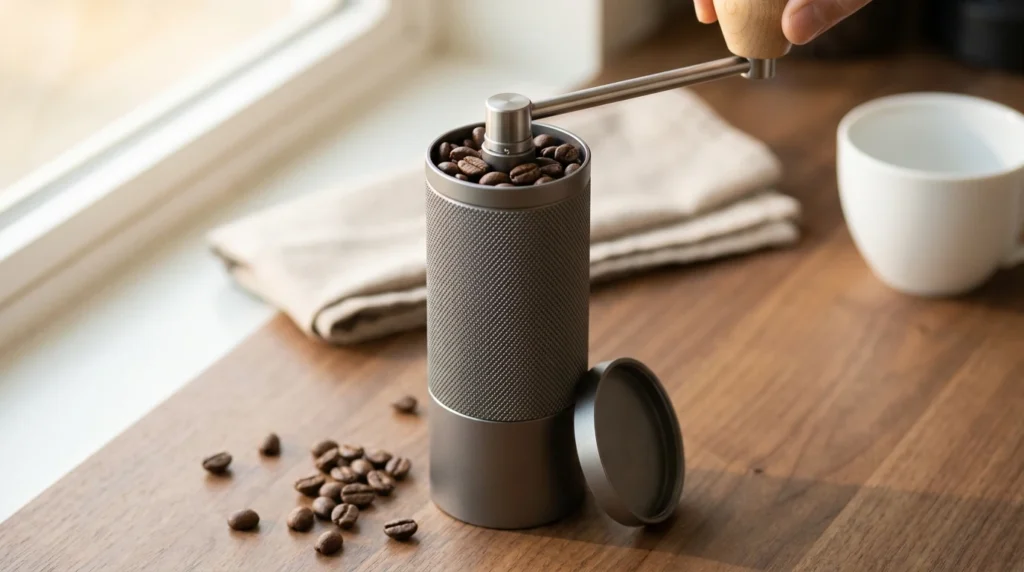
Best for: Anyone who wants 1Zpresso-class performance at half the price.
The KIN Grinder K6 is the most-talked-about value grinder of the year, and using one clarifies why. It has 48mm heptagonal stainless-steel burrs, a 240-click external adjustment collar with 16 microns per click, and an all-metal body that feels far more expensive than it is. You give up a foldable handle and the magnetic catch cup you get on 1Zpresso grinders, but not much else.
One quirky bonus: the K6 is explicitly designed to accept a power drill attachment for faster grinding, and the lid is engineered so beans don’t fly out during drill-assisted use. That is a genuinely useful feature if you grind for 2-3 cups at a time.
Pros
- External 16µm-per-click adjustment — real precision for espresso
- Power-drill compatible (rare at any price)
- Typically sells for under $100
- Aluminium body, dual-bearing spindle, low retention
Cons
- Crank can feel slightly loose on some units
- Top-heavy — stabilize with your non-cranking hand
Non-folding handle
5. Timemore C3 ESP Pro — Best Budget Manual Grinder for Espresso
Best for: First-time espresso grinders with a tight budget and a real espresso machine.
Time more’s C3 ESP Pro is one of very few manual grinders under $100 that can actually grind fine enough to pull a proper espresso shot. It uses 40mm Time more S2C stainless steel burrs and adds an espresso-tuned stepped internal micro-adjust with tighter step sizes than the regular C3. The folding handle is genuinely one of the best designs on any hand grinder, premium or budget.
Caveat: the adjustment is internal, not external, which means switching between espresso and pour over requires unscrewing the grinds cup and counting clicks. If you mostly brew one method, this is not a problem. If you switch daily, step up to the KIN Grinder K6.
Pros
- Pulls real espresso under $100
- Excellent folding handle — one of the best in the industry
- All-metal construction, dual-bearing spindle, low retention
Cons
- Internal adjustment is slow to change between brew methods
Smaller 25g capacity limits you to one double shot or one pour over at a time
6. Kinu M47 Classic — Best Premium Espresso Manual Grinder
Best for: Lever espresso users and light-roast obsessives willing to pay for stepless precision.
Kinu M47 is the grinder you buy when espresso is the point. The 47mm conical burrs with Kinu’s Black Fusion coating deliver remarkably even fine grinds, and the stepless adjustment — marked in 10-micron increments — lets you dial in a shot with precision most electric grinders can’t match. Two sets of ball bearings make cranking noticeably smooth even with light-roast beans, which typically fight back against hand grinders.
The trade-off is price and size. This is a heavy, premium grinder, not a travel tool. If you’re not pulling espresso, you will not get your money’s worth.
Pros
- Best-in-class espresso uniformity from a manual grinder
- Stepless adjustment with clear 10µm reference marks
- Smooth cranking, even with light roasts
Cons
- Heavy and bulky — not for travel
- Expensive — crosses into electric grinder territory at ~$340
- Performance dips slightly at French press-coarse settings
7. Timemore Chestnut C2 — Best Beginner Manual Coffee Grinder
Best for: Someone upgrading from pre-ground coffee or a blade grinder for the first time.
The Timemore C2 has been a beginner-friendly go-to for years, and the current version is still one of the fastest, cheapest ways to drink significantly better coffee at home. 38mm stainless steel burrs deliver a noticeably more consistent grind than cheap ceramic-burr alternatives, and pour over coffee from a C2 will beat anything from a blade grinder.
The limitations are real: internal adjustment, slow speed on espresso-fine settings, and a grip that gets uncomfortable if you grind for more than one or two cups. For drip, French press, and pour over it’s a great starter. For espresso, skip it and get the C3 ESP Pro instead.
Pros
- Costs about the same as a mediocre blade grinder but performs dramatically better
- Sweet, balanced cups on medium-roast drip and pour over
- Fast-grinding on coarse settings
Cons
- Too slow and imprecise for espresso
- Plastic parts throughout (especially the grinds cup)
- Internal adjustment — no external reference marks
8. 1Zpresso Q Air — Best Travel Manual Coffee Grinder
Best for: Campers, AeroPress-on-the-road brewers, and anyone who wants decent coffee out of a backpack.
The Q Air is 1Zpresso’s ultra-portable — it’s small enough to nest inside an AeroPress plunger, weighs about 365g, and uses 38mm heptagonal conical burrs that are shockingly good for the size. Numerical internal adjustment means you can note down your travel setting and reproduce it.
It’s not the fastest grinder here, and the 18g maximum capacity caps you at a single shot or single AeroPress, but that’s the nature of a travel grinder. If you’re choosing between the Q Air and a Porlex Mini, the Q Air’s steel burrs and 22-25µm-per-click precision are noticeably better than Porlex’s older ceramic-burr design.
Pros
- Nests inside an AeroPress
- Steel burrs — consistency you don’t expect from a travel grinder
- Numerical settings so you can reproduce grind size on the road
Cons
- 18g max capacity — single-serve only
- Slower than full-size grinders, especially on fine settings
How to Choose the Right Manual Coffee Grinder
Four things separate great manual grinders from merely okay ones. Get these right and you’ll pick the best manual coffee grinder for your kitchen, not someone else’s.
1. Burr material: steel beats ceramic
Ceramic burrs stay sharp longer in theory but produce a less uniform grind in practice and grind slowly. Stainless steel burrs — especially titanium-coated or nitrogen-hardened variants — are the standard for any grinder worth buying in 2026. All eight grinders on this list use steel.
2. Burr size: bigger is faster, not always better
Most quality hand grinders use 38-48mm conical burrs. Larger burrs (48mm) grind faster with less effort — meaningful if you grind more than about 18g at a time. Smaller burrs (38mm) are better for travel grinders where size matters more than speed.
3. Adjustment: external if you switch brew methods
External adjustment (visible clicks you can count on the outside of the grinder) makes switching between espresso and pour over a two-second job. Internal adjustment requires unscrewing the catch cup, which is fine if you brew one method but annoying if you don’t. The 1Zpresso J Ultra, K-Ultra, and KINGrinder K6 all have external adjustment. Most sub-$100 grinders do not.
4. Micron-per-click: this is what espresso demands
For espresso, you want roughly 8-16 microns per click. Below that and you’ll struggle to dial in small changes. Above that and the jump between clicks will over- or under-extract your shot. The J Ultra at 8µm, the K6 at 16µm, and the Kinu M47 with stepless adjustment all pass this bar. The Timemore C2 does not.
Manual Grinder Grind Size Reference
One advantage of a manual grinder with a numbered click system is reproducibility — you can note down the exact setting for each brew method. The ranges below are starting points; adjust based on your beans and taste.
| Brew Method | Grind Size | Reference (feels like…) | Typical Click Range* |
| Turkish | Extra fine | Powdered sugar | 0–20 |
| Espresso | Fine | Fine beach sand | 20–45 |
| Moka pot | Fine–medium fine | Coarse beach sand | 45–60 |
| Pour over / V60 | Medium | Table salt | 60–80 |
| Drip / flat-bottom | Medium | Table salt to kosher | 70–90 |
| AeroPress | Medium–medium fine | Table salt | 50–75 |
| French press | Coarse | Sea salt flakes | 90–110 |
| Cold brew | Extra coarse | Cracked peppercorns | 110–130 |
*Click ranges are approximate and vary by grinder model. Use as a starting point, then taste-adjust.
Manual Grinder vs Electric Grinder: Which Is Right for You?
Under $200, a good manual grinder will almost always out-grind an electric grinder at the same price. The reason is physical: a motor, fan, grinds bin, and timer circuit cost money, so electric grinders at a given price have less budget left for burrs, burr alignment, and bearings — which is where grind quality actually comes from.
Manual grinders also have almost zero retention (the grinds come out the bottom, not stuck in a motorized chute), which matters if you care about freshness and single-dose brewing.
The case for electric kicks in when you’re grinding for more than two people, pulling multiple espresso shots in a row, or just don’t want to crank a handle at 6 a.m. Above about $300, quality electric grinders catch up and then surpass manual grinders on convenience. Below $300, manual wins on grind quality.
Frequently Asked Questions
The 1Zpresso J Ultra is the best manual coffee grinder for 2026 overall, thanks to 48mm titanium-coated steel burrs, roughly 8 microns per click, and a grind range that handles espresso through cold brew for under $200. For pour over specifically, the Comandante C40 MK4 is the premium pick.
Yes — provided the grinder has small enough step sizes (ideally 16 microns per click or finer) and sharp steel burrs. The 1Zpresso J Ultra, Kinu M47, KINGrinder K6, and Timemore C3 ESP Pro can all pull quality espresso shots. Most sub-$50 hand grinders cannot, because their step sizes are too coarse and their burrs are not consistent enough at fine settings.
A quality manual grinder with sharp 48mm steel burrs will grind 20g in about 45-60 seconds. Smaller 38mm burrs take closer to 60-90 seconds. Grinding fine for espresso adds effort and time — expect around 60-80 seconds for an 18g espresso dose on a good grinder.
Absolutely. Coffee loses most of its aroma within 15-20 minutes of grinding, which is why pre-ground coffee tastes flat compared to fresh. Even the cheapest steel-burr manual grinder on this list will produce a dramatically better cup than any pre-ground bag, regardless of price.
Nearly all manual grinders use conical burrs because the geometry fits a cylindrical body. Conical burrs produce cups with more body and texture; flat burrs (common in electric grinders) emphasize clarity and separation. For manual grinding, conical is the norm and not a limitation.
Yes — coffee oils build up on the burrs and can go rancid. Brush out the burr chamber weekly with the included brush (or a small paintbrush), and fully disassemble and clean every month or two. Do not use water on the burrs; a dry brush is enough.
Close, but not identical. The K6 matches the J Ultra on burr size (48mm) and external adjustment, and beats it on price. The J Ultra has finer step resolution (8µm vs 16µm), a folding handle, a magnetic catch cup, and slightly more consistent grind output at espresso-fine settings. If budget is the priority, the K6 is the better buy. If espresso precision is, pay more for the J Ultra.
The KINGrinder K6 at around $100 is the best overall. For espresso specifically under $100, the Timemore C3 ESP Pro is the answer. For pour over only, the Timemore Chestnut C2 delivers solid cups at around $70.
Final Word: Which Manual Coffee Grinder Should You Buy?
Pick by what you actually brew. If you pull espresso and care about dial-in precision, the 1Zpresso J Ultra is the answer. If you’re obsessed with pour over and have the budget, the Comandante C40 MK4 Nitro Blade is a lifetime-buy. If you want 90% of the J Ultra’s performance for half the money, the KINGrinder K6 is remarkable value.
All eight grinders on this list are good — the differences come down to matching the grinder to your brew method and budget. Skip the cheap ceramic-burr grinders on Amazon, skip the novelty shapes, and buy one of these eight instead. You’ll be drinking noticeably better coffee by the end of the week.
Related Articles
Share your coffee experience
Have you tried this product? Add a thoughtful review or ask a question.
One Response