Table of contents
- Quick answer: which commercial grinder should your café buy?
- How we chose the best commercial espresso grinders
- The decision framework: volume → burr size → workflow → service → budget
- The 5 best commercial espresso grinders for 2026
- Honorable mention: Mazzer Robur S for traditional espresso body
- What we would not buy for a production café
- Total cost of ownership: the number that changes the winner
- Our verdict
- Frequently asked questions
The best commercial espresso grinder is not the grinder with the largest burrs, the newest screen, or the highest price. It is the grinder that can survive your peak 30 minutes, hold a repeatable dose across different baristas, fit your bar, and be repaired locally before downtime turns into lost sales.
This commercial espresso grinder guide therefore ranks operating fit first and treats every product recommendation as a conditional business decision.
That distinction matters because many pages ranking for espresso grinders are really home-grinder lists. If you are shopping for a kitchen setup, use our 2026 home espresso grinder index. This guide is for cafés, carts, restaurants, bakeries, hotels, and multi-site coffee programs buying production equipment.
Our best overall pick is the Mahlkönig E65W GbS for compact, connected café workflows. The Fiorenzato F64 EVO PRO Sense is the value choice when grind-by-weight and fast cleaning matter more than maximum output. The E80W GbS, F83 E PRO Sense, and Mythos MYG85 earn their places only when your volume or quality program can justify them. There is no honest universal winner.
Quick answer: which commercial grinder should your café buy?
Bottom line: Choose each commercial espresso grinder by peak-hour shots, not daily averages. Under roughly 150 drinks a day, a serviceable 64-65 mm grinder is usually enough. Above that, or when a rush compresses most sales into one hour, prioritize larger burrs, active cooling, faster output, and a backup plan. Grind-by-weight earns its premium when dose drift, staff turnover, or multi-site consistency creates measurable waste.
| Model | Best for | Volume fit | Burrs | Dosing | 2026 U.S. band |
| Fiorenzato F64 EVO PRO Sense | Best value GbW | Low-mid volume | 64 mm flat | Grind by weight | $2,500-$2,800 |
| Mahlkönig E65W GbS | Best overall | Mid volume / multi-site | 65 mm flat | GbW + Sync | $3,000-$3,300 |
| Mahlkönig E80W GbS | Best high-volume speed | High volume | 80 mm flat | GbW + Sync | $3,600-$4,200 |
| Fiorenzato F83 E PRO Sense | Best 83 mm value | Mid-high volume | 83 mm flat | Grind by weight | $3,000-$3,300 |
| Victoria Arduino Mythos MYG85 | Best specialty workflow | High-volume specialty | 85 mm flat | Gravimetric | $4,000-$5,500* |
*Planning band only; dealer quotes, voltage, finish, freight, and installation change the delivered price. Verify live stock and a written service quote before ordering.
How we chose the best commercial espresso grinders
We scored commercial espresso grinder fit, not countertop appeal. A grinder could not enter the top five unless the manufacturer positions it for professional service and publishes enough technical information to verify the model. We then evaluated six factors:
- Peak-hour capacity (25%): output and heat management during the rush, not an optimistic daily cup count.
- Dose repeatability and workflow (20%): gravimetric control, portafilter detection, adjustment speed, and training burden.
- Serviceability (20%): access for cleaning, replacement burrs, qualified local technicians, parts lead times, and warranty route.
- Cup-quality control (15%): burr geometry, thermal management, and the ability to hold a stable recipe as the bar heats up.
- Total cost of ownership (10%): purchase price, coffee waste, burr life, cleaning labor, and downtime exposure.
- Bar fit (10%): footprint, voltage, hopper height, noise, and compatibility with your espresso machine and tamper.
We checked current specs against Mahlkönig’s E65W product data, Mahlkönig’s E80W data, Fiorenzato’s F83 technical page, and Victoria Arduino’s Mythos comparison. Prices are planning bands, not promises.
The decision framework: volume → burr size → workflow → service → budget
A commercial espresso grinder should clear all five gates below. If it fails service coverage or peak demand, a lower price or longer feature list cannot rescue the decision.
1. Size for the rush, not the day
A café serving 180 drinks across ten hours has a different commercial espresso grinder problem from a commuter bar serving 120 drinks between 7:30 and 9:00 a.m. Count espresso doses in your busiest 15 and 60 minutes, add decaf and double-shot demand, then leave headroom. The best commercial espresso grinder for a smooth all-day bakery may fail in a short drive-thru rush even when both businesses report the same daily volume.
2. Use burr diameter as a capacity clue, not a quality score
Larger burrs can grind faster and manage heat better, but diameter alone does not guarantee a better commercial espresso grinder. Motor power, burr geometry, RPM, cooling, alignment, and the coffee all matter. A well-supported 64 mm grinder is often the rational choice for an owner-operated café; 80-85 mm platforms make more sense when seconds and temperature stability compound across hundreds of drinks.
3. Put a dollar value on grind-by-weight
Grind-by-weight removes a major source of commercial espresso grinder dose variance. Its return is easiest to justify when multiple baristas share a station, stores must follow one recipe, or coffee costs make over-dosing expensive. A stable owner-operated bar serving one house blend may get better value from a robust timer-based grinder plus disciplined scale checks.
4. Buy the technician before the grinder
Ask who will service the exact commercial espresso grinder model, which parts are stocked locally, and what happens if the control board or load cell fails on Friday morning. The commercial espresso machine maintenance checklist is a useful starting discipline, but a grinder also needs a written cleaning, burr, calibration, and backup schedule.
5. Budget for the system
Your commercial espresso grinder, espresso machine, water system, auto tamper, counter clearance, electrical service, and backup plan operate as one production line. Pair this guide with our commercial espresso machine selection framework before signing a purchase order.
The 5 best commercial espresso grinders for 2026
1. Mahlkönig E65W GbS — best overall for most modern cafés
The E65W GbS is our best commercial espresso grinder for cafés that value repeatable doses, a compact footprint, and recipe standardization more than maximum brute-force speed. It is the current connected successor to the older E65S GbW language still used on many competitor pages, so buyers should verify the exact model code on every quote.
Mahlkönig’s official specifications list 65 mm special-steel burrs, roughly 5-6 g/s at 60 Hz, a 1.2 kg hopper, active cooling, ETL sanitation certification, and a median burr-life estimate around 800 kg. The U.S. manufacturer price observed during research was $3,099.
- Buy it if: you run a mid-volume café, manage multiple staff or stores, and can use the weight-based workflow immediately.
- Skip it if: your rush demands E80-class speed, your local technician does not support it, or Sync compatibility adds no value to your machine fleet.
- Verify before purchase: exact voltage, machine/Sync compatibility, calibration routine, replacement load-cell lead time, and local loaner policy.
2. Fiorenzato F64 EVO PRO Sense — best value grind-by-weight pick
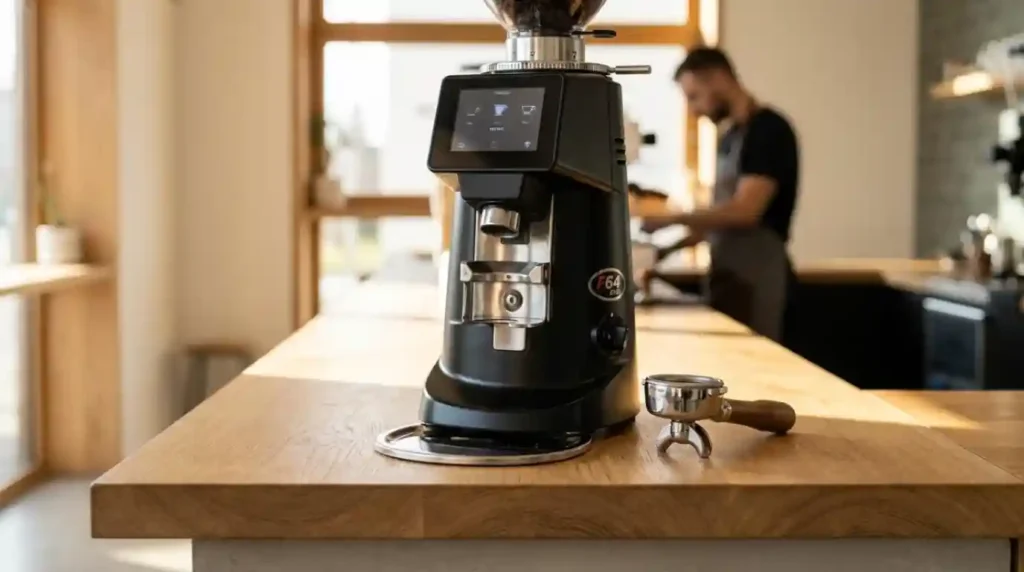
For a lower-volume independent café that wants a commercial espresso grinder with grind-by-weight without jumping above $3,000, the F64 EVO PRO Sense is the strongest value case. Its differentiator is not just dose-by-weight; the PRO chamber is designed for fast access without losing the grind setting, which can reduce cleaning friction in a real close-down routine.
Fiorenzato’s published F64 data lists 64 mm flat burrs, 0.1 g scale precision, a 450 W motor, and recommended consumption up to 3 kg per day. Fiorenzato USA listed the grinder at $2,695 during this review. Manufacturer throughput varies by burr finish, so do not convert a lab figure directly into café drinks per hour.
- Buy it if: your shop is low-to-mid volume, cleaning access is a priority, and a $400-$500 saving versus the E65W matters.
- Skip it if: your peak regularly pushes beyond its thermal/output comfort zone or your region lacks Fiorenzato service.
- Verify before purchase: stock status, Dark-T burr configuration, portafilter fit, scale calibration, and local parts inventory.
3. Mahlkönig E80W GbS — best for genuinely high-volume service
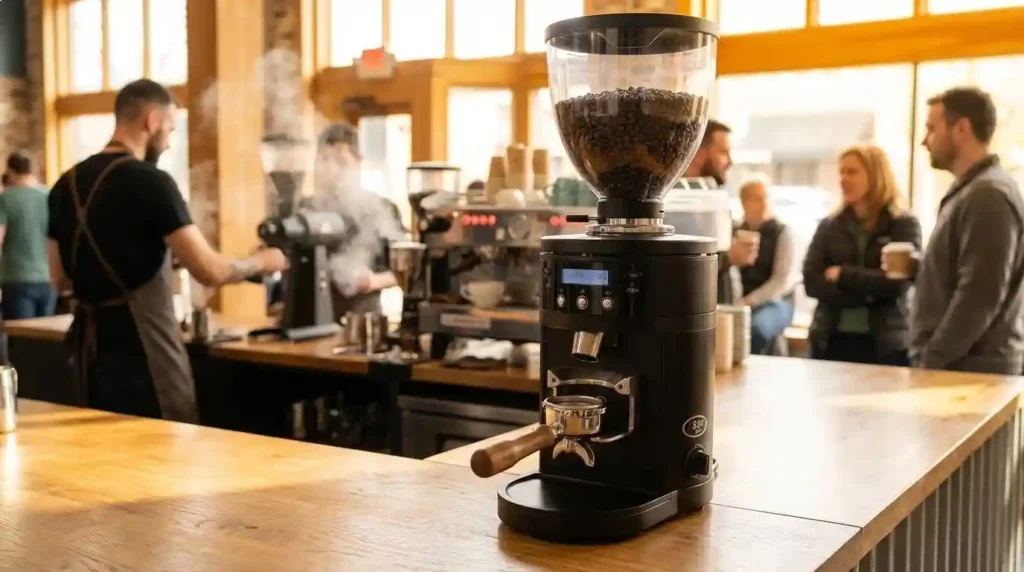
The E80W GbS is the best commercial espresso grinder here for bars where the rush is the business. It trades the E65W’s narrower body and lower price for 80 mm burrs, higher output, a larger hopper, and more thermal headroom. That only creates value when your queue, menu, and staffing can use it.
Mahlkönig’s E80W technical data lists 80 mm cast-steel burrs, about 7-8 g/s at 60 Hz, a 1.8 kg hopper, active temperature control, and a median burr-life estimate around 2,500 kg. The observed U.S. list price was $4,199, with a temporary sale price lower during research; budget from list, not promotion.
- Buy it if: you have a high-volume bar, concentrated rushes, multi-station recipes, or labor savings that justify Sync and GbW.
- Skip it if: you serve modest volume, change coffees constantly in a way that causes purge waste, or cannot support the electronics locally.
- Verify before purchase: counter height, 120 V load, firmware/update process, compatible equipment, and backup grinder capacity.
4. Fiorenzato F83 E PRO Sense — best 83 mm value
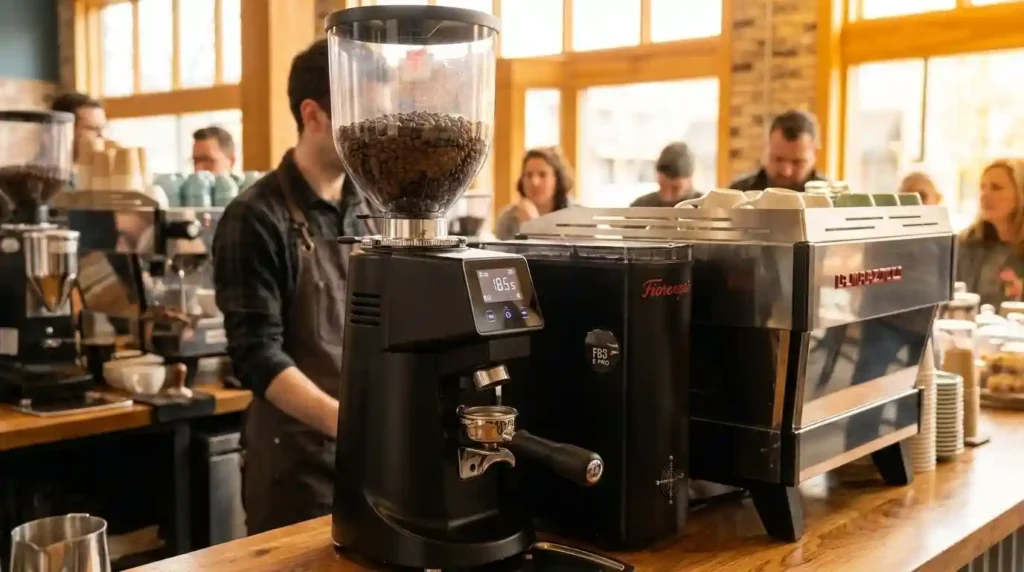
The F83 E PRO Sense gives high-volume buyers a large-burr, weight-based platform at a published price close to the smaller E65W. It is the best commercial espresso grinder for operators who prioritize cleaning access and straightforward gravimetric dosing over a connected recipe ecosystem.
Fiorenzato’s official F83 page lists 83 mm flat Dark-T burrs, a 650 W motor, 0.1 g scale precision, 3.1 g/s productivity, and recommended consumption up to 6 kg per day. Fiorenzato USA listed it at $3,095 during research. Note that the stated g/s figure is lower than some smaller competitors; burr size and daily capacity are not synonyms for shot speed.
- Buy it if: you need 83 mm thermal capacity, want a removable PRO chamber, and have dependable Fiorenzato support.
- Skip it if: peak speed is your first requirement or the dealer cannot demonstrate calibration and parts support.
- Verify before purchase: the exact SENSE versus ADAPT variant—these are different systems—and whether the quoted burr coating matches the listing.
5. Victoria Arduino Mythos MYG85 — best for specialty-bar control
The Mythos MYG85 belongs on a commercial espresso grinder shortlist for high-volume specialty cafés that will use its gravimetric workflow, 85 mm platform, and temperature-management system. It is not the automatic answer for every premium bar: its purchase price, service dependence, and operational complexity demand a local dealer relationship.
Victoria Arduino’s current Mythos comparison identifies the MYG85 as the 85 mm gravimetric model with a 1.5 kg hopper. The manufacturer also publishes cleaning and clump-crusher service tutorials, which is useful evidence of maintainability. Because U.S. quotes vary, use a $4,000-$5,500 planning band and request an installed price.
- Buy it if: your café runs a high-volume specialty program, controls recipes tightly, and has trained Mythos service nearby.
- Skip it if: you need the lowest total cost, your team will not maintain the gravimetric system, or a simpler 64-65 mm grinder already covers the rush.
- Verify before purchase: dealer commissioning, Gravitech calibration, burr and clump-crusher stock, warranty labor, and loaner availability.
Honorable mention: Mazzer Robur S for traditional espresso body
The Mazzer Robur S remains a credible high-volume conical option for cafés that prefer fuller-bodied traditional espresso and proven mechanical architecture. Mazzer publishes 71 mm conical burrs, roughly 6 g/s at 60 Hz, dual-fan cooling, and a 1.6 kg hopper. We did not place it in the top five because it lacks native grind-by-weight and U.S. pricing varies widely, but a strong local Mazzer service relationship can outweigh feature comparisons.
What we would not buy for a production café
Do not confuse “commercial-grade,” a large hopper, or an Amazon business listing with a grinder designed for sustained café service. Home single-dose grinders can make excellent espresso; that does not give them the thermal duty cycle, sanitation certification, workflow, warranty, or service network a business needs. That is the intent mismatch behind several broad “best espresso grinder” pages.
If you want the extraction science behind that distinction, read why the grinder matters more than the machine. For business use, add a second question: can the grinder make the next 100 doses consistently and be repaired locally?
Total cost of ownership: the number that changes the winner
The commercial espresso grinder purchase price is only the first line. Model coffee waste from purge and dose error, paid cleaning time, burr replacements, scale calibration, technician travel, downtime, and the cost of a backup grinder. A $500 cheaper unit that wastes 4 g per day or waits two weeks for a board can become the expensive choice.
| Cost input | What to measure | Decision rule |
| Coffee waste | Purge + over-dose grams/day × bean cost | GbW pays when saved coffee and training time recover its premium. |
| Labor | Minutes/day for cleaning, dialing and weighing | Fast chamber access matters only if staff actually use it. |
| Downtime | Gross margin/hour × likely outage hours | Local parts and a loaner can outrank a better spec sheet. |
| Burrs | Manufacturer life estimate + local replacement cost | Treat estimates as planning inputs; taste and shot drift decide replacement. |
| Backup | Second grinder capacity and changeover time | The main grinder is not a business-continuity plan. |
Our verdict
For most quality-focused independent cafés, the Mahlkönig E65W GbS is the best commercial espresso grinder because it balances compact size, fast 65 mm output, grind-by-weight, active cooling, and a current connected platform. The Fiorenzato F64 EVO PRO Sense is the more economical answer when volume is lower and easy cleaning matters. Buy the E80W, F83, or Mythos only when a documented rush, multi-site standard, or specialty program pays for the extra capacity.
Before ordering, make two calls: one to a local technician and one to a café already running the model. If neither can tell you how quickly parts arrive, the spreadsheet is not finished.
Frequently asked questions
The Mahlkönig E65W GbS is the best overall fit for many modern cafés, but the honest answer depends on peak volume, workflow, service coverage, and budget. Low-to-mid-volume shops may get better value from the Fiorenzato F64 EVO PRO Sense, while high-volume bars should compare the E80W GbS, F83 E PRO Sense, and Mythos MYG85.
A 64-65 mm flat-burr grinder is a practical starting point for many low-to-mid-volume cafés. Larger 80-85 mm platforms make more sense when a concentrated rush demands faster output and more thermal headroom. Burr diameter is a capacity clue, not a standalone quality score.
Usually, when several baristas share the grinder, the café has multiple locations, dose variance causes measurable waste, or the recipe must stay standardized. A low-volume owner-operated bar may prefer a simpler timer-based grinder and regular scale checks.
In the U.S. market researched in August 2026, serious grind-by-weight café grinders commonly plan around $2,500-$4,200, while premium specialty systems can exceed that. Include freight, tax, commissioning, burrs, calibration, and service in the budget.
Usually yes. A dedicated decaf grinder prevents constant redialing, reduces cross-contamination, and keeps both coffees ready during a rush. It can be smaller than the main grinder if decaf volume is low, but it still needs commercial duty and local service.
Brush and wipe the exterior and chute daily according to the manufacturer; deep-clean the chamber on the maker’s schedule and your café’s volume. Never introduce water into the burr chamber. Log cleaning, calibration, and burr changes so shot drift has a history.
A used commercial espresso grinder can be excellent value if a technician checks the motor, bearings, burr carrier, adjustment mechanism, electronics, load cell, and parts availability. Price new burrs and any control-board risk before comparing it with a new warranty-backed unit.
No. Oversizing ties up cash, counter space, and electricity and may add purge waste without improving your actual service. The best commercial espresso grinder is the smallest serviceable platform that handles your peak demand with safe headroom.
Share your coffee experience
Have you tried this product? Add a thoughtful review or ask a question.