This Breville Barista Express Impress review answers the question buyers actually ask: does the Impress Puck System justify paying roughly $800 for an all-in-one espresso setup? The short answer is yes for convenience-oriented beginners and medium-to-dark roast drinkers, but no if you want maximum grinder precision, fast back-to-back milk drinks or a highly customizable workflow.
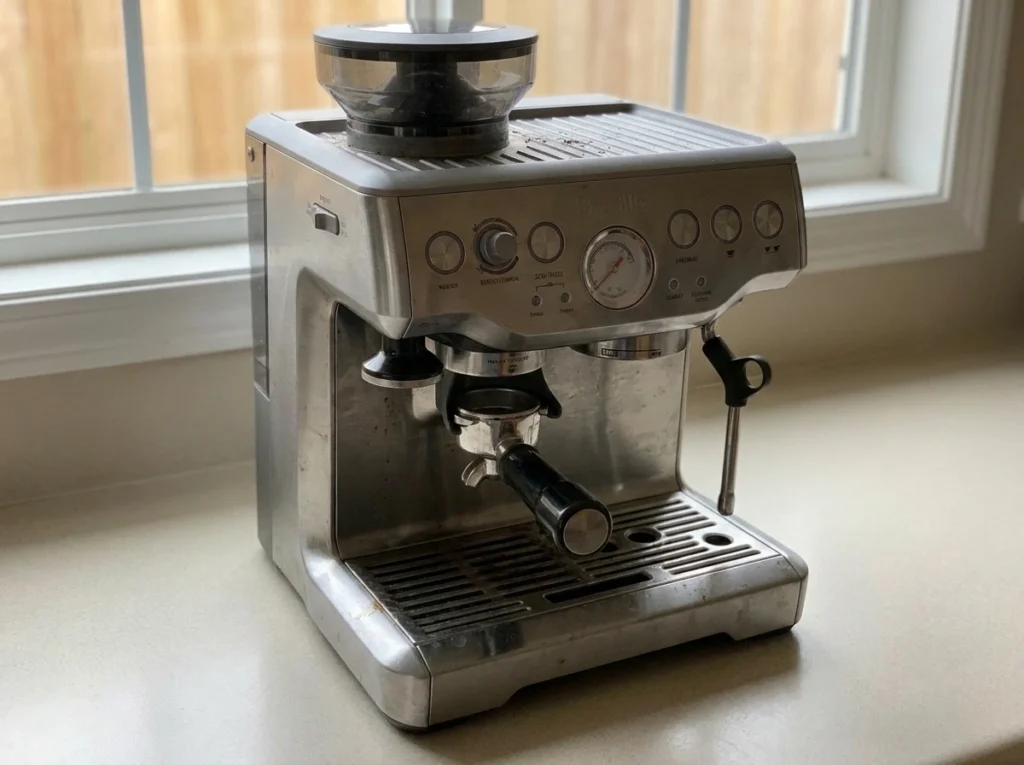
The BES876 combines a built-in conical-burr grinder, assisted tamping, depth-based dose correction, a Thermocoil heating system, PID temperature control, an analog pressure gauge and a manual steam wand. That package reduces the messy parts of learning espresso, but it does not turn a semi-automatic machine into a fully automatic one.
Quick verdict: is the BES876 worth it?
Verdict
Best fit
Main compromise
Buy it
Beginners who want repeatable dosing and a clean integrated workflow.
You pay a premium for convenience and give up some grinder flexibility.
Consider alternatives
Light-roast purists, frequent bean-switchers and high-volume milk-drink households.
A separate grinder or dual-heating machine may deliver better control.
Value rating
Strong when the workflow matters more than ultimate cup optimization.
Breville listed the BES876 at $799.95 when checked on September 20, 2026. Retailer promotions change frequently.
My bottom line: it is a smart “bridge” machine. It removes inconsistent hand tamping and dose guesswork while preserving enough manual control to teach espresso. It is not the best value for a buyer who will immediately replace the integrated grinder or wants to make four lattes without waiting. That is the central verdict of this assessment.
Advertisement
What is the Breville Barista Express Impress?
The Barista Express Impress is Breville’s assisted semi-automatic platform, identified in the United States as BES876. Its central feature is the Impress Puck System: the grinder doses into the portafilter, the user pulls an assisted tamp lever, and the machine adjusts the next dose based on the tamped puck’s depth. The purpose is consistency, not laboratory-accurate gram dosing.
The supplied research describes a spring-assisted tamp of about 22 pounds with a finishing twist of roughly 7 degrees. Those details explain why the puck looks more polished and why beginners tend to see fewer uneven-tamp problems. They should still be treated as manufacturer/secondary-source specifications, not a substitute for original measurement.
That distinction matters here: the feature is useful because it removes a common failure point, not because it makes every coffee identical.
Specifications that matter in daily use
Specification
BES876 detail
Why it matters
Portafilter
54 mm stainless steel
Accessory ecosystem is smaller than 58 mm commercial formats.
Grinder
Integrated conical burr; 25 macro settings plus upper-burr adjustment
Convenient, but less granular than a dedicated espresso grinder.
Dosing
Intelligent depth-based correction
Learns the next dose after tamping; bean changes require recalibration.
Heating
Thermocoil with PID control
Adequate for normal home shots; sequential brew-to-steam workflow.
Water / beans
2 L tank; 250 g hopper
Good for several drinks, but retention matters when changing beans.
Milk
Manual steam wand
You control air, vortex and temperature; there is no automatic texturing.
Included tools
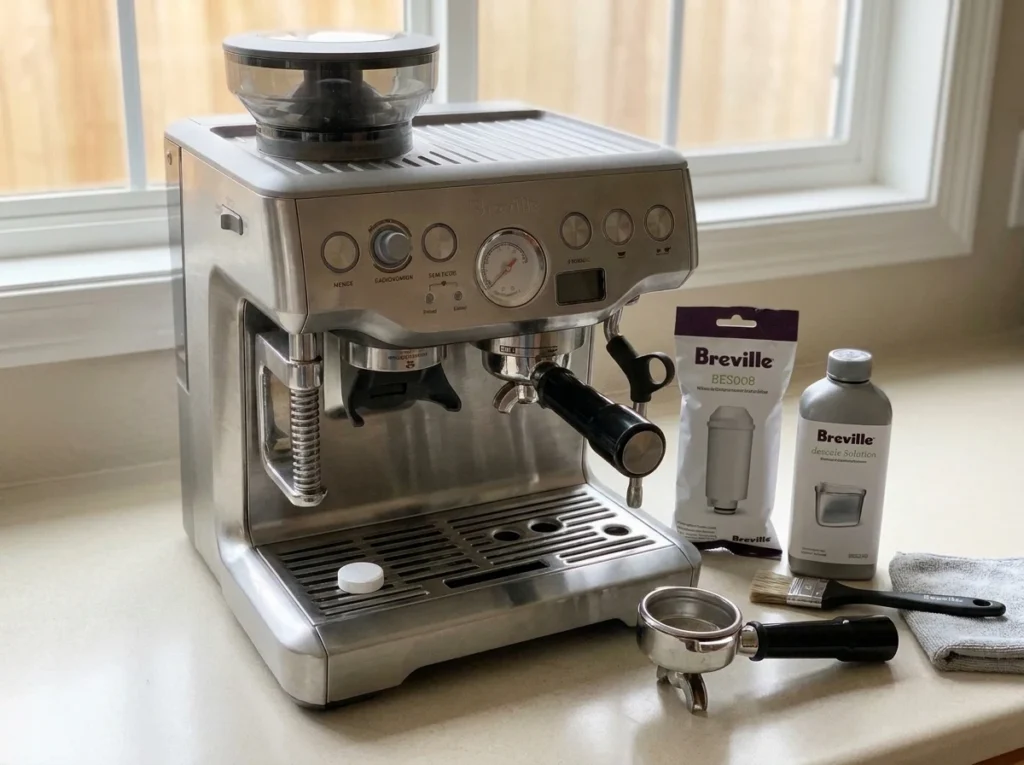
Razor tool, jug, cleaning supplies and water filter
Every step in this guide is written for the Breville Barista Express Impress
(model BES876). It pairs a built-in conical burr grinder with the Impress
puck system, so you grind, dose, and tamp in one place — the exact machine
our maintenance guides are based on.
Some links below are affiliate links. As an Amazon Associate, we earn from
qualifying purchases at no additional cost to you.
An all-in-one espresso machine with an integrated conical burr grinder
and assisted tamping, so you go from whole beans to a balanced shot
without a separate grinder. The brushed stainless steel finish wipes
clean and suits most kitchens.
Look for: model BES876 (Impress), integrated conical burr grinder,
54 mm portafilter, PID temperature control, and a steam wand for milk.
Fresh whole beans
The built-in grinder is the whole point — grind on demand from whole
beans for the best flavor and a consistent dose.
Milk jug (steaming pitcher)
A stainless pitcher makes it far easier to texture proper microfoam with
the steam wand.
Filtered water
Filling the tank with filtered water reduces scale build-up, so you
descale less often.
Skip pre-ground coffee. It defeats the built-in grinder and goes stale
quickly — whole beans, ground fresh, are what make this machine worth it.
1. Impress Puck System: does assisted tamping actually help?
The assisted-tamping system should be most valuable to beginners because it standardizes tamping force and gives visible dose feedback. Manual espresso fails most often because the dose varies, the puck is uneven, or the user changes several variables at once. The Impress workflow gives a tactile endpoint: pull the lever, watch the dose indicator, and repeat until the reading is in range. The finishing twist smooths the puck surface without requiring a separate distribution ritual.
The limitation is that depth is not weight. Coffee density changes with roast level, bean age and grind, so the same puck height can contain a different mass. The machine adjusts the next automatic dose after evaluating the previous tamped dose. Bean changes may therefore require more than one dosing cycle before the workflow stabilizes.
2. Grinder quality, retention and light-roast limits
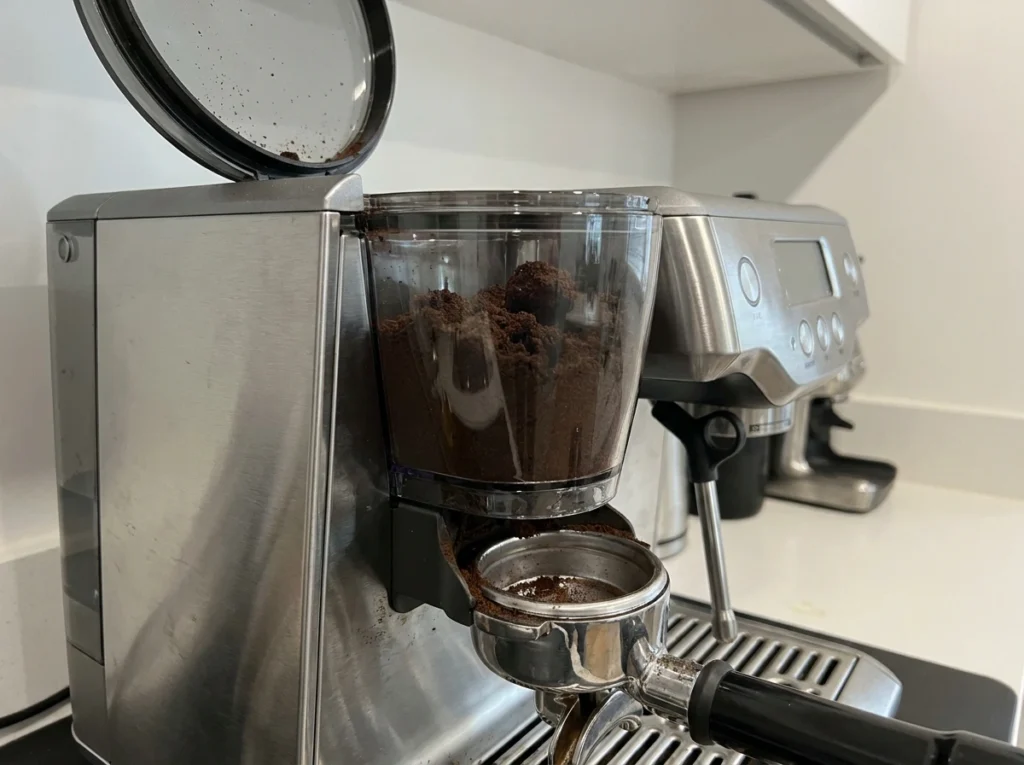
The integrated grinder is the machine’s biggest convenience and its clearest ceiling. Twenty-five macro settings are enough to dial in many medium and dark roasts, and the upper burr offers further adjustment. The trade-off is retention: when old grounds remain in the chute, the next dose is not a clean representation of the new beans. Purge after a bean change and expect a short recalibration period.
Independent testers have found that the built-in grinder can be less forgiving with demanding light roasts. Buyers who primarily use light-roasted specialty coffee may prefer a machine paired with a more adjustable standalone grinder. See the Wired hands-on review for an independent perspective.
For this assessment, grinder flexibility is therefore a bigger buying question than the headline number of grind settings.
With a fresh medium roast, the BES876 has the feedback beginners need: a visible pressure gauge, programmable 1- and 2-cup buttons, and enough manual control to adjust grind, dose and yield. A practical starting point is an 18 g double dose and a 1:2 beverage ratio, then adjust by taste and flow rather than chasing one gauge position.
Independent testers report that the BES876 can produce balanced, full-bodied espresso when properly dialed in with suitable beans. See the Wired hands-on review for an independent workflow and grinder perspective. It is less forgiving when a user changes dose and grind together, or when retained grounds blur the next shot. The correct conclusion is not “perfect espresso at one button press”; it is “a shorter path to repeatable espresso for a beginner who follows the workflow.”
That is the espresso-quality trade-off at the center of the buying decision.
4. Milk steaming and workflow speed
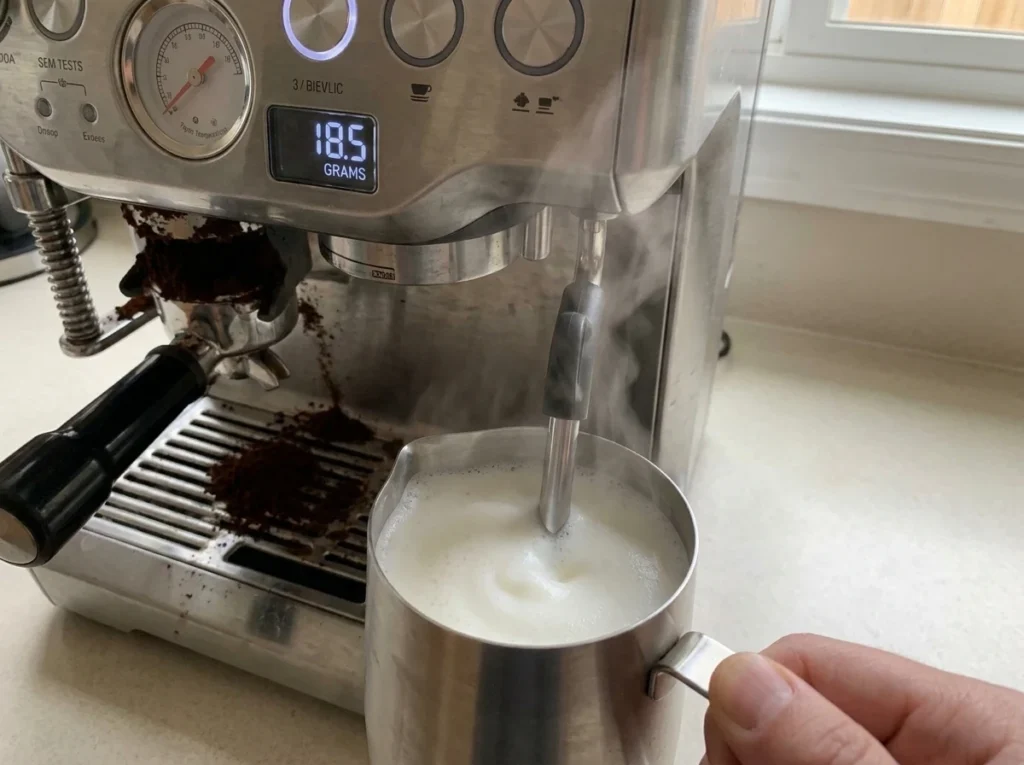
The manual steam wand can create good microfoam, but it asks you to learn the basics: purge condensation, introduce a small amount of air near the surface, then create a rolling vortex. There is no automatic milk program. That is a benefit for users who want control and a drawback for anyone expecting the convenience of the Barista Touch Impress or Ninja Luxe Cafe.
A fair evaluation must count that manual steaming time as part of the ownership experience.
The sequential brewing and steaming workflow is practical for a small number of drinks, but larger batches will take longer than on a machine designed for simultaneous brewing and steaming.
5. Cleaning, maintenance and reliability
Integrated machines reward consistent maintenance. Clean the wand after every milk drink, keep the hopper dry, empty the drip tray, replace the water filter as directed, and use the dedicated cleaning and descale cycles. Scale is not just cosmetic: restricted water paths can affect flow, valves and temperature behavior over time.
6. Three-year ownership cost: what the $800 really buys
Cost item
Assumption
1-year estimate
3-year estimate
Machine at listed price
Price checked September 20, 2026
$799.95
$799.95
Water filters
4 filters/year at about $17 each
$68
$204
Cleaning tablets
One 8-tablet pack at about $15/year
$15
$45
Descaler
About 2–4 cycles/year; rounded midpoint
$10
$30
Optional scale and knock box
One-time setup estimate
$65
$65
Estimated total range
Taxes, coffee, electricity and repairs excluded
$950–$1,050
$1,200–$1,350
Accessory prices are estimates checked in September 2026 and will vary by retailer, package size and replacement frequency. The three-year ownership figure is an estimate, not a guaranteed cost.
The integrated grinder and assisted tamping replace some separate purchases, but the value is workflow consolidation, not zero maintenance. The rounded three-year estimate is approximately $1,200–$1,350, excluding coffee, electricity and repairs. If you already own a capable grinder, the premium is harder to justify. If you are starting from nothing and want one coordinated footprint, the equation is more favorable. In other words, this assessment treats price as a workflow question, not a specification contest.
That makes this guide most useful to buyers comparing a complete setup rather than a machine alone.
7. Barista Express Impress vs. the alternatives
Alternative
Choose it when…
Trade-off versus BES876
Original Barista Express (BES870)
You want lower cost and a more manual learning path.
No assisted tamping; more puck-prep variability.
Breville Barista Touch Impress
You want touchscreen guidance and automated milk texturing.
Much higher price.
Ninja Luxe Cafe Premier
You prioritize weight-based dosing and hands-free milk options.
Different workflow and less traditional manual control.
Bambino Plus + standalone grinder
You prioritize grinder quality and fast milk drinks.
More counter clutter and two products to manage.
DeLonghi La Specialista Opera
You want smart tamping, 15 grind settings, cold-drink options and a different integrated workflow.
Different control layout and ecosystem.
The internal comparison hub, best espresso machines for 2026, is useful if the trade-offs above matter more than the Impress’s assisted tamping. It also gives readers a wider price context.
Who should buy the Breville Barista Express Impress?
Beginners who want a guided route into real espresso without a fully automatic machine.
Mess-averse users who value integrated grinding and tamping.
Medium- and dark-roast drinkers making one to four drinks at a time.
Buyers who want a pressure gauge and manual steam control in one footprint.
Who should avoid it?
Light-roast specialists who need very fine grinder increments.
Frequent bean-switchers who dislike purge and recalibration waste.
High-volume hosts who need rapid brew-and-steam recovery.
Experienced users who already own a precision grinder and want full manual puck access.
Frequently Asked Questions
Is the Breville Barista Express Impress worth it?
It is worth it for beginners who value a clean, repeatable integrated workflow. It is less compelling if you already own a strong grinder or mostly brew light roasts.
Is the BES876 good for beginners?
Yes. Assisted tamping, dose feedback and the pressure gauge shorten the learning curve, but users still need to learn grind, yield and milk texturing.
Does the Barista Express Impress weigh coffee?
No. Its dosing correction is based on puck depth, so bean density and retained grounds can change the actual mass.
Can it make café-quality espresso?
It can produce excellent home espresso with suitable beans and dialing-in, but no machine can remove the need for fresh coffee and consistent technique.
Is the grinder good enough for light roast coffee?
It can work, but the wider step size and retention make dense light roasts harder to dial in than with a dedicated grinder.
How often does it need cleaning?
Purge and wipe the wand after every milk drink, empty the tray regularly, and follow the BES876 cleaning and descale alerts.
Does it have automatic milk frothing?
No. The manual steam wand requires you to create the air and vortex yourself.
Conclusion: a smart convenience machine with real limits
This guide lands on a qualified recommendation. The BES876 makes the messy, inconsistent parts of beginner espresso easier without hiding the craft completely. Its best audience wants an attractive all-in-one machine, drinks mostly medium or dark roasts, and makes a modest number of milk drinks. If your priority is light-roast precision, rapid entertaining or long-term modular upgrades, spend the same budget on a simpler machine and a better standalone grinder. The recommendation is positive, but deliberately conditional.
Wired hands-on review — used for independent workflow and grinder observations.Serious Eats testing — used for independent dose, temperature and repeated-use observations.


One Response