
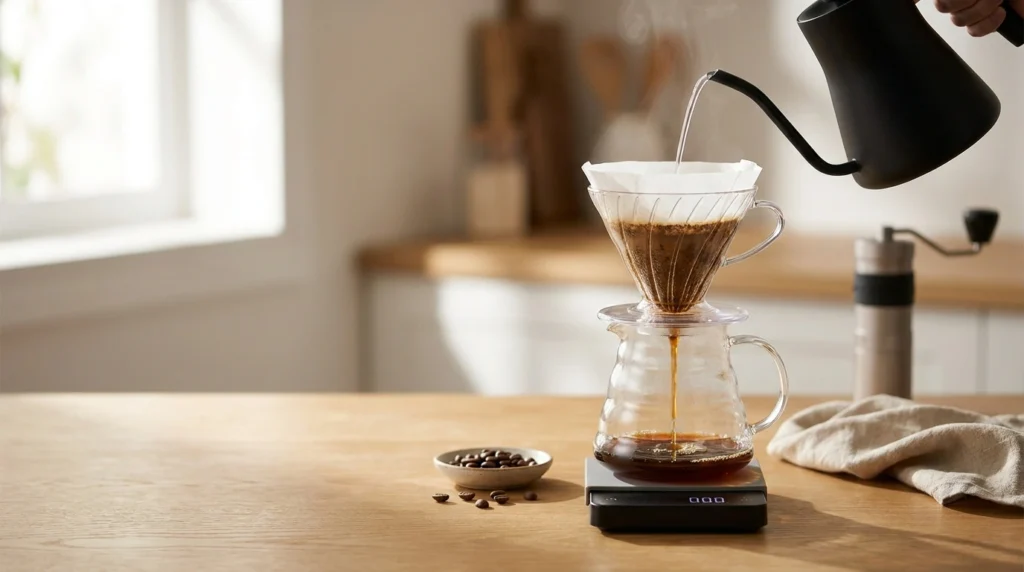
This Hario Switch recipe uses 15 grams of coffee, 240 grams of water, and a hybrid sequence that combines a bright pour-over opening with a forgiving immersion finish. It is designed to produce a sweet, clear cup in about four minutes—not to pretend that one recipe works perfectly for every coffee. The Switch is built for both jobs: Hario describes the brewer as a V60-style dripper that can work as either pour-over or immersion.
| QUICK ANSWER Start at 1:16: 15 g coffee to 240 g water. Use a medium-fine grind and 94°C / 201°F water. Brew with the valve open for the first 150 g, close it for the final 90 g, then release at 2:30. Aim to finish between 3:30 and 4:00. |
Hario Switch recipe at a glance
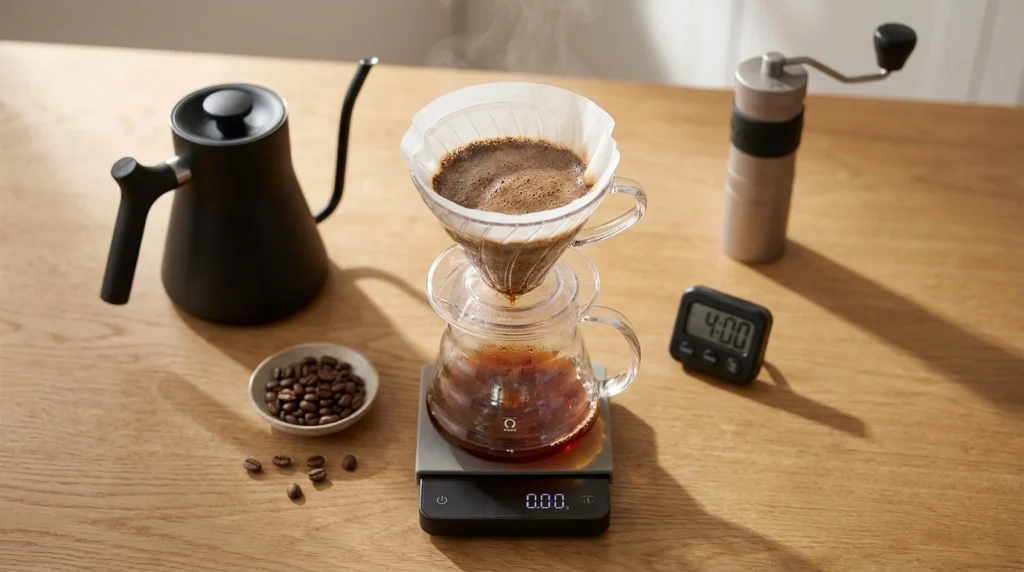
| Variable | Starting point | Why it works |
| Coffee | 15 g | A practical single-cup dose |
| Water | 240 g | A balanced 1:16 ratio |
| Grind | Medium-fine | Finer than French press; a little coarser than many V60 recipes |
| Temperature | 94°C / 201°F | A flexible start for light-to-medium roasts |
| Valve | Open → closed → open | Clarity first, then forgiving immersion |
| Total time | 3:30–4:00 | A diagnostic window, not a score to chase |
Weighing coffee and water makes this Hario Switch ratio repeatable. If you are new to brew ratios, the same logic is explained in this coffee-to-water ratio guide; the grind and steep differ, but the math does not.
What you need
- Hario Switch 02 or 03 and the matching V60 paper filter
- Fresh whole-bean coffee; light or medium roast is the easiest starting point
- A burr grinder, digital scale, timer, kettle, and serving vessel
- Filtered water that tastes clean on its own
Grind uniformity matters because excess fines can slow the drawdown and add dryness. If your current grinder produces a lot of dust, compare the filter-friendly options in our manual coffee grinder guide.
How to make Hario Switch coffee
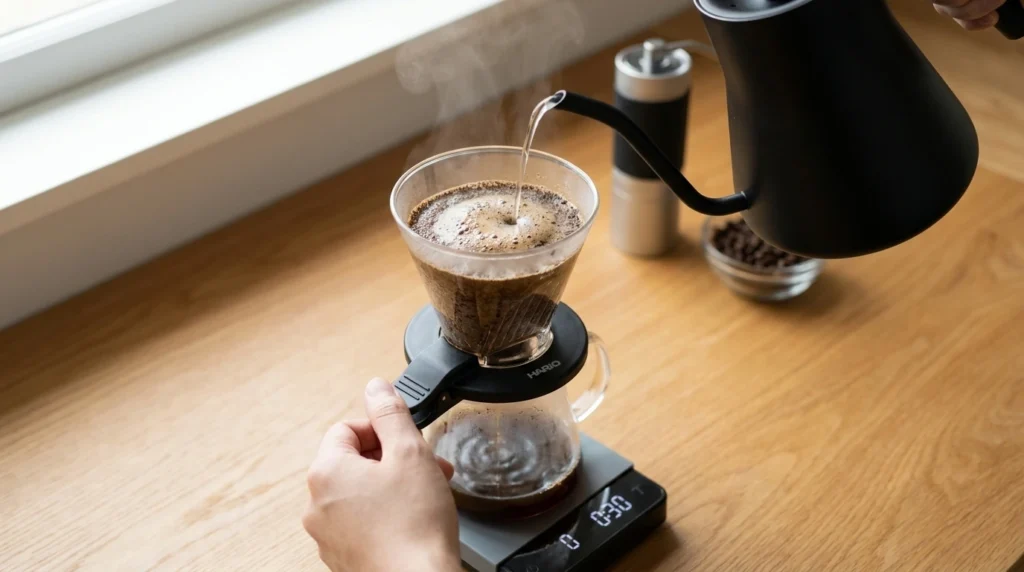
- Heat the water to 94°C / 201°F. Fold and place the paper filter, rinse it thoroughly, and preheat the glass cone and server. Drain the rinse water.
- Open the valve. Add 15 g of medium-fine coffee and gently level the bed.
- At 0:00, pour 45 g of water. Wet every ground, then give the brewer one gentle swirl. Let the coffee bloom until 0:45.
- With the valve still open, pour steadily to 150 g by about 1:05. Keep the stream controlled and avoid aggressively churning the bed.
- At 1:15, close the valve. Pour to 240 g by about 1:35. Give one small swirl only if dry grounds remain on the wall.
- At 2:30, open the valve and let the brewer drain. Swirl the finished coffee in the server, then taste it after it cools slightly.
| DO NOT CHASE THE CLOCK A tasty 3:20 brew beats a dry 4:00 brew. Use total time to notice a major change—especially a stalled drawdown—but make taste the final decision. |
Why this hybrid sequence works
With the valve open, fresh water moves through the coffee bed and emphasizes the clarity people associate with a V60. Closing the valve for the final pour gives the remaining water time to contact the grounds more evenly, reducing the precision demanded by an all-percolation technique. The paper filter keeps the cup cleaner than a metal-filter immersion brewer.
The recipe is a moderate baseline rather than a competition routine. As a reference point, Hario Europe publishes Ole Kristian Bøen’s Switch recipe at 16.5 g coffee to 240 g water, with closed, open, and closed phases. Partners Coffee uses a 15 g to 240 g hybrid recipe with a release at 2:30, while Foundry Coffee’s 18 g / 300 g Switch guide moves from an open first half to a closed second half. Those established methods support the structure here, while this guide keeps the pour pattern intentionally simple.
How to dial in by taste
Brew the baseline once, let the cup cool enough to taste clearly, and change only one variable on the next brew. Grind size is usually the best first adjustment because it changes extraction and flow without rewriting the entire method.
| What you taste | Likely direction | Change next |
| Sour, sharp, salty, or hollow | Under-extracted | Grind one or two small steps finer. If still sour, raise temperature 2°C. |
| Bitter, drying, rough, or papery | Too much extraction or agitation | Grind slightly coarser. Use one gentle swirl and no stirring. |
| Sweet but weak | Strength is low | Use 16 g coffee with 240 g water before grinding much finer. |
| Heavy or muddy | Too many fines or too much immersion | Grind coarser, agitate less, or release 15–20 seconds earlier. |
| Drawdown stalls | Fines migrated into the filter | Grind coarser and reduce swirling; check grinder cleanliness and filter seating. |
| Fast but thin | Grind too coarse or dose too low | Grind finer first; keep the ratio unchanged. |
Light roasts are denser and often need more extraction energy. Our light roast coffee brewing guide explains why a finer grind or hotter water can help. For darker coffee, begin around 88–92°C / 190–198°F and move coarser if the cup tastes smoky or dry.
Five mistakes that make the recipe harder to repeat
1. Changing several variables at once
If you grind finer, raise the temperature, extend immersion, and add more coffee in the same test, a better cup teaches you nothing about which change helped. Keep the Hario Switch recipe fixed and move one control at a time. Grind is the usual first choice; temperature is next; ratio is primarily a strength control.
2. Using aggressive agitation to force extraction
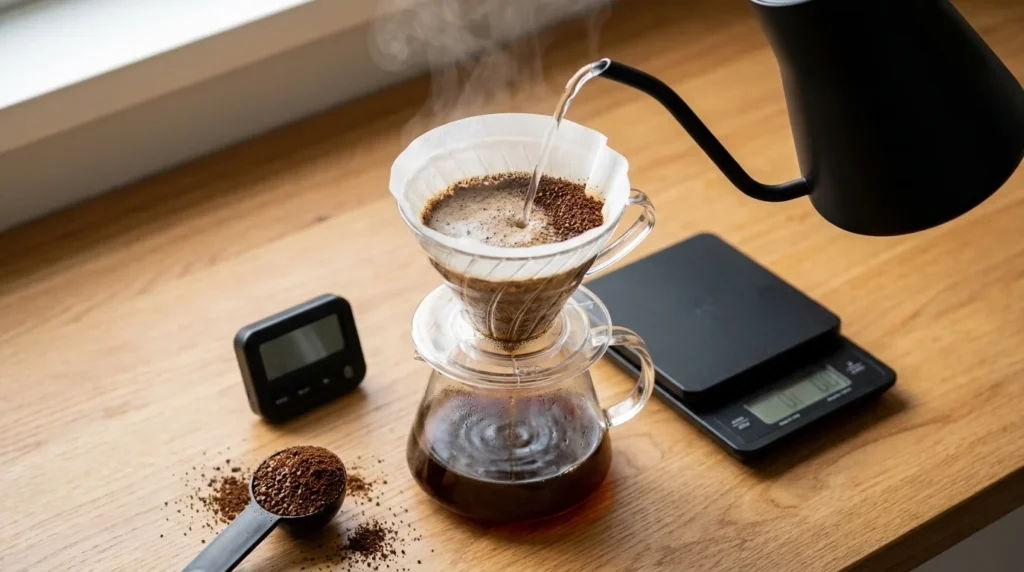
Stirring and swirling move fine particles toward the filter. That can slow the drawdown and create a dry finish even when the total brew time looks reasonable. Scott Rao’s discussion of agitation and filter clogging is useful as a general filter-brew principle, although it covers the Hoop brewer rather than a Hario Switch recipe. One small bloom swirl and, if needed, one small swirl after the final pour are enough. More movement is a deliberate experiment, not a free improvement.
3. Treating grinder settings as universal
A click number is useful only on the same grinder, with the same burr calibration. Even two units of one model can differ. Describe the starting texture as medium-fine, record your own setting, and let taste plus drawdown guide the next move. Avoid copying an online setting without checking which grinder and zero point were used.
4. Ignoring heat lost to the glass
The glass cone can absorb heat from the slurry, especially in a cold kitchen. Rinsing the filter with hot water also preheats the brewer and server. If a light roast stays sour despite a reasonable grind, preheat consistently before raising the kettle temperature. Consistency matters more than chasing an exact slurry temperature without measuring it.
5. Diagnosing the cup while it is too hot
Very hot coffee hides sweetness and makes bitterness difficult to separate from heat. Swirl the server, pour, and taste at several temperatures. Write one short note when hot and another after a few minutes. A cup that seems sharp at first may become lively and sweet; a finish that grows drying as it cools is a stronger signal to grind coarser or reduce agitation.
| SIMPLE BREW LOG Coffee and roast date • dose and water • grinder setting • water temperature • valve release • finish time • taste when warm and cool |
Choose the method that matches your goal
Option 1: Full immersion for maximum consistency
Close the valve, add 15 g coffee, pour 240 g water, and give one gentle stir to wet the grounds. Steep until 2:30, open the valve, and let it drain. Start with a medium grind. This is the easiest Hario Switch recipe when you value repeatability more than maximum clarity.
Full immersion will feel familiar if you already know how to use a French press, but the Switch’s paper filter produces a cleaner cup and the draining phase makes grind size more important.
Option 2: Hybrid for clarity and sweetness
Use the main 15 g / 240 g method in this guide. It is the best starting point for most light-to-medium roasts because the open phase preserves separation while the closed phase makes the final extraction less sensitive to pouring technique.
Option 3: Kasuya-style temperature drop
For an advanced variation, Tetsu Kasuya’s Switch method as documented by Comori Coffee uses 20 g coffee and 280 g water. The first 120 g passes through at about 90°C / 194°F; the valve then closes and the final pour uses water cooled to roughly 70°C / 158°F before release at 1:45. Try it when you want a softer finish from a coffee that becomes drying in a conventional recipe. Because it adds a second water temperature, it is an experiment—not the beginner default.
Hario Switch 02 vs 03
The glass Switch is sold in two sizes. Hario USA lists the 02 at a 200 ml finished capacity and the 03 at a 360 ml dripper capacity. The 02 is ideal for this 240 g hybrid recipe because part of the brew drains before the final pour. For larger full-immersion batches, choose the 03 and stay below the manufacturer’s stated capacity rather than relying on informal maximum-fill claims. Always match the paper filter to the cone size.
Scaling the Hario Switch ratio
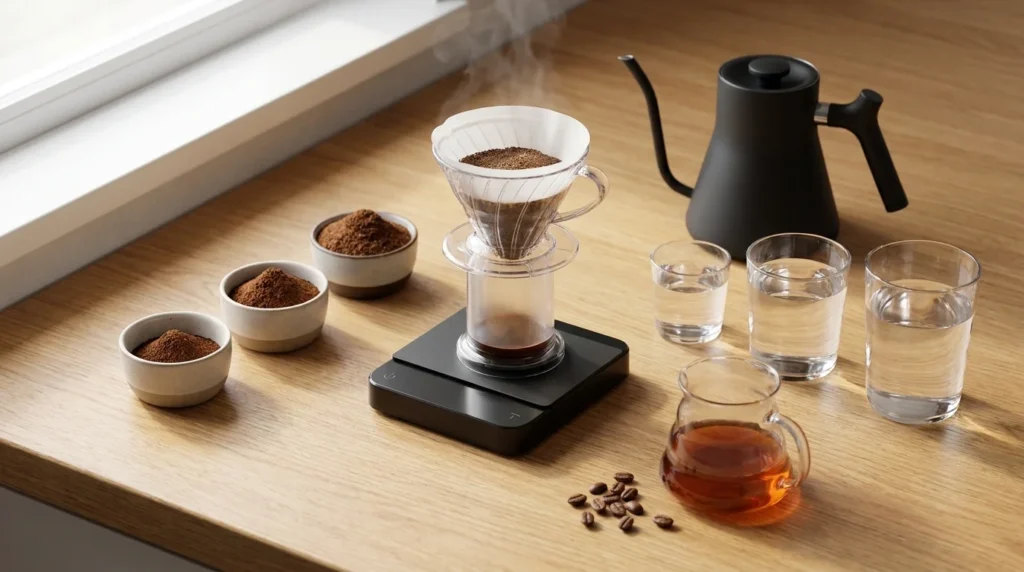
Keep 1:16 as the first test, then adjust the dose to your preferred beverage size. This Hario Switch recipe scales cleanly when coffee and water move together. For hybrid recipes, cone capacity is less restrictive because some liquid drains during the open phase. For full immersion, the entire water dose must fit at once.
| Coffee | Water at 1:16 | Best use |
| 12 g | 192 g | Small cup |
| 15 g | 240 g | Main single-cup recipe |
| 18 g | 288 g | Large mug; easier in 03 for immersion |
| 20 g | 320 g | Large brew; use 03 for full immersion |
| 25 g | 400 g | Use 03 and confirm headroom before pouring |
Water, coffee freshness, and repeatability
A precise Hario Switch recipe cannot rescue unpleasant water or stale beans. Use water you enjoy drinking, weigh rather than scoop, and grind immediately before brewing. Record coffee dose, water dose, grind setting, temperature, release time, finish time, and one sentence about taste.
If you switch between bags frequently, keep them away from heat, light, moisture, and repeated air exposure. The practical storage principles in our coffee bean freshness guidance apply to filter coffee too, even though this Hario Switch brew guide uses a different extraction method.
Cleaning the Hario Switch
After brewing, discard the paper and rinse the cone, silicone base, switch, and stainless-steel ball with warm water. Coffee oils and fine particles can collect around the ball and channel. Separate removable parts periodically and wash with a gentle, neutral detergent, then rinse thoroughly and air-dry. Follow the manual for your exact model; material and dishwasher guidance can differ between glass, ceramic, Mugen, and replacement-base versions.
General coffee equipment also benefits from cleaning oils separately from mineral scale. Our coffee maker cleaning guide explains that distinction, but use Hario’s model-specific instructions for the Switch parts.
Frequently asked questions
Start at 1:16—15 g coffee to 240 g water. Use 1:15 for a stronger cup or 1:17 for a lighter one, but change only the dose or water amount before altering the rest of the recipe.
Start medium-fine for a hybrid recipe and medium for full immersion. Grind finer if the cup is sour and the drawdown is fast; grind coarser if it tastes dry or the filter stalls.
Begin around 94°C / 201°F for light-to-medium roasts. Very light coffee may improve closer to boiling. Darker roasts often taste smoother around 88–92°C / 190–198°F.
Yes. Leave the valve open and brew through it like a V60. Hario markets the Switch as a hybrid that supports both pour-over and immersion brewing.
Choose 02 for single cups and hybrid recipes around 240 g. Choose 03 when you want more headroom or larger full-immersion brews.
A slow drawdown usually points to excessive fines, a grind that is too fine, strong swirling or stirring, or a filter that is poorly seated. Grind coarser and reduce agitation before changing the recipe timing.
Not always. A bloom helps release gas from very fresh coffee and is useful in the hybrid method. In a full-immersion recipe, you can pour all the water at once as long as every ground becomes wet.
No. Competition methods are designed around a specific coffee, water, grinder, and flavor goal. Treat them as useful experiments and keep a simple baseline for daily brewing.
The bottom line
The most useful Hario Switch recipe is the one you can repeat and diagnose. Begin with 15 g coffee, 240 g water, 94°C / 201°F water, and the open–closed–open hybrid sequence. Taste the cooled cup, change one variable, and write down the result. Use full immersion when simplicity matters, the hybrid method when you want a clean but forgiving cup, and advanced recipes only when they solve a specific taste problem.
| NEXT BREW Keep the recipe fixed and move the grinder by one small step. That single comparison will teach you more than changing grind, temperature, ratio, and timing together. |
Share your coffee experience
Have you tried this product? Add a thoughtful review or ask a question.