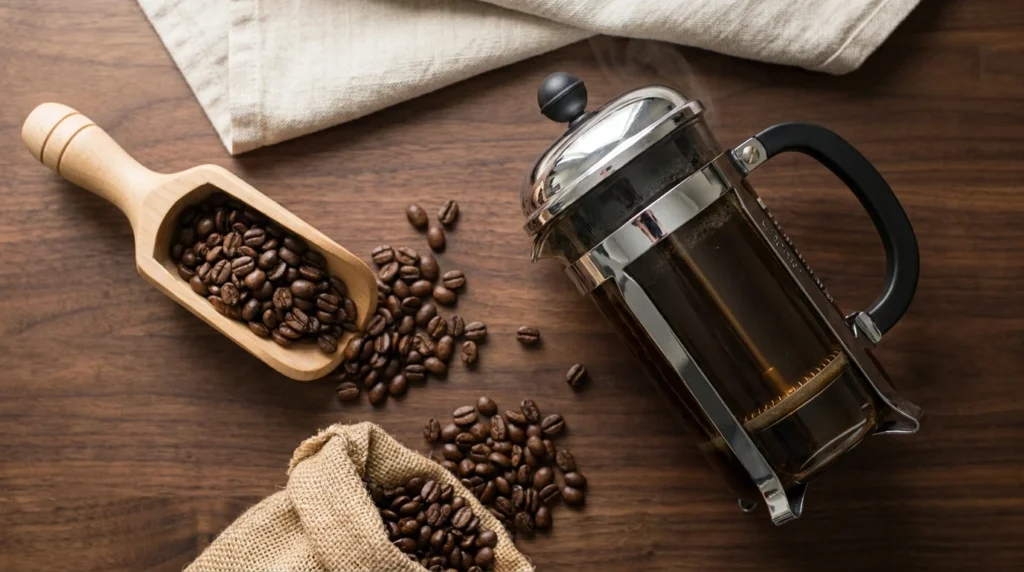
The best coffee beans for French press are medium to dark roasts with full body — Brazilian, Sumatran, Colombian, Guatemalan, and natural-process Ethiopian beans lead the pack. French press is an immersion brew method with a metal filter, which means the grounds sit in hot water for a full four minutes and the coffee’s oils and fine particles pass straight into your cup. That brewing style amplifies body and sweetness, but it also amplifies anything harsh, grassy, or over-acidic in the bean.
Pick the wrong beans — washed light roasts, stale grocery store blends, or anything past the three-week post-roast window — and French press will make those flaws more obvious, not less. Pick the right beans and French press will reward you with one of the most full-bodied, sweetest cups you can brew at home.
This guide walks through the eight best coffee beans for French press right now, organized by goal (best overall, best dark roast, best budget, etc.), plus the origin-and-roast framework you need to pick beans from anywhere in the world with confidence. And a section on what NOT to buy, because that’s where most French press brewers quietly sabotage themselves.
Quick Answer: Top Picks at a Glance
| Best For | Our Pick | Roast / Origin |
| Best overall | Stumptown Hair Bender | Medium-dark blend |
| Best dark roast | Kicking Horse Kick Ass | Dark roast, Indonesia + Latin America |
| Best medium roast | Volcanica Costa Rica Peaberry | Medium, single-origin Costa Rica |
| Best for full body | Peet’s Major Dickason’s Blend | Dark, Sumatra-forward blend |
| Best light roast | Volcanica Ethiopian Yirgacheffe | Light-medium, natural process |
| Best supermarket pick | Lavazza Super Crema | Medium, Arabica + Robusta |
| Best organic | Kicking Horse Three Sisters | Medium, USDA Organic |
| Best budget | Peet’s Major Dickason’s | Dark, widely available |
All picks are whole-bean, specialty or premium grade, and widely available in the US (most also ship internationally). Prices shift; check current pricing before ordering.
What Makes a Coffee Bean “Best” for French Press
French press is an unforgiving brew method. It’s also one of the most forgiving — it sounds contradictory, but it makes sense once you understand what the immersion-and-metal-filter combination actually does to coffee.
Immersion brewing amplifies body and sweetness
A French press steeps grounds in water for about four minutes with zero flow-through. Every particle of coffee is fully wetted the entire time, which extracts more of the coffee’s soluble solids and oils than any paper-filter method. The result: a fuller, heavier, sweeter cup — provided the beans you start with can hold up to that treatment.
The metal filter lets oils through
Unlike a pour over or drip machine, a French press uses a metal mesh filter, not paper. Paper filters trap a significant portion of coffee’s natural oils and some of its finest particles. A metal filter lets them all through. This is what gives French press coffee its famous heavy, silky mouthfeel — and it’s also why bean choice matters more here than with any other method.
What to look for, specifically
- 100% Arabica, specialty-grade beans (Arabica-Robusta blends work for bolder profiles)
- Medium to medium-dark roast for the safest bet
- A roast date on the bag — ideally within the last 2–3 weeks
- Whole beans, not pre-ground, if you own a grinder
- Origins with full body: Brazil, Sumatra, Colombia, Guatemala, natural Ethiopia
If you don’t have a grinder yet, see our best manual coffee grinders for 2026 a $100 hand grinder will improve every bean on this list.
The 8 Best Coffee Beans for French Press in 2026
1. Stumptown Hair Bender — Best Overall
Stumptown’s Hair Bender is a medium-dark blend that lands in the sweet spot for French press: it has the body to survive four minutes of immersion without thinning out, enough roast depth to push sweet chocolate and caramel notes forward, and enough bean quality to resist the bitterness that darker roasts often develop in a press. Stumptown blends beans from Latin America, East Africa, and Indonesia, which gives Hair Bender a layered complexity most single-origin coffees can’t match at this brew method.
Why it works: The Indonesian component gives it syrupy body; the Latin American beans add clarity; the East African beans contribute a hint of fruit that survives the immersion. Rare to find in one bag.
2. Kicking Horse Kick Ass — Best Dark Roast
Kicking Horse Kick Ass is exactly what French press darkness should taste like: bold, full-bodied, chocolatey, without the burnt-toast bitterness cheap dark roasts produce. The blend uses Indonesian beans for body and Central/South American beans for a subtle brightness underneath. It’s USDA Organic and Fair Trade certified, which matters at this roast level because lower-quality dark roasts often hide origin defects behind roast character.
Why it works: Indonesian base gives it the heavy body French press demands; the organic certification is a genuine quality signal at the dark-roast end of the market. Consistently one of the highest-rated dark roasts on specialty review sites.
3. Volcanica Costa Rica Peaberry — Best Medium Roast
Peaberry beans are genetic anomalies — instead of two flat-sided coffee beans per cherry, the cherry produces one round bean, which roasts more evenly and often develops more concentrated flavor. Volcanica’s Costa Rica Peaberry is a clean, balanced medium roast with caramel sweetness, mild citrus acidity, and enough body to hold up in a French press without the heaviness of a darker Sumatran.
Why it works: Medium roasts often fail in French press because they lack body, but Costa Rican peaberry beans are naturally denser and hold up to immersion better than most medium-roast beans at the same roast level.
4. Peet’s Major Dickason’s Blend — Best Full-Body / Best Budget
Major Dickason’s has been Peet’s flagship for decades and remains one of the best supermarket-available French press coffees. It’s a dark roast dominated by Sumatran beans, which is exactly what you want for maximum body. It’s widely available (Walmart, Costco, Target, Amazon), comes in coarse-ground bags if you don’t have a grinder, and typically sells for under $15 a bag.
Why it works: Sumatra-forward blends are the classic full-body French press pick. What you give up in freshness compared to specialty roasters, you get back in price, availability, and consistency.
5. Volcanica Ethiopian Yirgacheffe — Best Light Roast
Washed light roasts from Ethiopia are generally poor French press choices — they taste thin and grassy after four minutes of immersion. Volcanica’s Ethiopian Yirgacheffe is different because it’s on the darker end of “light roast” and uses heirloom varieties from wild coffee trees, which gives it enough body to survive immersion. The result is a brighter, fruitier French press cup than most buyers expect, with ripe-berry notes that come through without being overpowered.
Why it works: This is the rare light roast that holds up in a press. If you’ve dismissed light roasts in French press before, try this one before giving up on the category entirely.
6. Lavazza Super Crema — Best Supermarket Pick
Lavazza Super Crema is marketed as an espresso blend, but it shines in French press thanks to its Arabica-Robusta mix. Robusta gives it a heavier body and creamier texture than most all-Arabica supermarket coffees, which is exactly what French press needs. It’s medium roast, widely available internationally, and usually cheaper per pound than any specialty roaster.
Why it works: Arabica-Robusta blends are controversial in specialty circles, but for French press specifically, the added body from Robusta is an advantage, not a flaw. Good pick if you want French press quality without hunting down specialty roasters.
7. Kicking Horse Three Sisters — Best Organic
Three Sisters is Kicking Horse’s medium roast organic blend beans from three origins (hence the name) that deliver more balanced complexity than Kick Ass without the dark-roast intensity. It’s USDA Organic and Fair Trade certified, which matters if sourcing ethics are a priority. The flavor leans toward milk chocolate, toasted nut, and mild cherry all profiles that immersion brewing tends to emphasize.
Why it works: The organic certification is genuine here Kicking Horse is one of the few mass-market roasters that treats organic sourcing as a baseline, not a premium add-on.
8. Counter Culture Big Trouble — Best for Pairing with Milk
Counter Culture’s Big Trouble is a medium roast blend designed specifically to pair well with milk and sugar, which makes it an excellent French press pick for anyone who takes their press coffee with cream. Honey, graham cracker, and caramel notes dominate the cup, and the body is full enough to not disappear when you add milk. Not every French press drinker takes it black — this is the best option for the other camp.
Why it works: Most “best French press coffee” lists ignore the milk-and-cream drinker, even though that’s a significant portion of the market. Big Trouble is deliberately blended for that use case.
How to Pick Beans by Origin and Roast
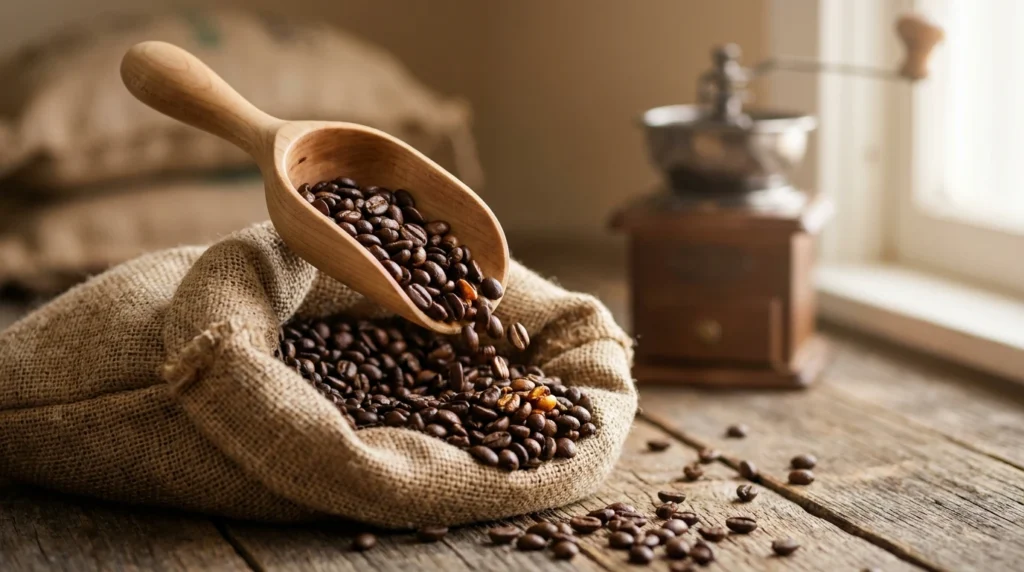
Once you’ve run through this list of specific picks, you’ll want to branch out. Here’s the origin-and-roast framework that tells you what to expect from any bag of French press coffee, wherever it’s from:
| Origin | Flavor Profile | Best Roast for French Press | Body |
| Brazil | Nutty, chocolatey, low-acid, smooth | Medium to medium-dark | Full |
| Sumatra (Indonesia) | Earthy, syrupy, herbal, minimal acidity | Medium-dark to dark | Very full |
| Colombia | Balanced, caramel, mild citrus | Medium | Medium-full |
| Guatemala | Chocolate, toffee, slight smoke | Medium | Medium-full |
| Ethiopia (natural) | Berry, jam-like, wine notes | Medium | Full |
| Ethiopia (washed) | Floral, citrus, tea-like | Avoid in French press | Light |
| Kenya | Bright berry, tomato, high acidity | Avoid in French press | Light-medium |
| Costa Rica | Clean, bright, honey, citrus | Medium | Medium |
Use this as your cheat sheet. Any bag of beans matching “medium to medium-dark roast, Brazilian or Sumatran origin” is almost certainly going to produce great French press coffee, regardless of the brand. The inverse is also true — washed Kenyan light roast will disappoint in a press no matter how hyped the roaster is.
What NOT to Buy for French Press
The fastest way to improve your French press coffee is to stop buying the wrong beans. These categories consistently underperform in immersion brewing no matter how careful you are with technique:
Washed light roasts (especially Kenyan and washed Ethiopian)
These beans are prized for their bright, floral, tea-like qualities in pour over and Chemex. Those same qualities collapse in French press — the four-minute immersion flattens the delicate high notes and the metal filter lets through oils that muddy the brightness. The result tastes thin, grassy, or weirdly astringent. Save these beans for a V60 or Chemex.
Pre-ground coffee not labeled for French press
Standard pre-ground coffee is ground for drip machines — too fine for a French press. Fine grinds slip past the metal filter and over-extract during steeping, producing bitter, gritty coffee. If you must buy pre-ground, specifically look for bags labeled “coarse grind” or “French press grind.”
Anything with no visible roast date
Supermarket coffees often show only a “best by” date, which is typically 12+ months after roasting. Coffee peaks 7–14 days post-roast and degrades rapidly after about four weeks. A bag with no roast date has almost certainly been sitting on a shelf for months, and French press will emphasize the staleness.
Very dark roasts (Italian roast, French roast)
Extended immersion in a French press amplifies bitter and astringent compounds that heavy roasting produces. A medium-dark roast is the upper limit for most palates. True Italian or French roasts turn harsh in a press — they’re better suited to espresso or moka pot, where the brief contact time doesn’t compound the bitterness.
Flavored coffee (unless you truly love it)
Flavored beans are coated in oils and flavoring compounds that linger in a French press and taint the next brew. If you like flavored coffee, keep a second press dedicated to them. But for a quality-focused French press, skip the vanilla caramel Hazelnut blends.
How Fresh Is Fresh Enough?
Freshness matters more for French press than for most other brew methods because the immersion method concentrates and amplifies bean character — including staleness. Here’s the simple hierarchy:
- Peak flavor: 7–14 days post-roast
- Very good: 14–28 days post-roast
- Acceptable: 4–6 weeks post-roast
- Declining rapidly: 6+ weeks
- Essentially stale: any bag with only a “best by” date
Once you open a bag, store it in an airtight container out of direct sunlight and use it within two to three weeks for best results. Never freeze coffee beans — the condensation damages them more than the cold preserves them.
Grind Size Matters As Much As the Beans
The best coffee beans in the world will taste mediocre in a French press if the grind size is wrong. French press needs a coarse grind — particles roughly the size of sea salt or kosher salt. Coarser than drip, much coarser than espresso.
Too-fine grinds cause two problems simultaneously: fines slip past the metal filter and make the cup gritty, and the smaller particles over-extract quickly, producing bitter coffee regardless of bean quality. Too-coarse grinds under-extract, making the brew taste thin.
If you don’t already own a grinder, get one. A $100 hand grinder will do more for your French press than upgrading from mid-tier beans to specialty beans — the freshness alone is worth it.
Once you’ve got your beans sorted, nail the ratios with our French press coffee ratio guide.
Frequently Asked Questions
Medium to medium-dark roast is the sweet spot for most French press drinkers. Medium roasts preserve more origin character and work well with beans that have natural body (like Brazilian or Sumatran). Dark roasts amplify chocolate, caramel, and smoke notes but can turn bitter in a press past medium-dark.
Yes, but only if it’s specifically labeled for French press or percolator a coarse grind. Standard drip-grind pre-ground coffee is too fine and will produce muddy, bitter coffee in a press. Always prefer whole beans and a burr grinder if the option is available.
Natural-process Ethiopian beans (like natural Yirgacheffe) work well — their fruit-forward body survives immersion brewing. Washed Ethiopian light roasts (like washed Yirgacheffe or Sidamo) don’t — they taste thin and grassy in a press. Always check the processing method.
Coffee peaks 7–14 days after roasting and stays very good for about four weeks. Always check the roast date on the bag, not the “best by” date. Bags without a roast date have almost certainly been sitting for months and won’t produce good French press coffee.
Kicking Horse Three Sisters (medium roast) or Kicking Horse Kick Ass (dark roast) are the most reliable USDA Organic and Fair Trade certified options with consistent availability. Both are specifically well-suited to French press brewing.
They work together, but origin sets the floor — certain origins (Brazil, Sumatra, Colombia, natural Ethiopia) perform well across roasts because their natural body and flavor profiles fit immersion brewing. Origins with delicate, bright profiles (washed Kenyan, washed Ethiopian) tend to struggle in French press regardless of roast level.
The Bottom Line
The best coffee beans for French press share three traits: full body, medium to medium-dark roast, and a recent roast date. Brazil, Sumatra, Colombia, and Guatemala are the safest origins; Stumptown Hair Bender, Kicking Horse Kick Ass, and Peet’s Major Dickason’s are the safest specific picks. Avoid washed light roasts, extra-dark roasts, and anything without a roast date on the bag.
If you’re just starting out, pick any medium-dark Latin American or Indonesian blend from this list and you’ll dramatically out-brew most of the French press coffee being made in American kitchens right now. If you’re deeper into specialty coffee, use the origin-and-roast framework to branch into single-origin beans — just keep “body” as your first criterion, not brightness or acidity.
For help picking a grinder to go with your beans, read our hand grinder vs electric grinder comparison, and for brewing technique, see the French press coffee ratio guide.
Share your coffee experience
Have you tried this product? Add a thoughtful review or ask a question.