- Concentration vs. Total Dose: Two Different Questions
- Espresso vs Drip Coffee Caffeine by Serving Size
- What Lab Tests of Real Café Coffee Found
- What Influences the Caffeine in Your Cup
- Light vs. Dark Roast: Does Roast Level Change Caffeine?
- Why Espresso Tastes Stronger (Bitterness Isn’t a Caffeine Gauge)
- Lattes, Americanos, and Cappuccinos: Does Milk or Water Dilute Caffeine?
- Does Drinking Speed Change the Effect?
- Caffeine Safety Benchmarks: What They Mean and What They Don’t
- Espresso or Drip Coffee: How to Think About the Choice
Ask a room full of coffee drinkers which has more caffeine and you will get two confident, opposite answers. One side says espresso, because it tastes more intense. The other says drip coffee, because the cup is so much bigger. Each side is right under some conditions and wrong under others.
The honest answer to the espresso vs drip coffee caffeine question depends on what you measure and which servings you compare. Ounce for ounce, espresso is far more concentrated. Per drink, the winner flips depending on how many shots are in the espresso, how big the drip cup is, and how strong each was made.
This guide shows the reference numbers and the math behind them, then looks at what laboratory tests of real café drinks found. We label every figure by type (reference value, calculation, menu figure, or lab measurement) so you can see how much weight each one can bear.
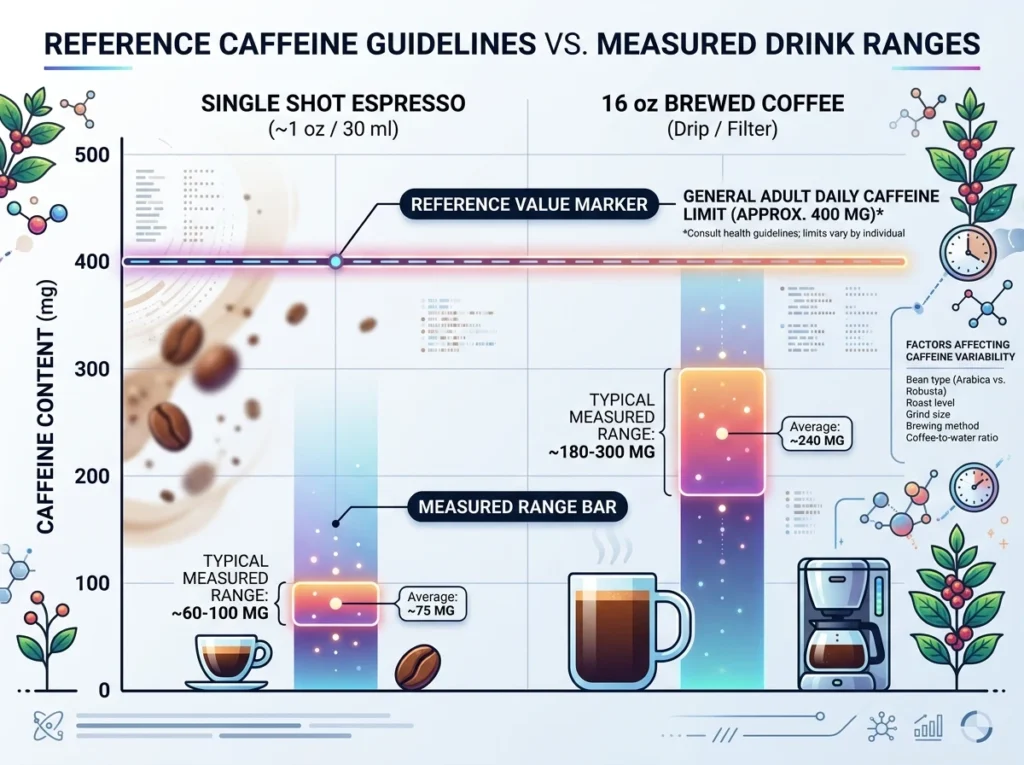
| Quick Answer Per ounce: espresso is much more concentrated. Reference values put it at about 63 mg/oz, versus about 12 mg/oz for drip coffee, roughly 5×.Per serving, it depends on the servings compared. Using reference values: one shot (~63 mg) < an 8 oz cup (~95 mg) < a double shot (~126 mg, calculated) < a 16 oz cup at the same strength (~190 mg, calculated).In words: an 8 oz reference cup exceeds one reference shot; a double can exceed that 8 oz cup; a larger or stronger drip serving can reverse it again.Reality check: reference values are guides, not predictions. Lab tests found café espresso servings from 25 to 214 mg (97 Australian samples) and 51 to 322 mg (20 Glasgow samples), and one 16 oz brewed coffee from the same store measured 259 to 564 mg across six days. |
In this guide: Concentration vs. dose · Caffeine by serving size · What café lab tests found · What influences caffeine · Light vs. dark roast · Why espresso tastes stronger · Lattes and Americanos · Safety benchmarks · Choosing between them · FAQ
Concentration vs. Total Dose: Two Different Questions
Most of the confusion in the espresso-versus-coffee argument comes from mixing up two measurements:
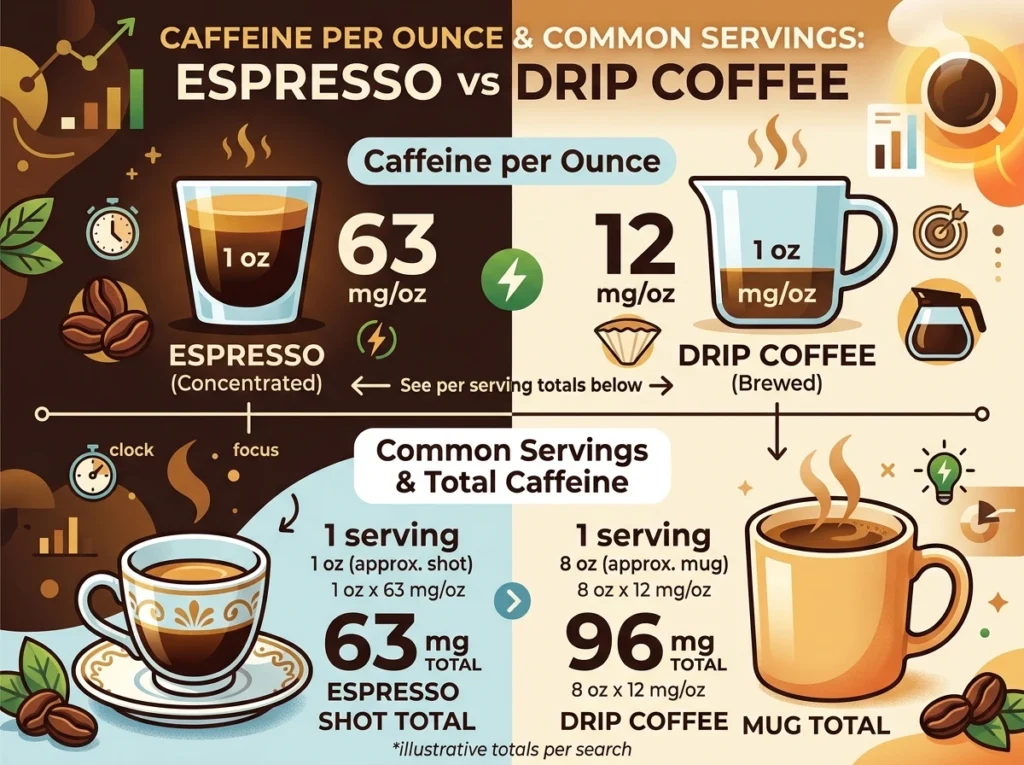
- Milligrams per fluid ounce (mg/oz) tells you how concentrated a drink is. Espresso clearly leads here.
- Milligrams per serving (mg/serving) tells you how much caffeine is in the drink you actually consume. This is the number relevant to sleep and safety benchmarks, and it has no single winner.
Here is the math using the USDA FoodData Central reference values most sites quote:
| Calculation | Espresso | Drip coffee |
| Reference serving | 1 fl oz (30 mL) = 63 mg | 8 fl oz (237 mL) = 95 mg |
| Concentration | 63 ÷ 1 = 63 mg/oz | 95 ÷ 8 = ≈11.9 mg/oz |
| How many times more concentrated? | 63 ÷ 11.9 ≈ 5.3× | — |
| One reference serving | 63 mg (single) | 95 mg (8 oz) |
| Two shots / larger cup (calculated) | 2 × 63 = 126 mg (double) | 16 × 11.9 ≈ 190 mg (16 oz) |
So a reference 8 oz cup contains more caffeine than a reference single shot, but a calculated double shot contains more than that 8 oz cup. A 16 oz cup brewed at the same reference strength would then pull ahead again. Which drink “wins” is a question about the specific servings, not the brew method.
One caveat before going further: USDA numbers are database reference values. They are useful for comparison, but they are not measurements of the drink in your hand. The calculated rows assume a double shot and a larger cup behave exactly like the reference servings, which real cafés do not guarantee.
Espresso vs Drip Coffee Caffeine by Serving Size
The table separates reference values, calculations based on them, a chain menu figure, and a lab measurement. The calculated rows are “what if” scenarios: they show what happens if strength stays at the reference level, not what any particular café serves.
| Drink | Serving | Caffeine | mg per fl oz | Data type |
| Single espresso | 1 fl oz | ~63 mg | ~63 | USDA reference value |
| Double espresso | 2 fl oz | ~126 mg | ~63 | Calculation (2 × reference single; not a measured double) |
| Starbucks Doppio | 1.5 fl oz | 150 mg | ~100 | Chain menu figure |
| Drip coffee | 8 fl oz | ~95 mg | ~11.9 | USDA / Mayo Clinic reference (guide) |
| Drip coffee | 12 fl oz | ~143 mg | ~11.9 | Scenario (reference strength assumed) |
| Drip coffee | 16 fl oz | ~190 mg | ~11.9 | Scenario (reference strength assumed) |
| Specialty brewed coffee | 16 fl oz | 188 mg (average) | ~11.8 | Lab measurement, McCusker et al. 2003 |
The lab average for 16 oz specialty brewed coffee in 2003 happened to sit close to the 16 oz scenario. The same study, though, measured one 16 oz brew from a single store at anywhere from 259 to 564 mg across six days. Cup size matters, but caffeine does not rise as a predictable multiplier from one café or recipe to the next.
How much caffeine is in a shot of espresso?
The standard reference answer is about 63 mg for a 1 oz single shot. Measured café values have run higher on average in some studies: two Australian retail surveys averaged about 106–107 mg per espresso serving. Across the lab studies below, individual servings ranged from roughly 25 mg to 322 mg, so no single number reliably describes a café shot.
How much caffeine is in a double shot (or 2, 3, and 4 shots)?
Multiplying the reference single gives about 126 mg for two shots, 189 mg for three, and 252 mg for four. These are calculations, not measured doubles, triples, or quads. Starbucks lists its Doppio (two shots, 1.5 fl oz) at 150 mg. Many specialty cafés pull a double as their default, so if you are keeping track, it helps to ask how many shots go into a drink and to dial in your espresso shot consistently at home.
How much caffeine is in drip coffee?
USDA lists about 95 mg for an 8 oz cup, and the Mayo Clinic gives a similar reference figure, which it presents as a guide rather than a guarantee. That 8 oz cup is a reference convention; café cups are often larger, and in the 2003 lab study, 16 oz specialty brews averaged 188 mg with wide variation between and within outlets. If you brew espresso-based cups at home, our guide to making an Americano at home shows how water changes strength without touching the caffeine.
What Lab Tests of Real Café Coffee Found
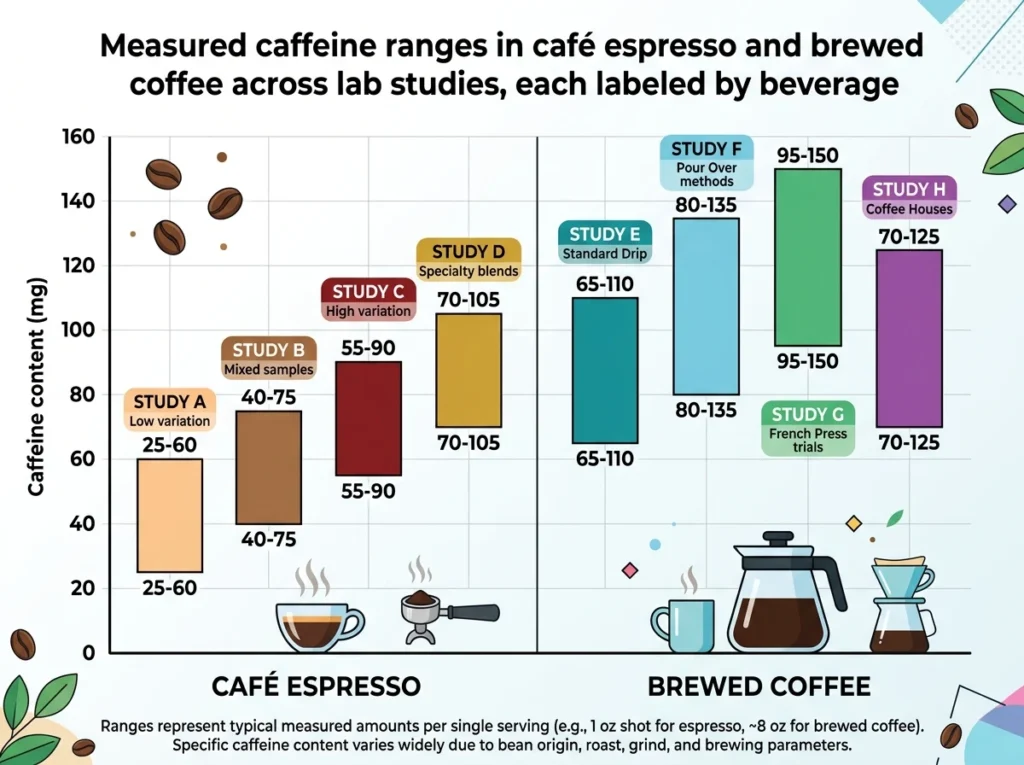
Many articles on this topic treat 63 mg per shot as fixed. Independent labs that bought coffee from real shops and analyzed it found large, unpredictable swings. Each row below identifies the beverage and sample it describes.
| Study | Beverage and sample | Finding |
| McCusker et al., 2003 (Journal of Analytical Toxicology) | All caffeinated coffee-shop samples combined (espresso and brewed drinks), Gainesville, Florida | 58–259 mg per serving. This range mixes beverage types; it is not an espresso-only range. |
| McCusker et al., 2003 | Brewed specialty coffees, 16 oz | Average 188 mg (SD 36 mg). |
| McCusker et al., 2003 | One brewed coffee (Starbucks Breakfast Blend, 16 oz), same store, six consecutive days | 259–564 mg. This is a brewed-coffee result, not espresso. |
| Desbrow et al., 2007 (Food and Chemical Toxicology) | 97 espresso (“short black”) servings, five retail centers, Gold Coast, Australia | Average 106 mg, range 25–214 mg; 24.7% of samples had 120 mg or more. |
| Desbrow et al., 2012 (Journal of Food Composition and Analysis) | 131 espresso servings (plus 20 coffee-flavoured milks), four Australian cities | Espresso average about 107 mg, with wide variation between and within brands. |
| Crozier et al., 2012 (Food & Function) | Single espressos from 20 outlets, Glasgow | 51–322 mg per serving; four samples exceeded 200 mg. |
Two lessons stand out. In the Australian samples, the average espresso serving held noticeably more caffeine than the 63 mg reference value. And brewed coffee varied just as dramatically: one drink from one store swung by more than 300 mg across a week.
Keep the limits of these studies in mind too. They sampled specific cities at specific times, and some are more than a decade old. They show how wide the spread can be; they cannot tell you what your café serves today (see the Desbrow et al. 2007 abstract for the full retail dataset).
What Influences the Caffeine in Your Cup
Brew method matters mostly because it changes the variables below, not because espresso or drip is inherently “stronger.” None of them lets you calculate a precise caffeine figure on its own, because they interact.
| Variable | What the evidence suggests | Context |
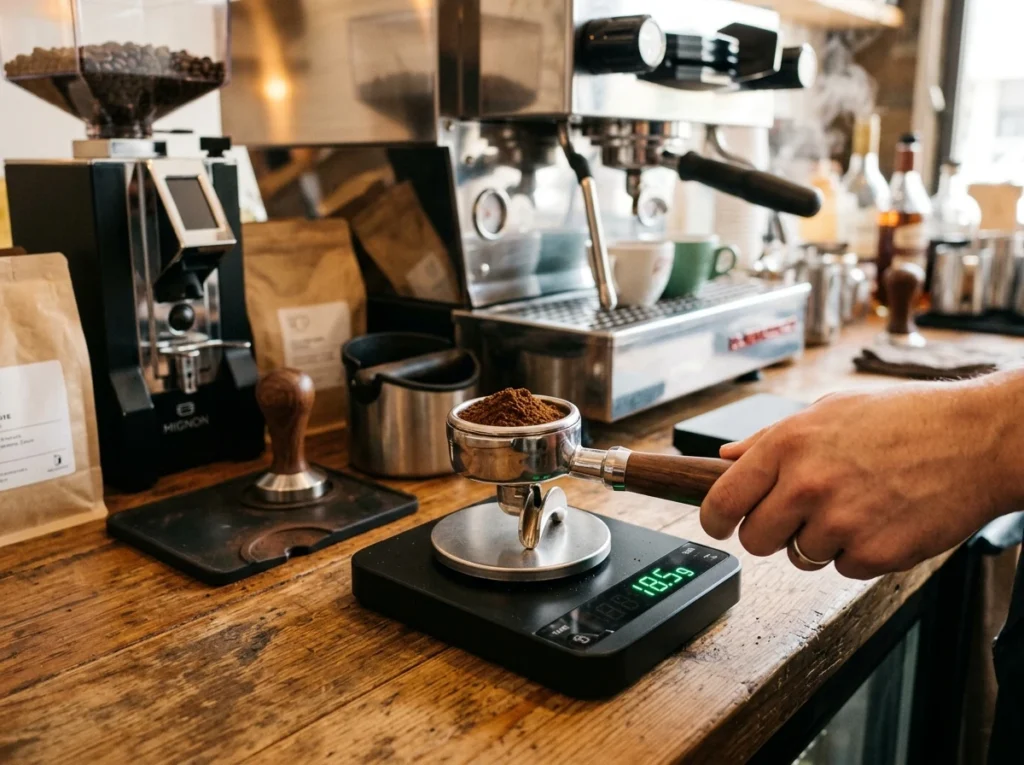
| Amount of ground coffee (dose) | The Glasgow researchers identified the amount of coffee used as the likely main driver of their six-fold spread | A modern double espresso often uses 18–20 g; a 12–16 oz pour-over at a 1:16 ratio often uses 22–28 g. |
| Brew ratio / shot yield | Pushing more water through the same coffee can extract more caffeine | A 2023 study in Foods, using a 20 g coffee dose, reported average caffeine of about 130 mg at a 1:1 ratio and about 183 mg at 1:2 — experimental averages, not a prediction for any café shot. |
| Bean species | Robusta contains substantially more caffeine than Arabica | Commonly cited ranges: Arabica about 1.2–1.5% caffeine by dry weight; Robusta about 2.2–2.7%. |
| Roast degree and extraction yield | Interact in ways that change the result depending on how you compare | See the roast section below. |
| Serving size | Within the same brew, a bigger cup contains more caffeine | Across different cafés and recipes, cup size alone does not predict the total. |
Why weighing your coffee is not a caffeine test
Weighing your grounds tells you the dose of coffee you used, and it is the best way to make your drinks consistent from day to day. It does not tell you how much caffeine ends up in the finished cup. That still depends on the beans, the roast, the grind, the recipe, and how much the brew extracted. Only a lab analysis of the drink itself measures its caffeine. For consistency, our espresso brewing guides walk through dose, ratio, and extraction step by step.
Light vs. Dark Roast: Does Roast Level Change Caffeine?
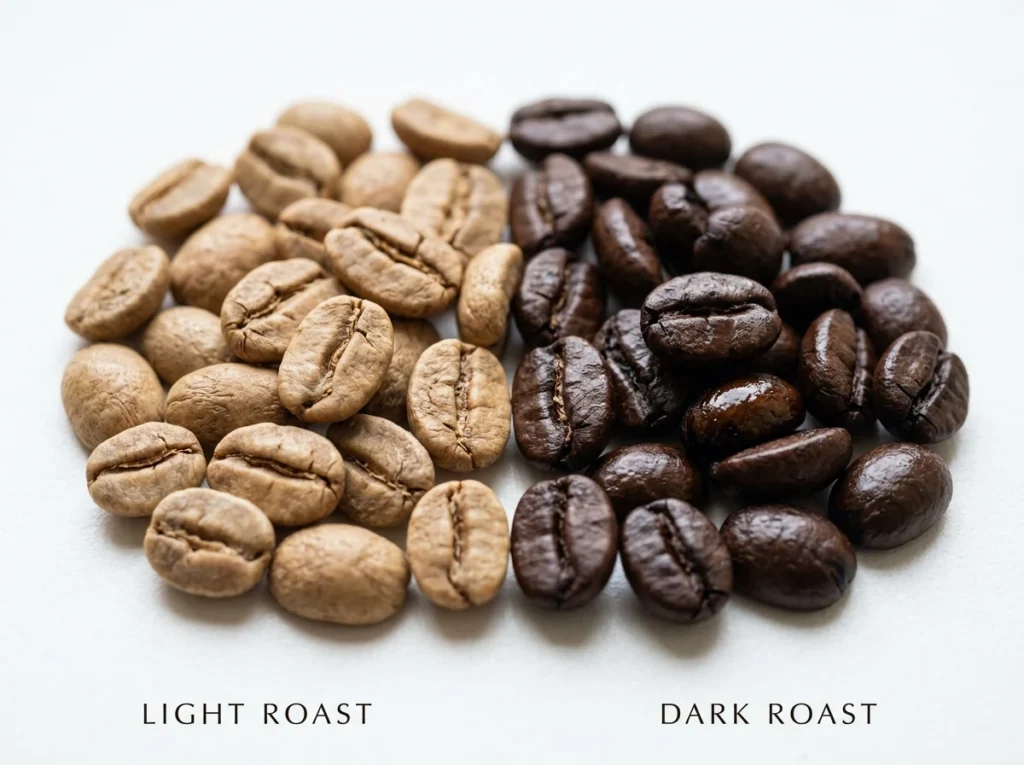
Two opposite claims circulate: that dark roasts are “stronger,” and that light roasts pack more caffeine. The research is less settled than either side suggests, and published studies disagree.
A 2024 controlled study in Scientific Reports, covering 30 combinations of bean, roast degree, and brew time, measured the caffeine in brewed coffee and interpreted a decline in the darker roasts as evidence that some caffeine is lost during the later stages of roasting. Its results depended on how the comparison was set up:
- Under identical brewing conditions, dark roasts generally produced lower caffeine concentrations than light and medium roasts.
- At identical extraction yields, dark roasts generally produced higher caffeine concentrations than lighter roasts.
The researchers cautioned against drawing a universal rule across brewing conditions. How you measure your coffee adds another layer: roasting makes beans lighter and less dense, so measuring by scoop instead of by weight changes how much coffee goes into the brew in the first place (the 2024 Scientific Reports study lays out both effects).
The practical takeaway: roast color alone is a poor predictor of how much caffeine is in your cup, as our explainer on what light roast coffee actually is discusses in more detail.
Why Espresso Tastes Stronger (Bitterness Isn’t a Caffeine Gauge)
Espresso tastes intense because it is concentrated in everything, not just caffeine. Each sip carries several times more dissolved coffee solids than filter coffee, plus emulsified oils that a paper filter would trap, along with acids and roast compounds.
Caffeine is bitter, but it is only one of many bitter compounds in coffee. Others form during roasting, including breakdown products of chlorogenic acids, and extraction level shifts bitterness too. That is why flavor intensity cannot tell you how much caffeine a drink contains. Serving size and shot count are more useful clues, though still not precise ones.
Lattes, Americanos, and Cappuccinos: Does Milk or Water Dilute Caffeine?
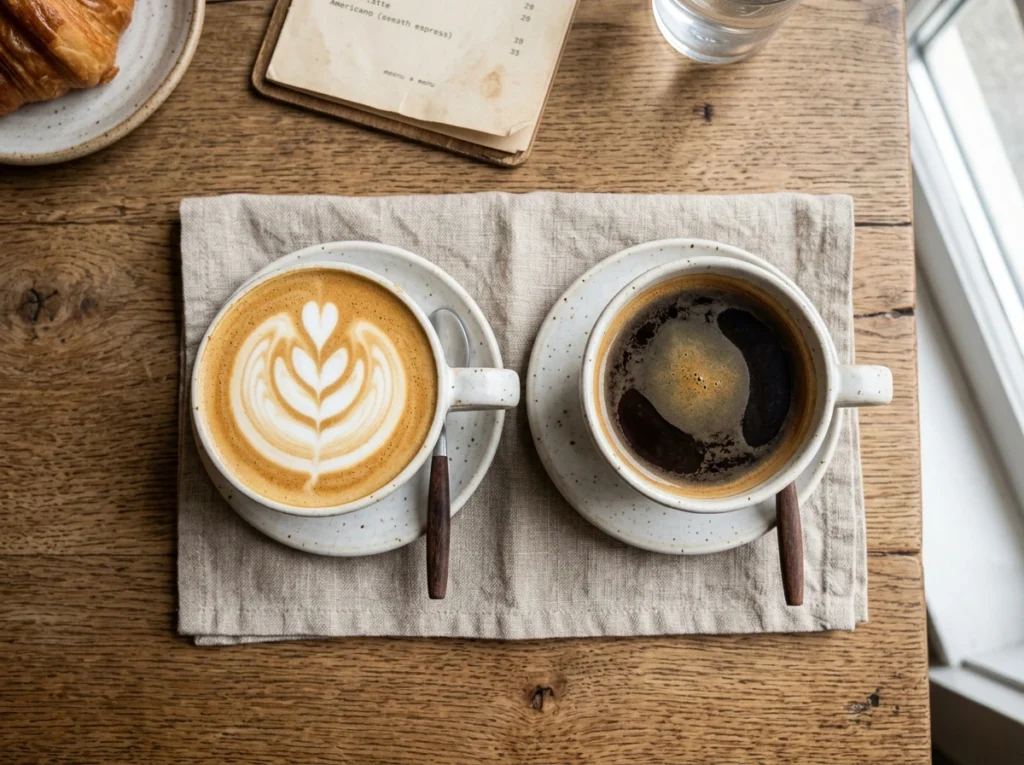
Adding milk or water lowers the concentration (mg per ounce), but it does not remove or neutralize caffeine. A milk drink or Americano contains the caffeine that was in its espresso shots.
- A latte made with two shots contains the caffeine of those two shots, however much milk is added.
- An Americano is espresso topped with hot water, so its caffeine follows its shot count.
- A cappuccino and a latte made with the same number of shots supply roughly the same caffeine; their different amounts of milk and foam change the concentration and taste, not the caffeine from those shots.
- At reference values, a 16 oz latte with two shots (~126 mg) contains less than a 16 oz drip coffee at reference strength (~190 mg). Real shot and brew strengths vary enough that this comparison is not guaranteed for any specific café drink.
For a closer look at how these milk drinks differ in construction rather than caffeine, see our breakdown of the difference between a cappuccino and a latte.
Does Drinking Speed Change the Effect?
People sometimes ask whether drinking a shot quickly produces a sharper effect than sipping a large coffee slowly. We could not find a controlled study that compares the two at equal doses, so we make no claim either way. Official benchmarks are set in milligrams, not drinking speed.
Caffeine Safety Benchmarks: What They Mean and What They Don’t
Health authorities publish assessments of caffeine intake. They are reference points for populations, not targets to drink up to, and individual sensitivity varies.
- 400 mg per day: the FDA notes in “Spilling the Beans” that this is an amount not generally associated with dangerous, negative effects for healthy adults, and EFSA reached a similar assessment for habitual daily intake in healthy adults.
- 200 mg in a single dose: EFSA assessed single doses up to this level as not raising safety concerns for healthy adults.
- 200 mg per day in pregnancy: a separate EFSA assessment found habitual intake up to this level does not raise safety concerns for the fetus. It is a different question from the single-dose assessment above.
- Around 1,200 mg consumed rapidly: the FDA estimates toxic effects such as seizures can occur at about this level.
The practical problem is that café drinks do not come with a measured caffeine number. Compare the reference values with what labs measured:
| Drink | Reference value | Measured in lab studies |
| Espresso serving | ~63 mg (USDA single) | 25–214 mg (97 Australian samples); 51–322 mg (20 Glasgow samples) |
| 16 oz brewed coffee | ~190 mg (scenario at reference strength) | Average 188 mg; one brew 259–564 mg across six days (McCusker 2003) |
| Decaf coffee | 2–15 mg per 8 oz (FDA) | Coffee-shop decaf samples below 17.7 mg per serving (McCusker 2003) |
Because of that spread, you cannot assume a specific café drink falls below any particular threshold. Some single espressos in the Glasgow study exceeded 200 mg, and one 16 oz brew in the Florida study exceeded 500 mg. Older references that put an espresso at 30–50 mg may understate what some cafés serve.
If you are pregnant, caffeine-sensitive, taking medications that interact with caffeine, or managing a heart condition or anxiety, ask your doctor or midwife for guidance that fits your situation.
Espresso or Drip Coffee: How to Think About the Choice
Because neither drink reliably contains more caffeine in every situation, these are the questions that matter more than the brew method:
- How big is the serving, and how many shots? Fewer shots and smaller cups lower the reference value, though they cannot guarantee a specific amount in a café drink.
- Does the café publish figures? Chain menu numbers are useful for comparison, but treat them as averages for a standard recipe.
- Would decaf work? Decaf still contains some caffeine, but far less than regular coffee in the lab data above.
- Do you brew at home? A consistent dose and recipe give you a consistent drink, even though they do not produce a measured caffeine figure. Pairing that with one of the best coffee grinders for a repeatable grind removes another source of cup-to-cup variation.
The Bottom Line
The espresso vs drip coffee caffeine question has two answers. On concentration, espresso clearly leads, at about five times the caffeine per ounce. On total caffeine per drink, there is no fixed winner: it depends on shot count, cup size, and brew strength, and reference values can flip either way as those change.
Measured café drinks add another layer of uncertainty, with espresso servings from about 25 mg to over 300 mg and a single brewed coffee varying by hundreds of milligrams across a week. Use reference numbers as rough guides, check published menu figures where they exist, and treat any single number for a café drink as an estimate. When you want a shot you can actually control, our step-by-step espresso brewing guides are the place to start.
Sources and How We Researched This
This article compares database reference values, a chain menu figure, and peer-reviewed lab analyses, and labels which is which. We did not run our own lab tests, and calculated figures are marked as calculations.
- USDA FoodData Central — espresso and brewed coffee reference values (fdc.nal.usda.gov).
- U.S. Food and Drug Administration — Spilling the Beans: How Much Caffeine Is Too Much?
- European Food Safety Authority (2015) — Scientific Opinion on the Safety of Caffeine.
- Mayo Clinic — Caffeine content for coffee, tea, soda and more.
- McCusker RR, Goldberger BA, Cone EJ (2003). Caffeine content of specialty coffees. Journal of Analytical Toxicology 27(7):520–522 (PubMed).
- Desbrow B et al. (2007). An examination of consumer exposure to caffeine from retail coffee outlets. Food and Chemical Toxicology 45(9):1588–1592.
- Desbrow B, Henry M, Scheelings P (2012). Journal of Food Composition and Analysis 28:114–118.
- Crozier TWM et al. (2012). Espresso coffees, caffeine and chlorogenic acid intake: potential health implications. Food & Function 3:30–33 (PubMed).
- Caffeine content in filter coffee brews as a function of degree of roast and extraction yield (2024). Scientific Reports.
- Schmieder BKL et al. (2023). Foods — espresso brew ratio and caffeine extraction.
- Starbucks published nutrition information — Doppio espresso (confirm the current figure on the Starbucks menu page before publishing).
Share your coffee experience
Have you tried this product? Add a thoughtful review or ask a question.