
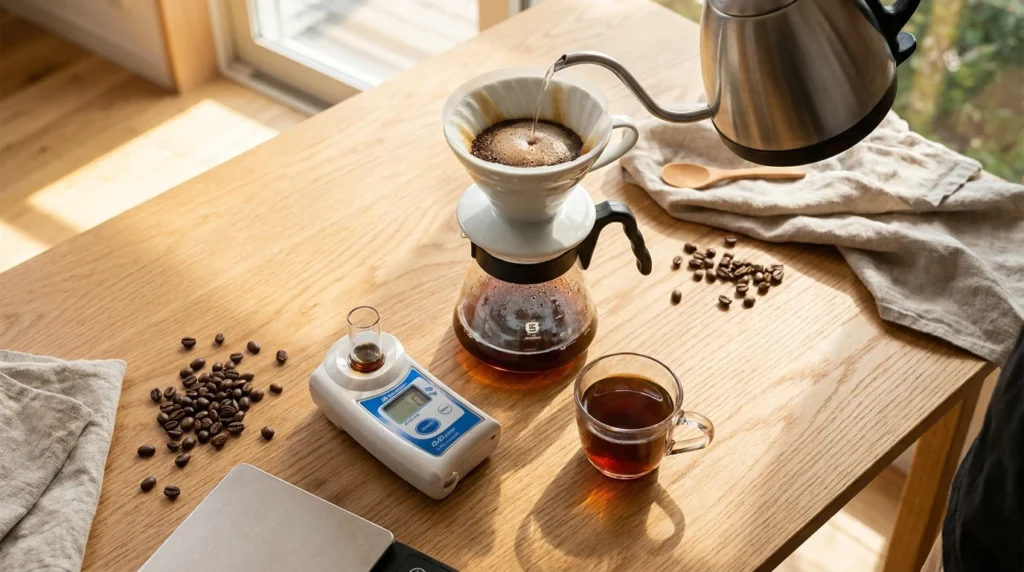
The Golden Cup Standard is the specialty-coffee industry’s definition of a properly brewed cup: coffee with a brew strength of 1.15–1.35% total dissolved solids (TDS) and an extraction yield of 18–22%, produced with a coffee-to-water ratio of about 55 grams per litre (≈1:18) and water near 93 °C (200 °F). Maintained by the Specialty Coffee Association (SCA), it is the target that certified home brewers are built to hit.
It is also one of the most-cited and least-precisely-quoted numbers in coffee. Sites routinely confuse strength with extraction, mix up the ratio, or copy a figure that was never in the standard at all. This page collects the exact parameters — with their acceptable ranges — in one place, explains what each one means, and shows how to hit them on any brewer at home.
Whether you are dialing in a pour-over, calibrating a batch brewer, or just want to know what “SCA Golden Cup Standard” actually specifies, everything you need is below, drawn from the SCA’s own published figures and the research the standard is built on.
Quick Answer: What Is the Golden Cup Standard?
| The Golden Cup Standard, in one paragraph The Golden Cup Standard is the Specialty Coffee Association’s benchmark for balanced brewed coffee. It defines a target strength of 1.15–1.35% TDS, a target extraction yield of 18–22%, and a recommended brew ratio of 55 g of coffee per litre of water, ±10% (49.5–60.5 g/L, ≈1:18), brewed with water at 93 °C ±3 °C (200 °F ±5 °F) at the point of contact. Hit that window and most drinkers perceive the cup as sweet, clear and balanced — neither weak and sour nor strong and bitter. |
The Golden Cup Standard Parameters at a Glance
These are the five numbers that define the standard. Each is covered in detail in the sections that follow, but this is the quotable summary — the block most reference pages link to.
| Parameter | Target | Acceptable range | Measured as |
| Brew strength (TDS) | 1.25% | 1.15–1.35% | % dissolved solids |
| Extraction yield | 20% | 18–22% | % of dose extracted |
| Brew ratio | 55 g/L | 49.5–60.5 g/L (±10%) | grams per litre |
| Ratio (by weight) | ≈1:18 | ≈1:16.6 – 1:20 | coffee : water |
| Water temperature | 93 °C / 200 °F | 90–96 °C / 195–205 °F | at contact point |
| Contact time (drip) | — | 4–8 minutes | brew duration |
Source: the SCA / SCAA Golden Cup figures, last revised in the SCAA’s 2015 Golden Cup Standard document.
Brew Strength (TDS): 1.15–1.35%
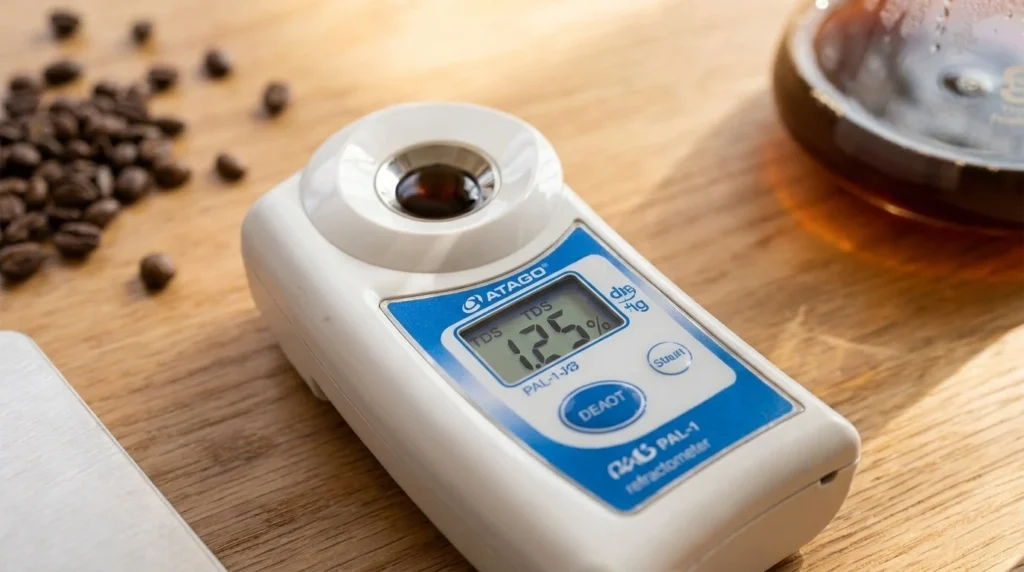
Brew strength is how concentrated the cup is — the fraction of the liquid that is dissolved coffee rather than water. It is measured as Total Dissolved Solids (TDS), usually with a coffee refractometer. The Golden Cup window is 1.15% to 1.35% TDS, which is identical to 11.5–13.5 grams of dissolved solids per litre of finished coffee. The centre of the range, about 1.25%, is the usual target.
| Strength band | TDS | How it tastes |
| Below standard | < 1.15% | Thin, watery, weak |
| Golden Cup | 1.15–1.35% | Balanced, full, clear |
| Above standard | > 1.35% | Heavy, muddy, intense |
TDS on its own does not tell you whether coffee is well brewed — a cup can be strong and still taste bad. It answers only one question: how concentrated is this? To know whether the flavour is developed, you also need extraction yield.
Extraction Yield: 18–22%
Extraction yield (also called percent extraction, PE, or EY) is the share of the dry coffee dose that actually dissolved into the water. The Golden Cup range is 18% to 22%, with roughly 20% as the target. Under about 18%, too little has been pulled from the grounds and the cup skews sour, grassy and underdeveloped. Over about 22%, the brew has started pulling bitter, astringent compounds and tastes hollow or harsh.
| Extraction band | Yield | Typical fault |
| Under-extracted | < 18% | Sour, salty, grassy |
| Golden Cup | 18–22% | Sweet, balanced, complete |
| Over-extracted | > 22% | Bitter, dry, hollow |
You cannot read extraction yield directly. It is calculated from the TDS, the brewed weight, and the dose using the coffee-industry formula EY% = (beverage weight × TDS%) ÷ dose. Most brewing apps and refractometer tools do this arithmetic for you once you enter the three numbers. Roast level also shifts how easily coffee gives up its solubles — as we cover in our guide to what light roast coffee is and how to brew it, denser light roasts extract more slowly and often reward a slightly wider ratio to reach the same 18–22% window.
How Strength and Extraction Fit Together: The Brewing Control Chart
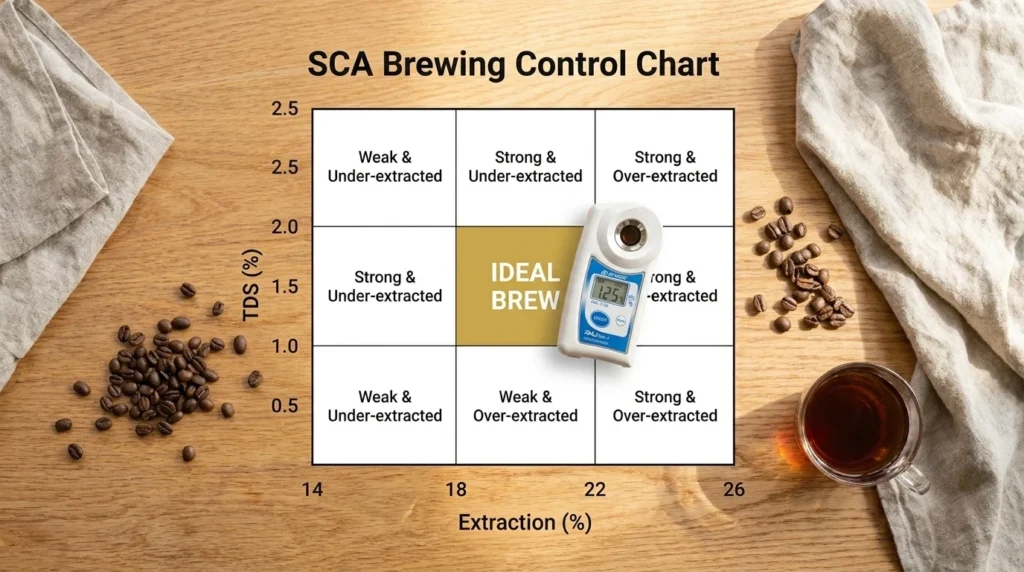
Strength and extraction are the two axes of the Coffee Brewing Control Chart — the diagram at the heart of the whole standard. TDS runs up the vertical axis, extraction yield runs along the horizontal axis, and the brew ratio appears as diagonal lines crossing the grid. The chart divides brewing outcomes into nine zones; the small box in the centre, where 1.15–1.35% TDS overlaps with 18–22% extraction, is the Golden Cup zone.
The chart is useful because it turns vague tasting words into coordinates. A sour, weak cup sits in the bottom-left (low strength, low extraction); a bitter, heavy cup sits in the top-right. Instead of guessing, you can measure where a brew landed and move deliberately toward the centre — grind finer to push extraction right, add coffee to push strength up, and so on. Because grind size does more to move you across this chart than almost any other variable, a consistent grinder matters: our breakdown of hand versus electric grinders explains why particle uniformity is what actually controls even extraction.
The Golden Cup Brew Ratio: 55 g/L (≈1:18)
The standard recommends 55 grams of coffee per litre of water, plus or minus 10% — a working range of 49.5 to 60.5 grams per litre. Expressed as a weight ratio, 55 g/L is close to 1:18, and the ±10% band spans roughly 1:16.6 to 1:20. This is the single most-quoted figure in the standard and the one most often mangled, so it is worth being exact: the ratio is what makes the target strength and extraction achievable at the same time. Brew far outside it and you mathematically cannot land in the Golden Cup box. The same weight-based approach carries over to full-immersion brewing — when you set the coffee-to-water ratio in a French press, you are using exactly this logic, just at a slightly stronger ratio.
Golden Cup ratio by batch size
Because almost nobody brews exactly one litre, here is the 55 g/L target scaled to common batch sizes. Water is taken at 1 g = 1 mL. Round dose figures to your scale’s resolution.
| Water | Coffee @ 55 g/L | ±10% range | Ratio |
| 250 mL (1 mug) | 13.8 g | 12.4–15.1 g | ≈1:18 |
| 350 mL | 19.3 g | 17.3–21.2 g | ≈1:18 |
| 500 mL | 27.5 g | 24.8–30.3 g | ≈1:18 |
| 1 L | 55 g | 49.5–60.5 g | ≈1:18 |
| 1.5 L (full carafe) | 82.5 g | 74.3–90.8 g | ≈1:18 |
Scaling works the same way for any batch: pick your water weight and multiply by 0.055. If you brew big immersion batches, our guide to making cold brew coffee at home shows the identical weigh-and-multiply method applied to a much stronger concentrate ratio.
Note on “cups”: a brewer “cup” is usually about 5 fl oz (≈150 mL), not a 240 mL measuring cup, so a “10-cup” machine brews roughly 1.25–1.5 L. Always work from weights, not cup markings.
Water Temperature: 93 °C ±3 °C (200 °F ±5 °F)
The standard calls for brewing water at 93.0 °C ±3 °C — 200 °F ±5 °F — measured at the point where water meets the grounds. In practice that is a working window of roughly 90–96 °C (about 195–205 °F), the range most brewing guides quote. Too cool and extraction stalls (sour, underdeveloped); too hot and it accelerates toward bitterness, and near-boiling water can scorch delicate coffees.
The phrase “at the point of contact” matters. A kettle at 96 °C loses a few degrees crossing the air and hitting a cold brew bed, so pour-over brewers often boil and pour straight away, while certified machines are engineered to deliver water already in the target band onto the coffee.
Temperature control is one of the first things we drill in our step-by-step brewing guides, because getting the water into this band is what separates a sour, underdeveloped cup from a balanced one.
What “Golden Cup Certified” Actually Means
“Golden Cup” is the brewing target; certification is a separate, formal programme. Under the SCA’s Certified Equipment Program (for home machines, the Certified Home Brewer track), a coffee maker is submitted to the SCA’s independent testing centre and evaluated against the brewing standards. A brewer earns the mark only if it can reliably land finished coffee inside the Golden Cup window.
Certified brewers are judged on criteria including:
- Coffee dose and correct brew ratio handling
- Brew (contact) time — commonly 4–8 minutes for batch drip; excessively long brews fail
- Water temperature held in the target band throughout the brew
- Even, uniform extraction of the coffee bed
- Beverage clarity and correct holding temperature after brewing
- Consistent, repeatable performance across brews
Testing is carried out at a third-party centre, and certification runs on a multi-year licensing term with an annual fee, so the badge signals independent verification rather than a self-applied claim. The current list of certified machines lives on the SCA’s site.
You can browse the SCA’s current list of Certified Home Equipment to check whether a specific brewer has passed Golden Cup testing before you buy.
A Short History of the Golden Cup Standard
The standard is older than the SCA itself. In 1952, the National Coffee Association and the Pan American Coffee Bureau founded the Coffee Brewing Institute (CBI), directed by MIT-trained biochemist Dr. Ernest Earl Lockhart. In 1957, Lockhart published “The Soluble Solids in Beverage Coffee as an Index to Cup Quality,” proposing that cup quality could be pinned to two measurable numbers — dissolved solids and extraction — linked by the brew ratio. That paper produced the Coffee Brewing Control Chart and its central, best-rated “Golden Cup” zone.
The CBI dissolved in 1964 and its work passed to the Coffee Brewing Center. Decades later the Specialty Coffee Association of America (SCAA) adopted the Golden Cup zone as the basis for its brewing standards; the SCAA’s Golden Cup Standard document was last revised on 23 December 2015. After the SCAA and the European counterpart merged into today’s Specialty Coffee Association, the SCA became the standard’s custodian. Notably, the SCA’s older “Heritage Coffee Standards” reference page has since been retired, which is exactly why a clear, accurate restatement of the numbers is still needed.
| Year | Milestone |
| 1952 | Coffee Brewing Institute founded (NCA + Pan American Coffee Bureau); Dr. E. E. Lockhart, director |
| 1957 | Lockhart’s soluble-solids paper and the Coffee Brewing Control Chart |
| 1964 | CBI dissolved; work continues under the Coffee Brewing Center |
| 2015 | SCAA Golden Cup Standard document last revised (Dec 23) |
| Today | Maintained by the SCA; underpins the Certified Equipment Program |
How to Brew to the Golden Cup Standard at Home
You do not need a refractometer to get close. The ratio and temperature are the two levers you can set directly; strength and extraction then fall into the window on their own if your grind and technique are reasonable. Here is the practical version.
Step 1 — Weigh with the 55 g/L ratio
Scale, not scoops. Weigh your water (1 mL = 1 g) and multiply by 0.055 for your coffee dose — e.g. 500 g water × 0.055 = 27.5 g coffee. That puts you at the centre of the ratio band and gives strength and extraction room to land in range.
Step 2 — Get the water to 90–96 °C
Off a boil, water sits around 100 °C; let it rest 30–45 seconds, or use a variable-temperature kettle set to 93 °C. If your coffee tastes sour, nudge hotter; if it turns harsh, nudge cooler.
Step 3 — Match grind to method and time
Grind is your main extraction dial. Aim for the typical contact time for your method and adjust grind to hit it: finer extracts more (pushes yield up), coarser extracts less.
| Method | Grind | Contact time |
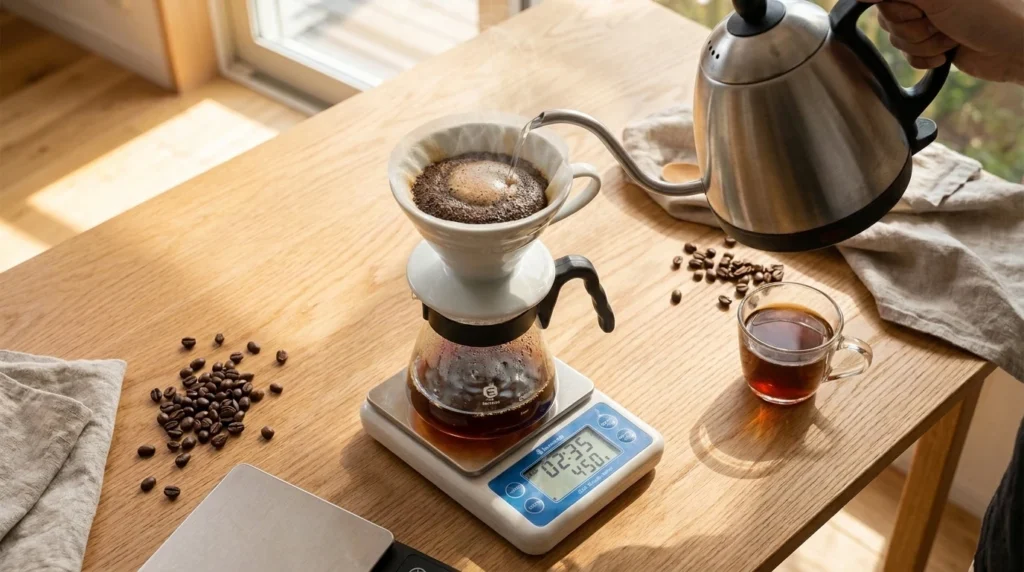
| Pour-over (V60, etc.) | Medium / medium-fine | 2:30–3:30 |
| Batch / drip machine | Medium | 4–8 min |
| French press | Coarse | 4 min |
Step 4 — Taste, then adjust one thing
Sour or weak means under-extracted: grind finer, brew hotter, or slow the pour. Bitter or hollow means over-extracted: grind coarser, brew cooler, or speed things up. Change one variable at a time so you can tell what did what.
Step 5 (optional) — Measure to confirm
A refractometer closes the loop. Read the TDS, enter dose and brewed weight, and check that TDS lands in 1.15–1.35% and calculated extraction in 18–22%. If strength is low but extraction is fine, tighten the ratio (more coffee); if extraction is low across the board, grind finer or brew hotter.
Is the Golden Cup Standard Still Right?
The standard is a starting point, not a verdict on taste. Its ranges come from mid-century sensory panels with mid-century coffee, and recent work — notably sensory research from the UC Davis Coffee Center — suggests the “ideal” zone can shift with roast level, processing and brew method, and that pleasant cups exist outside the classic box. Many cafés and home brewers also work stronger and tighter than 1:18, often around 1:15–1:17.
None of that makes the Golden Cup Standard obsolete. As a shared, measurable reference — a common language for strength and extraction, and the basis for equipment certification — it remains the most useful single benchmark in brewed coffee. Treat it as the centre of the map, then explore outward to your own preference.
Frequently Asked Questions
It is coffee’s recommended “balanced” target: a strength of 1.15–1.35% TDS and an extraction of 18–22%, reached with about 55 g of coffee per litre of water (≈1:18) and water near 93 °C. Brew inside that window and most people find the cup sweet and well-balanced.
55 grams of coffee per litre of water, ±10% — so 49.5–60.5 g/L, which is roughly a 1:18 weight ratio. For a 500 mL brew that is about 27.5 g of coffee.
Effectively yes. 55 g/L works out to about 1:18 by weight, and the ±10% tolerance covers roughly 1:16.6 to 1:20. Many brewers prefer the stronger end, closer to 1:16.
TDS is how concentrated the cup is (how much dissolved coffee is in the liquid). Extraction yield is how much of the ground coffee dissolved out of the grounds. A cup can be strong yet under-extracted, so both matter — the Golden Cup zone is where they overlap correctly.
93 °C ±3 °C — that is 200 °F ±5 °F — at the point where water meets the coffee, a working range of about 90–96 °C (195–205 °F).
Not directly. It was defined for brewed/filter coffee, where TDS runs around 1.15–1.35%. Espresso is far more concentrated (often 8–12% TDS) and is evaluated differently, though the same strength-versus-extraction thinking applies. If espresso is your focus, our guide to choosing the best beans for an espresso machine and our walkthrough on how to use an espresso machine apply that thinking to the pressurised world.
Check the SCA’s certified equipment list. Certified machines have passed independent testing for ratio, temperature, brew time, even extraction and consistency, verifying they can land coffee in the Golden Cup window.
No. Nail the 55 g/L ratio and 90–96 °C water, match your grind to the method, and you will usually land in range. A refractometer only confirms it and helps you fine-tune.
The Bottom Line
The Golden Cup Standard gives brewed coffee a precise, shared target: 1.15–1.35% TDS, 18–22% extraction, 55 g/L (≈1:18), and 93 °C ±3 °C water. You do not need a lab to use it — weigh to the ratio, control the temperature, match grind to method, and taste toward the centre. Measure if you want to confirm it. Whatever brewer you own, those numbers are the fastest route to a consistently balanced cup. Ready to put them to work? Start with our step-by-step brewing guides and dial your next brew into the Golden Cup window.
Share your coffee experience
Have you tried this product? Add a thoughtful review or ask a question.